Pakistan’s K2 Airways Resumes Flight Operations
Pakistan’s K2 Airways has restarted flight operations, marking a renewal of activity for the emerging cargo carrier after initial revenue service.
 Jishan Khan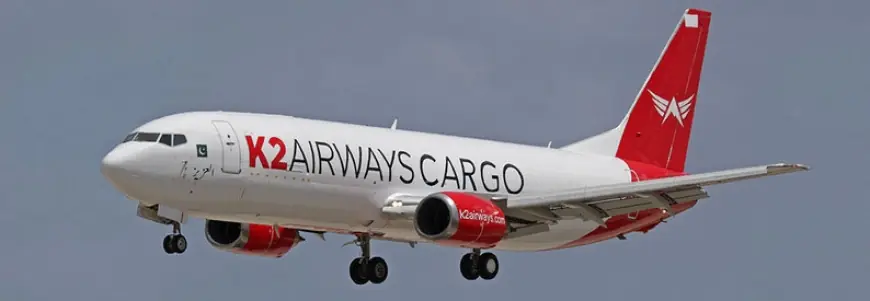

Pakistan’s K2 Airways has resumed flight operations, signalling renewed activity for the Karachi-based aviation start-up after initial cargo services introduced late in 2024 and subsequent pauses in service delivery.
The airline first made industry headlines after ferrying its inaugural Boeing 737-400SF freighter into Pakistan in mid-2024 and commencing revenue cargo flights later that December. Despite delays in expanding its fleet and network beyond a single freighter, K2 Airways took the strategic step to restart operations in January 2026, reaffirming its commitment to grow cargo connectivity from Pakistan’s primary gateway at Karachi International Airport.
K2 Airways’ resumption comes amid a challenging environment for emerging carriers in South Asia, where regulatory hurdles, fleet acquisition bottlenecks and network access can complicate sustained operations. The airline’s focus on freight transport sets it apart from several other new Pakistan entrants that have pursued passenger services or mixed-use business models but have struggled to reach full launch phases.
The restarted operations are expected to leverage the 737-400SF’s approximately 18 tonne payload capability, a platform that suits regional cargo missions and intra-Asia logistics flows. This freighter type — a converted Boeing 737 classic — remains widely used by independent cargo operators for point-to-point freight work and is seen by analysts as a pragmatic choice for startups seeking to avoid the higher capital costs associated with larger widebody freighters
Industry observers note that K2’s resumption may also be timed with broader regional demand trends for air cargo, including e-commerce growth, perishable exports and integrated supply chain flows between South Asia and key trade partners such as China and the Gulf. A previous planned partnership between K2 and Chinese logistics firms pointed toward ambitions to connect Karachi with Chinese interior markets, underscoring the potential trade corridors the airline hopes to serve.
From a regulatory perspective, Pakistan’s aviation authorities have been active in supporting sector expansions, including licensing new operators and overseeing technical compliance. K2’s return to operations shows that its air operator certificate (AOC) remains valid and that it continues to meet oversight requirements for cargo flights, an important benchmark for aviation safety and operational oversight.
The airline’s future expansion beyond a single-freighter operation will depend on timely acquisition of additional aircraft or conversions, crew and ground support scaling, and integration into Pakistan’s aviation supply chain ecosystem. Cargo carriers typically require network density and frequency to achieve sustainable yields, and K2’s ability to attract further assets or partnerships will be key to its medium-term viability.
For the Pakistan aviation sector, which has seen renewed activity with other carriers resuming or launching services, K2 Airways’ return adds a niche freight operator to a landscape traditionally dominated by larger network carriers. The development also comes at a time when cargo demand patterns are evolving globally, with secondary markets and regional corridors gaining prominence.
As K2 Airways scales up its resumed operations, its progress will be watched by industry professionals interested in cargo market growth, fleet acquisition strategies, and how start-up carriers navigate the operational complexities of international and domestic air cargo markets.