Hazelbury Manor Luxury Hotel Unveils a New Chapter
Hazelbury Manor Luxury Hotel plans gain approval as the 14th century Wiltshire estate converts into 23 suites while preserving its Grade I listed heritage.
 RUKAIYA KADIWAL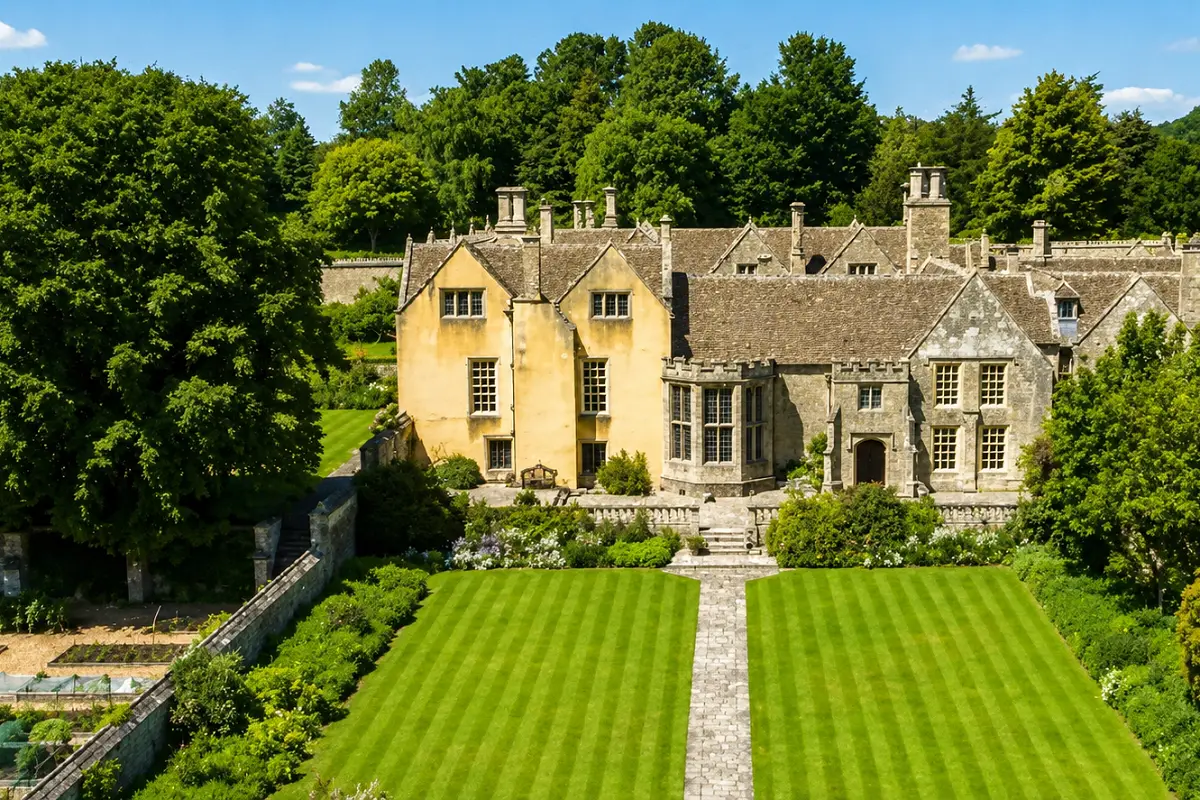
Sunlight settles across a striped lawn stretching toward a honey coloured facade, its gabled rooflines and stone chimneys rising against a backdrop of dense woodland. A single stone path cuts straight through the manicured grass, leading directly to a doorway that has welcomed residents, students and now, soon, hotel guests across nearly five centuries. This is Hazelbury Manor at Box in Wiltshire, and the estate now stands on the threshold of becoming Hazelbury Manor Luxury Hotel, following planning approval that will reshape its long, layered history yet again.
The new owners of Hazelbury Manor have been granted permission by Wiltshire Council to change the use of the Grade I listed building from residential to hospitality, a decision that formally opens the path toward converting one of the county's most architecturally significant private estates into a working hotel.
A House Built for a Different Era
Agents representing the owners argued that the property's long corridors, multiple courtyards and extensive floorspace made it unsuitable for modern living, yet entirely appropriate for use as a hotel, a description that captures the peculiar challenge facing many historic English estates today. Buildings designed centuries ago around household staff, formal reception rooms and sprawling family wings often struggle to accommodate contemporary domestic life, even as those same features translate naturally into hospitality use.
Dating back to the 14th century, the manor house was restored and extended in the 1920s, according to the Local Democracy Reporting Service, layering yet another architectural chapter onto its already complex history. Between 1943 and 1971, the estate operated as a girls' school before eventually returning to private residential use, meaning this latest transformation marks not the building's first departure from purely domestic life, but rather its return to a more communal purpose after decades spent as a private home.
What Planning Officers Actually Approved
Wiltshire Council's planning officers recommended the change of use application for approval, describing it as an appropriate and viable way of securing the long term conservation of both the manor house and its surrounding grounds. That framing matters considerably, since it positions hotel conversion not simply as a commercial opportunity for the new owners, but as a genuine preservation strategy for a heritage asset that might otherwise struggle to secure adequate long term investment.
The approved change of use spans three distinct buildings across the estate. The manor house itself will contain 12 hotel suites, while the Dower House will hold three additional suites, and the Granary will offer eight more, bringing the total accommodation across the property to 23 suites once the conversion is complete.
Gardens Steeped in Their Own History
The approval extends beyond the buildings themselves to encompass the park and garden surrounding Hazelbury Manor, including the remains of a 17th century formal garden that has survived, in some form, for more than 300 years. Alongside that historic layer sits something considerably more recent and unexpected, a quirky yew circle built in the mid 1980s and directly inspired by Stonehenge, a detail that adds an eccentric, distinctly modern flourish to grounds otherwise steeped in medieval and Georgian history.
That blend of centuries old formal landscaping alongside a playful, more contemporary garden feature reflects the layered character of the estate as a whole, a property that has never existed as a single fixed moment in time, but rather as an ongoing accumulation of additions and adaptations across generations.
A High Quality Hospitality Vision
The owners have said they want to deliver a high quality hospitality offer that will support Wiltshire's visitor economy while also ensuring the long term conservation of these significant heritage assets. That dual ambition, generating genuine economic activity for the surrounding region while simultaneously protecting a nationally significant building, reflects a broader pattern increasingly common across historic property conversions throughout the English countryside. Full details on Wiltshire's planning process and local heritage guidance are available on the official Wiltshire Council website.
Box Parish Council raised no objection in principle to the planning application, though its support came subject to a wide range of concerns being satisfactorily addressed before final approval, a typical caveat for developments of this scale within a small, historically sensitive village.
Heritage Bodies Weigh In Cautiously
The Society for the Protection of Ancient Buildings offered a measured endorsement of the proposal, stating that it may represent a viable option to secure the long term conservation of the site, language that acknowledges genuine benefit while stopping short of unqualified enthusiasm. That careful phrasing reflects the inherent tension heritage organisations often navigate when evaluating commercial conversions of historic properties, weighing preservation benefits against the risks that come with introducing new, revenue driven uses into buildings never originally designed for them.
The Cotswolds National Landscape Board offered similarly considered support, recognising that hotel use represents an appropriate and viable option to secure the long term conservation of the manor and its grounds. Coming from a body specifically tasked with protecting the wider landscape character of the region, that endorsement carries particular weight, suggesting the proposed hotel conversion aligns reasonably well with broader conservation priorities for the surrounding Cotswolds countryside.
What This Conversion Reveals About Historic Hospitality
Hazelbury Manor's transformation into a hotel fits within a much wider pattern reshaping how Britain's historic country estates find sustainable futures, as private ownership increasingly proves financially unsustainable for buildings this large and architecturally demanding. Converting to hospitality use allows these properties to generate the ongoing income necessary for proper maintenance, while simultaneously opening spaces once reserved for private families to a broader public able to experience their architecture and history firsthand.
Similar transformations are unfolding across the international hospitality landscape too, where distinctive historic or architecturally significant properties increasingly become vehicles for culturally rich guest experiences rather than purely transactional stays, a theme echoed in recent coverage of Torel Private Collection's approach to luxury hospitality in Porto, where heritage and hospitality similarly intertwine to create something more meaningful than standard accommodation.
A House Preparing for Its Next Guests
That long stone path stretching across Hazelbury Manor's lawn has, over five centuries, welcomed residents, students, and now soon, paying guests drawn to experience the estate's history firsthand rather than simply admire it from beyond the gate. Whether arriving for a countryside escape or genuine curiosity about a building this architecturally rich, future visitors will step through doorways that have witnessed medieval origins, 1920s restoration, decades as a girls' school, and now, finally, a return to communal life as a working hotel. Few buildings carry quite so many chapters within a single set of walls, and fewer still manage to fold each one into the next without losing what made the place worth preserving in the first place.