Dassault Aviation Invests in Harmattan AI at $1.4B Valuation
Dassault Aviation leads a $200 million funding round in Harmattan AI, valuing the defence AI firm at $1.4 billion as combat aviation shifts toward autonomy.
 Munni Khatun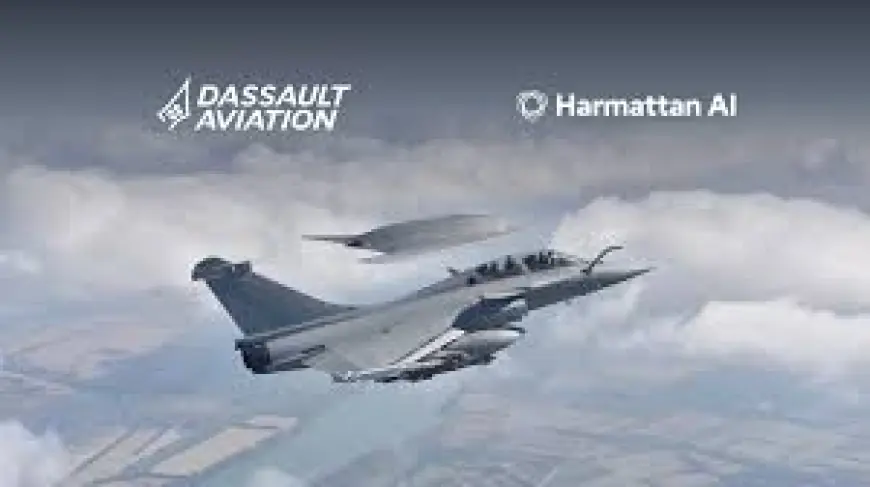

Dassault Aviation has taken a lead role in a $200 million Series B funding round for Paris-based defence technology company Harmattan AI, valuing the firm at approximately $1.4 billion and positioning it among Europe’s highest-valued defence-focused artificial intelligence companies.
The investment reflects a strategic push by Dassault to accelerate the integration of artificial intelligence into next-generation combat aviation platforms, as European defence programmes place increasing emphasis on autonomy, data-driven mission systems, and sovereign technology control.
Founded in 2024, Harmattan AI specialises in AI-enabled defence systems spanning unmanned aerial vehicles, electronic warfare applications, and command-and-control software. The company has already secured early-stage defence contracts in Europe, providing operational validation for its technology in military environments.
Dassault’s participation goes beyond financial backing. The aircraft manufacturer is expected to work closely with Harmattan AI to embed scalable, certifiable artificial intelligence into future combat air systems, including the planned Rafale F5 standard and associated unmanned combat air vehicles.
The Rafale F5 roadmap places significant focus on manned-unmanned teaming, sensor fusion, and AI-assisted decision support, requiring software architectures capable of operating in contested and degraded environments. Harmattan’s autonomy stack is designed to function with human oversight while enabling automated mission execution, a key requirement for future air combat doctrines.
The funding round also highlights a broader shift within the defence aerospace sector from platform-centric development to software-defined capability growth. Artificial intelligence is increasingly viewed as a force multiplier, enabling faster decision cycles, reduced pilot workload, and improved survivability across multi-domain operations.
Harmattan AI plans to use the new capital to scale engineering teams, industrialise its software products, and expand deployments across intelligence, surveillance and reconnaissance, drone interception, and electronic warfare missions. The company is also expected to invest in compliance and certification pathways required for operational use on military aircraft.
For Dassault Aviation, the investment supports long-term competitiveness as air forces demand combat aircraft capable of operating seamlessly alongside autonomous systems. The move aligns with wider European efforts to reinforce defence technology sovereignty amid growing reliance on software-intensive systems.
From an industry perspective, the transaction underscores rising investor confidence in defence-focused AI firms as governments accelerate procurement of autonomous and semi-autonomous capabilities. It also signals a maturation of Europe’s defence startup ecosystem, where close alignment with established aerospace primes is becoming a defining growth strategy.
As combat aviation evolves toward distributed, networked operations, partnerships between airframe manufacturers and specialised AI developers are expected to play a central role in shaping the next generation of manned and unmanned air power.