Air India’s New CEO Tewolde Gebremariam Puts Safety First
Air India’s new CEO Tewolde Gebremariam has made safety, reliability and operational discipline his first priorities as he takes charge.
 Jishan Khan
"It Is Not Enough to Say It. We Must Live It Every Day", Air India's New CEO Skipped the Vision Speech and Went Straight to the Basics
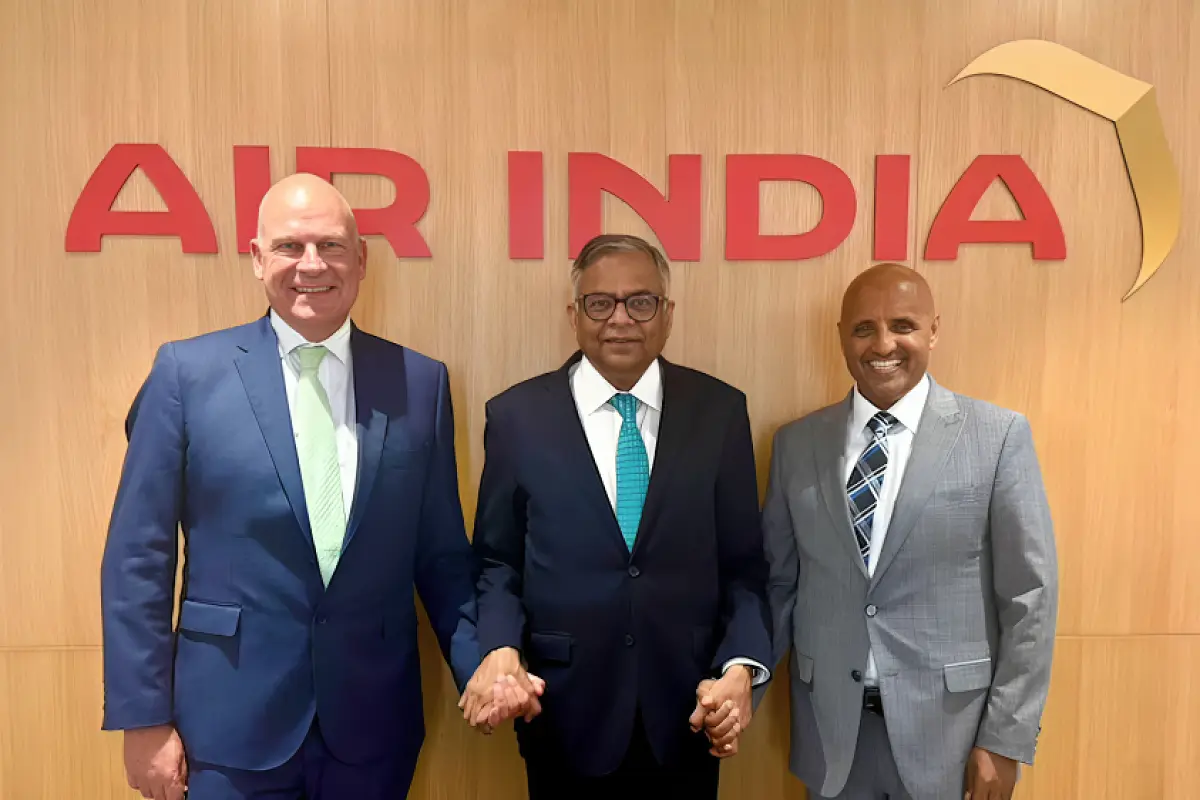
Tewolde Gebremariam formally began transitioning into the role of Air India's CEO and Managing Director on September 7, 2026, addressing employees at a town hall alongside outgoing CEO Campbell Wilson and chairman N. Chandrasekaran. His opening message contained no mention of aircraft orders, new routes, or global expansion, the themes that dominated nearly every Air India headline this feed has covered over the past year. Instead: "A safety-first culture has to be our number one priority. It is not enough to say it. We must live it every day." He followed with a message to staff that reads less like corporate messaging and more like an operational directive: if something is not right, stop.
For an airline sitting on one of the largest aircraft orders in aviation history, 470 jets, a fleet renewal this feed has tracked across Boeing 787-10s, A350-1000s, and a $36 billion-plus capital programme spanning multiple manufacturers — a new CEO's very first public words being about baggage handling and aircraft cleanliness is not a modest opening. It is a diagnosis.
Why Ethiopian Airlines Former CEO Is the Right Person to Give That Diagnosis
Gebremariam spent nearly four decades at Ethiopian Airlines, including more than 11 years as its CEO from 2011 to 2022, transforming a solid but regional African carrier into the continent's most consistently profitable airline group, a turnaround built on operational discipline as much as network ambition. This feed's earlier coverage of Pakistan International Airlines' privatisation noted his name specifically for the discipline he brought to Ethiopian's operations, a reputation that made him a credible pick for any carrier attempting a genuine post-crisis rebuild rather than simply a growth story. He retired from Ethiopian Airlines in March 2022 citing personal health reasons, was succeeded by Mesfin Tasew Bekele, and spent roughly four years outside active airline leadership before Air India's board, following what the airline itself described as "an exhaustive search for executives," selected him in August 2026.
That search timeline matters. Air India was not looking for a network strategist or a growth-story communicator, those roles had already been filled repeatedly across the Tata-era transformation. It was looking, specifically and deliberately, for someone whose defining professional credibility rests on having actually fixed the unglamorous, operationally granular parts of running an airline reliably at scale.
What Campbell Wilson Actually Leaves Behind
Wilson's nearly four-year tenure, beginning when Tata Group regained control of Air India in 2022, was genuinely transformational in scope, merging Vistara into the mainline carrier, consolidating the group's low-cost operations under Air India Express, and placing the fleet modernisation orders this feed has documented extensively. But his final year was defined by crisis rather than momentum: the June 2025 crash of Air India Flight AI171 in Ahmedabad, followed just weeks before this leadership transition by a separate hydraulic-system incident on a Phuket-Delhi flight, alongside the Pakistan airspace ban, the Iran conflict's fuel shock, and financial results that Chandrasekaran openly acknowledged represented one of the most difficult periods in the airline's recent history.
Wilson himself framed his departure honestly rather than triumphantly, telling employees the transformation "was not yet complete" and pledging to remain Air India's "biggest cheerleader" from the sidelines, language that reads as a builder handing off a structure that is standing, but visibly unfinished, to someone whose specific mandate is to make it hold weight reliably rather than to keep adding floors.
The Number That Explains Why "Reliability Before Growth" Is Not Optional
Air India Group posted a loss of approximately $2.3 billion in fiscal 2026, with revenue down nearly 9%, figures that sit directly alongside this feed's earlier reporting on Singapore Airlines' own scrutiny of its 25.1% Air India stake, Temasek's careful public distancing from any funding decision, and the Indian carrier's request for roughly $1.1 billion in staged, milestone-linked shareholder support. That capital is not being released unconditionally. It is tied explicitly to performance, meaning Gebremariam's ability to demonstrate measurable operational improvement, on-time performance, baggage handling, safety metrics, customer satisfaction, is not simply good management practice. It is the literal precondition for Air India's owners releasing the next tranche of money the airline needs to keep executing its own fleet expansion plan.
That is the structural logic connecting Gebremariam's opening safety-and-basics message directly to the fleet growth story this feed has covered all year. An airline cannot credibly ask shareholders for staged capital tied to performance milestones while its public narrative remains dominated by a fatal crash and a subsequent hydraulic incident. Fixing the fundamentals is not a distraction from the growth agenda, under the current funding structure, it is the only path back to unlocking it.
Why Chandrasekaran's Four Priorities Read as a Report Card, Not a Vision Statement
Chandrasekaran's own framing at the same town hall was notably unambitious in tone by design: safety, customer trust, reliable operations and cost discipline, four words that describe basic competent airline operation, not transformation or ambition. He explicitly demanded a safety record "better than the world's best carriers," a standard that, following AI171, is less an aspiration than a minimum bar Air India now has no choice but to clear given the scrutiny it remains under from regulators, the flying public and its own shareholders simultaneously.
That framing matters because it signals something about where the Tata Group's own internal assessment of Air India's transformation currently sits, not "we built something ambitious and now need to scale it," but "we built something large and complex, and now urgently need to prove it works reliably before doing anything else with it." Gebremariam's mandate, as multiple outlets covering the town hall converged on describing it, is explicitly "to make the enlarged, merged airline operate reliably and profitably rather than build new strategy, a phrase that draws about as clean a line as possible between his job and Wilson's.
Why This Is a Genuinely Harder Job Than It Sounds
The uncomfortable truth underneath Gebremariam's safety-first framing is that fixing punctuality, baggage handling and aircraft cleanliness at an airline mid-way through absorbing a Vistara merger, a fleet expansion spanning multiple aircraft manufacturers, and continued operation under Pakistan's ongoing airspace ban, now well past its 16th consecutive monthly extension per this feed's earlier coverage, is not simply a matter of managerial focus. Every one of those basic operational metrics is directly stressed by the same structural complexity the growth agenda has created: more aircraft types mean more maintenance variability, a merged workforce means less standardised training and culture, and continued route disruption from geopolitical airspace restrictions makes schedule reliability harder to guarantee regardless of how disciplined ground operations become.
Gebremariam is not being asked to fix a stable airline that has drifted on execution. He is being asked to install operational discipline into an airline that is still mid-transformation, absorbing new aircraft types, integrating merged workforces, and operating under real external constraints it cannot control, while simultaneously being judged, tranche by tranche, on whether that discipline is visibly working. His own history at Ethiopian Airlines demonstrates he has done something like this before. Whether the same playbook translates to an airline of Air India's scale, complexity and current reputational exposure is the test that begins now, measured, as he himself has framed it, not in strategy documents, but in whether the next flight leaves on time, the bags arrive, and the aircraft is clean.