Qatar Airways ATM 2026 Showcases Digital Innovations
Qatar Airways showcased Q Search, Infinite Awards, QVerse Island and Qsuite Next Gen at ATM 2026, highlighting its expanding digital passenger experience.
 Jishan Khan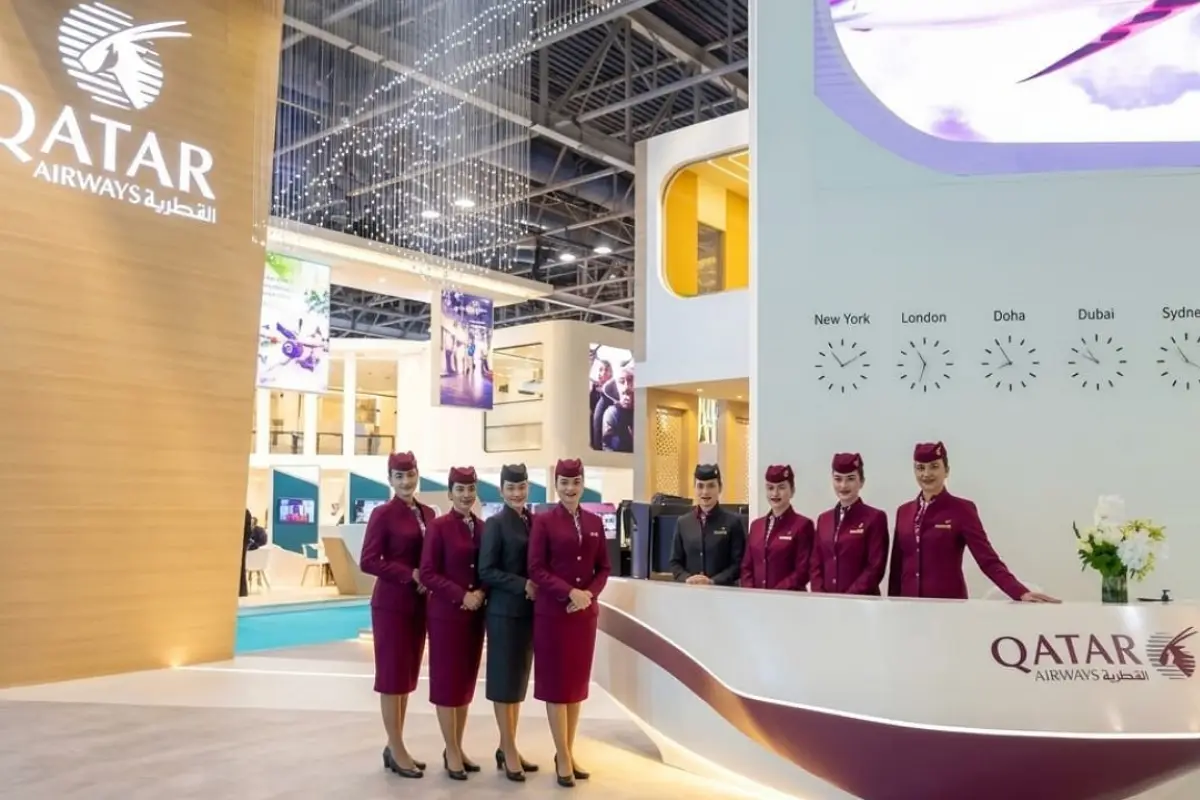
Qatar Airways Didn't Send You to a Search Engine at ATM 2026, It Sent You Into a Fortnite Map of Its Own Airport
Qatar Airways ATM 2026 saw the airline use Arabian Travel Market 2026 in Dubai to showcase four genuinely distinct digital products simultaneously, Q Search, Infinite Awards, QVerse Island and Qsuite Next Gen, alongside signing new tourism Memoranda of Understanding with the Kenya Tourism Board, Jordan Tourism Board, Sri Lanka Promotions Bureau, Tourism Malaysia, Visit Newport Beach and Visit Maldives. The airline's own framing was explicit about the underlying intent, showing "how it is reshaping the customer experience at each stage of the journey." That is a genuinely more coherent strategic claim than most airline tech showcases make, because each product Qatar Airways demonstrated actually targets a different, specific moment in a passenger's relationship with the airline, before booking, during loyalty planning, inside the cabin, and, strangest of all, nowhere near an airport at all.
Why Q Search Is Solving a Problem Every Airline Website Already Has, Just Badly
Qatar Airways Q Search is described as "a conversational AI solution integrated into the Qatar Airways website," designed to provide instant answers about products and services through natural-language questions rather than forcing passengers to navigate traditional menu structures or FAQ pages. That sounds like a modest, almost unremarkable feature, until you consider how genuinely poor most airline website search and information architecture has historically been. Airline websites are notoriously difficult to navigate for anything beyond straightforward booking flows, burying baggage policy details, upgrade eligibility rules and route-specific service information across dozens of separate pages that a passenger has to already know exist in order to find. Q Search's actual value proposition is not novelty, it is removing the friction of an information-retrieval problem that has quietly frustrated airline customers for decades, well before "conversational AI" became the industry's preferred vocabulary for describing it.
Why Infinite Awards Is a Materially Harder Problem Than Q Search, Even Though It Sounds Similar
Infinite Awards run through the Qatar Airways Privilege Club, is described as a conversational, AI-powered loyalty tool but the underlying problem it solves is genuinely more complex than Q Search's information-lookup function. Award travel and points redemption is one of the most persistently confusing aspects of any airline loyalty programme: passengers routinely struggle to identify which flights actually have award availability, how many Avios a specific redemption will cost across different cabin classes and dates, and which combination of cash-plus-points or partner-airline redemptions offers the best value for a given itinerary. That is not a simple factual lookup question with one correct answer, it involves genuine optimisation across variables (dates, routes, cabin class, partner availability) that most loyalty programme members have historically had to solve through trial and error, or by relying on third-party enthusiast websites and forums that specialise in decoding exactly this kind of complexity.
An AI tool that can genuinely navigate that optimisation problem conversationally, rather than simply answering "how many Avios do I have" represents a materially more ambitious use of AI than a standard customer-service chatbot, precisely because it requires the system to reason across constraints rather than retrieve a single stored answer. This is also where Qatar Airways Avios becomes relevant, as the loyalty currency sits at the centre of the award travel and redemption experience.
Why QVerse Island Is the Genuinely Strange One, and Why That Might Be the Point
QVerse Island, described consistently across every outlet as Qatar Airways' "first-ever digital destination" in Fortnite, recreates Doha and Hamad International Airport as an explorable virtual space, guided by Sama, the airline's existing digital cabin crew character, through "mission-based challenges" across the city's landmarks and attractions. This is the Qatar Airways Fortnite experience, and it is a fundamentally different kind of product from the other three, because it is not solving any operational or transactional problem in the passenger journey at all. Nobody books a flight, redeems a loyalty reward, or resolves a customer service question inside QVerse Island. It exists purely as brand exposure, placing Doha and Qatar Airways' visual identity in front of Fortnite's audience, a demographic skewing considerably younger than the typical premium airline customer actually booking Qsuite tickets today.
That mismatch is not necessarily a flaw in the strategy, it may be exactly the point. Airlines building brand familiarity with a younger audience years before that audience becomes a genuine premium travel customer is a long-horizon marketing bet, not a short-term conversion tool. Whether a teenager exploring a gamified version of Hamad International Airport in Fortnite in 2026 translates into a Qatar Airways booking a decade later is genuinely unknowable, but the strategic logic, building brand association early, in a space where that audience already spends enormous amounts of time, mirrors exactly the kind of long-term audience-building this feed covered with ANA's decades-long Pokémon aircraft partnership, another case of an airline investing in youth-oriented entertainment brand association with no immediate booking conversion attached.
Why Qsuite Next Gen's "Make My Bed" Button Says More Than It Sounds Like It Should
Qsuite Next Gen's showcased features, adjustable privacy controls, digitally controlled personal dividers, and a dedicated "Make My Bed" button triggering the airline's turn-down service, alongside 4K OLED manoeuvrable entertainment screens across configurations accommodating up to four passengers in a Quad Suite or two in a Companion Suite, represents the one product in this entire showcase addressing the physical cabin experience rather than a digital or loyalty layer. That distinction matters for understanding Qatar Airways' overall strategy: the airline is not simply digitising the passenger journey and neglecting the physical product, but running both tracks in parallel. A "Make My Bed" button is a small, almost gimmicky-sounding detail, but it represents exactly the kind of automated, digitally triggered physical service this feed has tracked across the industry's broader shift toward passenger self-service, giving a passenger direct control over crew service timing through a simple digital interface, rather than requiring a flag-down interaction with cabin crew.
Why the Starlink Numbers Matter More Than Anything Shown at the Pavilion
This feed's own earlier reporting on Qatar Airways' Starlink rollout documented the airline becoming the first in the world to operate a Starlink-equipped Boeing 787-9, reaching more than 150 widebody aircraft, over 83% of its widebody fleet, with up to 323 daily Starlink-enabled departures and more than 23 million passengers connected since the October 2024 launch. Those figures, still growing as the rollout approaches full 787 fleet completion by year-end 2026, are arguably more commercially consequential than any single product unveiled at the ATM pavilion, because Starlink connectivity is the infrastructure layer that makes every other digital product genuinely functional in the air rather than merely on the ground. Q Search and Infinite Awards work reasonably well through an airline's website before a flight. Whether a passenger can actually use equivalent AI-powered tools inflight, in real time, depends entirely on whether the aircraft they are sitting on has fast, reliable connectivity, which is precisely the constraint this feed's Forthcode ANiX coverage highlighted as the central, unsolved problem most aviation AI products currently ignore.
Qatar Airways' Starlink fleet coverage gives it a genuine structural advantage in eventually extending these digital products beyond the pre-flight and loyalty-planning stages into the cabin itself, closing exactly the gap between "AI that helps you plan your trip" and "AI that works with you at 35,000 feet" that most competing airlines, still mid-rollout on their own connectivity upgrades, cannot yet offer at comparable scale.
Why the Tourism MoUs Are the Least Glamorous Part of This Story and Arguably the Most Consequential
Six new tourism board partnerships, Kenya, Jordan, Sri Lanka, Malaysia, Newport Beach and the Maldives, signed on the sidelines of the same event, received almost no coverage relative to the Fortnite and AI announcements, but represent Qatar Airways' more conventional and more immediately revenue-relevant strategy: using Doha's hub position to drive connecting traffic toward destinations across its own network. This feed has documented the same pattern repeatedly throughout 2026, Emirates' Roland-Garros sponsorship, its KHDA education partnership, Turkish Airlines absorbing Gulf-disrupted connecting traffic during the Iran conflict, all reflecting a consistent industry recognition that a hub carrier's commercial value depends as much on destination marketing partnerships driving traffic through its network as on any single flashy consumer-facing product.
What This ATM Showcase Actually Demonstrates About Where Airline Technology Investment Is Heading
Read individually, Q Search, Infinite Awards, QVerse Island and Qsuite Next Gen look like four unrelated technology initiatives an airline happened to unveil at the same trade show. Read together, against the backdrop of Qatar Airways' already-substantial Starlink connectivity infrastructure and its parallel tourism-partnership strategy, they describe something closer to a deliberate, multi-layered attempt to own every distinct moment of a passenger's relationship with the airline, the research phase, the loyalty optimisation phase, the brand-building phase aimed at future customers who are not yet booking flights at all, and the physical cabin experience itself, rather than treating any single one of those moments as the primary battleground competitors need to win. Whether that breadth translates into measurably better passenger outcomes, or simply generates an impressively long list of ATM pavilion features, will depend on execution details none of this week's showcase coverage can actually verify, but the strategic ambition itself, spanning gaming platforms most airlines have never touched to AI-driven Avios optimisation most loyalty programmes still handle through static rules pages, is genuinely broader than what most competing carriers have attempted simultaneously.