Vietravel Airlines Signs LOI for 50 Airbus Aircraft in France
Vietravel Airlines signed an LOI for 50 Airbus aircraft during Vietnam's state visit to France, alongside Vietnam Airlines' A350 deal.
 Jishan Khan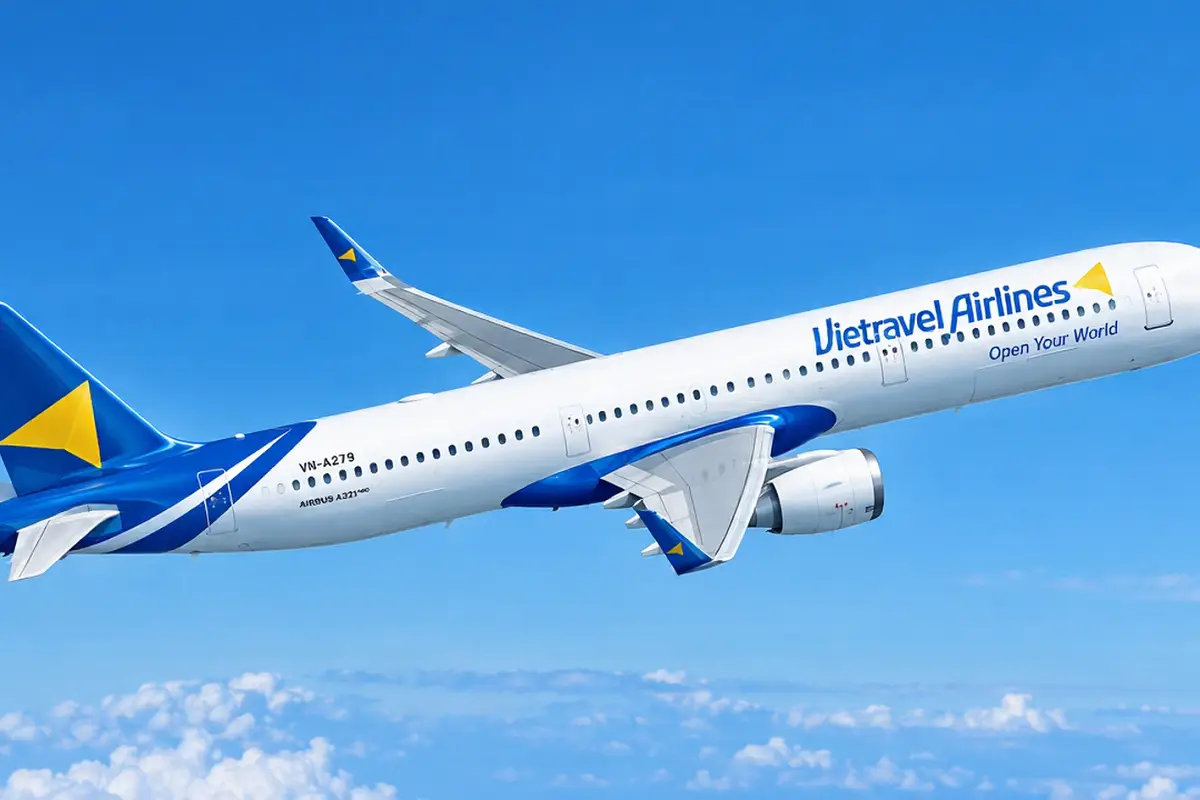
Vietravel Signed Its 50-Jet Airbus Deal in the Same Room, on the Same Day, as Vietnam Airlines Signed for A350s, the Timing Was Never About Aircraft
Vietravel Airlines signed a letter of intent for 50 Airbus aircraft, 20 A220s and 30 A321-family jets including A321neo and A321XLR variants, at the Élysée Palace in Paris on September 10, 2026, during a state visit by Vietnam's General Secretary and President To Lam. Deliveries are expected to begin in 2029. The airline currently operates four A321-200s and a single A320-200, according to ch-aviation fleet data, five aircraft in total. In the same Paris summit, on the same day, Vietnam Airlines separately signed a memorandum of understanding with Airbus covering A350 aircraft. Two Vietnamese carriers, two Airbus agreements, one diplomatic visit. That is not a coincidence of scheduling, it is the entire point of the venue.
The Vietravel Airlines 50 aircraft deal is therefore bigger than the aircraft count itself. It places Vietravel Airlines' expansion plans directly alongside Vietnam's broader aviation ambitions, with the Élysée Palace providing the diplomatic setting for both deals.
Why the Élysée Palace Matters More Than the Aircraft Count
Sovereign state visits are frequently used as vehicles for exactly this kind of commercial announcement, precisely because they let a government demonstrate deepening economic ties with a host country through concrete, headline-generating deals rather than abstract diplomatic communiqués. To Lam's visit to Paris covered "new areas of economic, trade and investment cooperation" and Vietravel's LOI, alongside Vietnam Airlines separate A350 memorandum, functioned as the tangible commercial proof point of that cooperation. T&T Group founder and Executive Chairman Đỗ Quang Hiển and Vietravel Airlines Chairman Đỗ Vinh Quang attended personally, alongside Airbus International President Wouter van Wersch, a level of corporate and political seniority on both sides that reflects how much this signing was designed as a state-visit set-piece as much as a genuine aircraft procurement milestone.
That context matters directly for how seriously to weigh the deal's near-term reality. Every outlet covering the story is careful to note this is a letter of intent, not a firm order, Airbus's own spokesperson confirmed "we are pleased to have signed the commitments, and look forward to finalising the contracts," language that explicitly acknowledges the contracts do not yet exist. LOIs signed at high-profile diplomatic events carry a specific risk: they generate maximum publicity at the moment of signing, precisely because that publicity serves the diplomatic purpose, while the harder commercial work, final pricing, financing structure, delivery slot confirmation, happens later, out of the spotlight, and does not always convert on the announced terms or timeline.
This is also why the Vietravel Airlines Airbus deal should currently be read as a major strategic commitment rather than a completed 50-aircraft purchase. The headline is real, the intent is public, but the final commercial contracts still have to follow.
Why a Five-Aircraft Airline Ordering 50 Jets Is Less Reckless Than It Sounds
The scale of ambition here is genuinely enormous relative to Vietravel's current size, a tenfold fleet expansion for a carrier that only took delivery of its first owned Airbus A321 in June 2025. But reading this as a five-aircraft startup suddenly overreaching misunderstands the actual sequencing. Vietravel Airlines was founded in 2019 as a subsidiary of established Vietnamese travel agency Vietravel Holdings, commenced flight operations in November 2021, and was acquired into the T&T Group conglomerate ecosystem at the end of 2024, meaning the carrier's current fleet-building phase is not the first chapter of an entirely new airline's existence, but a second chapter under new, considerably better-capitalised ownership.
T&T Group is one of Vietnam's larger private conglomerates, and the airline's own statement frames the 50-aircraft LOI explicitly as "the next step in Vietravel Airlines' transformation roadmap since joining the T&T Group ecosystem" language that positions this squarely as a corporate parent using its balance sheet to fund a long-planned scale-up, not an independent airline stretching beyond its means. The stated progression, "consolidating resources," then "gradually increasing the proportion of owned aircraft, starting with the first Airbus A321 in June 2025," now moving into "long-term fleet planning" describes a staged, deliberate capital deployment plan rather than a sudden leap.
Why Two Different Airbus Aircraft Types Signals Two Distinct Route Strategies, Not Indecision
The specific pairing of A220s and A321-family jets is the most substantively interesting technical detail in this story, because it reveals Vietravel is planning two structurally different kinds of route simultaneously rather than simply buying more capacity of a single type. The A220 is explicitly framed as a "market opening" aircraft, sized to "pioneer new direct air connections to cities and regions that previously lacked regular direct flights or had limited air accessibility," per the airline's own statement. That is precisely the same logic this feed has already documented with TransNusa's COMAC C909 deployment and Luxair's parallel E190-E2/737-10 order, an airline matching a smaller, right-sized aircraft to thinner routes that a larger jet would fly at an uneconomical passenger load, rather than forcing every route onto one standard aircraft type regardless of actual demand.
The A321neo and A321XLR variants serve the opposite function, higher-capacity, higher-demand domestic and international corridors, with the XLR specifically enabling "substantially longer international routes with a narrowbody aircraft," per Air Data News's reporting. That XLR inclusion is the detail connecting Vietravel's ambitions directly to the stated target markets of South Asia, Central Asia and the Middle East, regions that sit well beyond what a standard A321neo's range could serve nonstop from Vietnam, but that fall within reach of the XLR's extended fuel capacity, the same aircraft this feed has tracked reshaping United's and American's own long-haul narrowbody strategies into markets too thin for a widebody.
The Existing Network Is Almost Entirely Domestic, Which Makes the Ambition More Striking, Not Less
Vietravel's actual scheduled international network today consists of exactly two routes, Bangkok and Shenzhen. That is the starting point for a stated ambition to reach South Asia, Central Asia and the Middle East, markets Vietravel currently has zero presence in whatsoever. The airline's own near-term operational target, reaching approximately 80-90 daily flights by the second half of 2026 (one Vietnamese-language source states the figure closer to 100), is itself still an overwhelmingly domestic growth story, connecting "key economic and tourism centers" within Vietnam, with the international expansion explicitly described as gradual rather than immediate.
That sequencing, build domestic scale and operational reliability first, then layer in modest existing international routes, then use the incoming A220 and A321XLR fleet from 2029 onward to genuinely enter new international markets, is a considerably more conservative growth path than the "50 aircraft" headline number alone suggests. Vietravel is not proposing to leap directly from a five-aircraft, two-international-route carrier into Central Asian and Middle Eastern markets tomorrow. It is describing a decade-long fleet and network transformation, anchored to aircraft deliveries that do not even begin until 2029, giving the airline roughly three additional years of domestic and near-region operational maturation before the first of these new jets forces the international ambition to become real.
Why 2029 Is Both the Deal's Biggest Strength and Its Biggest Uncertainty
A delivery start date three years out gives Vietravel genuine planning runway, time to build crew training pipelines, secure the regulatory approvals and bilateral air service agreements that South Asian, Central Asian and Middle Eastern route entry would require, and demonstrate to Airbus and to its own T&T Group ownership that its domestic and near-region operations can sustain the utilisation rates a 50-aircraft fleet would need to be commercially viable. It also means nothing about this LOI is binding on either side in the way a firm order with penalty clauses would be, a considerable amount can change in Vietnamese aviation, in T&T Group's own capital priorities, and in Airbus's own production slot allocation between now and 2029, before a single one of these 50 aircraft actually needs to be built.
The genuinely open question this deal raises is not whether Vietravel can eventually operate 50 Airbus jets, T&T Group's backing and the staged delivery timeline make that mechanically achievable if the capital commitment holds. It is whether Vietravel can build the operational track record, the bilateral route rights, and the actual passenger demand across South Asia, Central Asia and the Middle East to fill that fleet profitably once it arrives, markets where established competitors, from Gulf carriers to India's own expanding long-haul ambitions this feed has tracked extensively throughout 2026, are not standing still waiting for a Vietnamese entrant to establish itself.