Visit Qatar Arabian Travel Market 2026 Showcase Begins
Visit Qatar Arabian Travel Market 2026 participation brings a 650-square-metre Qatar Pavilion to Dubai, with 50 partners and immersive cultural experiences at ATM.
 RUKAIYA KADIWAL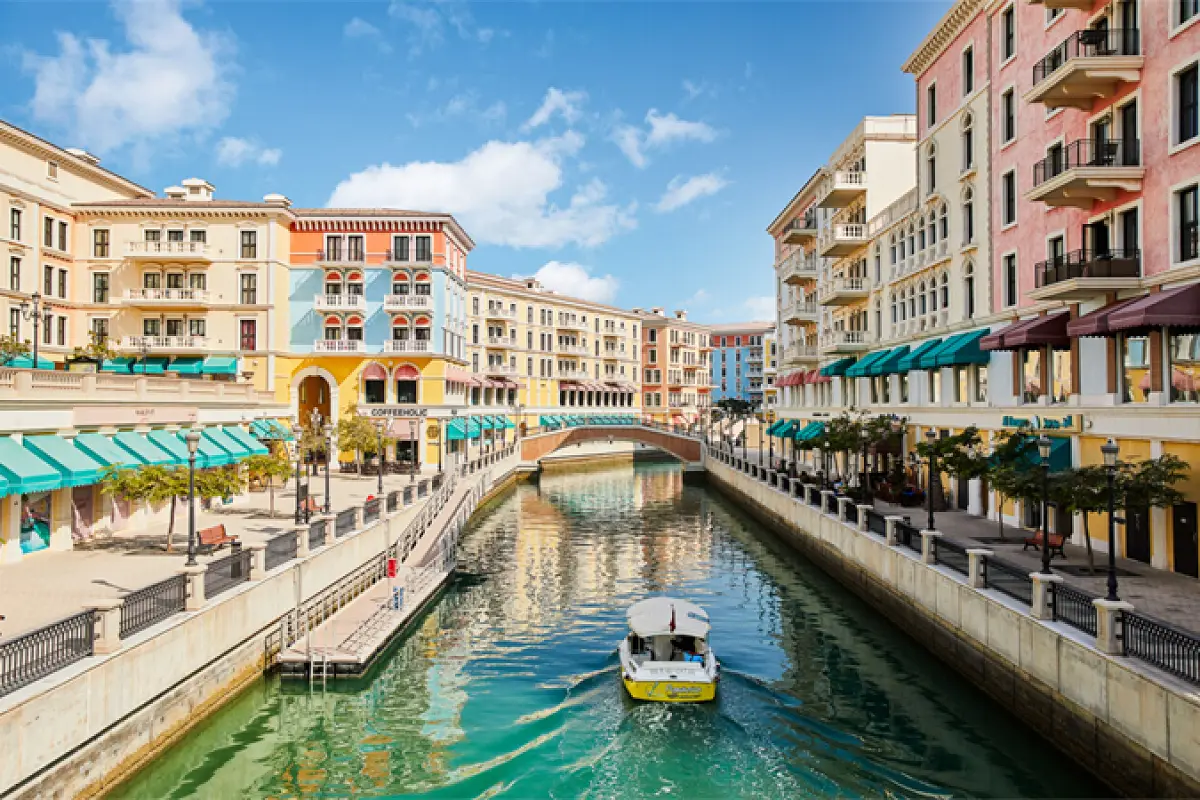
The water in the canals of Qanat Quartier moves with the particular stillness of water that has been managed rather than found, its turquoise surface carrying the reflections of the Venetian-inspired facades that line the banks of The Pearl-Qatar. A small boat moves through the channel between the coloured buildings, unhurried, while cafes set their chairs along the water's edge in the way cafes in this part of Doha have learned to do, placing the canal view as casually as a more ordinary restaurant might set out a blackboard menu. The scene is photographed daily by visitors who are experiencing Qatar for the first time and by residents who have photographed it many times before. It is the kind of image that a tourism board knows how to use, and Visit Qatar knows how to use it.
Visit Qatar Arabian Travel Market 2026 Participation Opens in Dubai
From 14 to 17 September 2026, Visit Qatar Arabian Travel Market 2026 participation takes shape at Dubai World Trade Centre, where the 33rd edition of the Arabian Travel Market brings together travel and tourism professionals from across the world under the theme Travel 2040: Driving New Frontiers Through Innovation and Technology. Visit Qatar arrives with a 650-square-metre Qatar Pavilion in Saeed Hall, Stand ME1520, and a delegation of 50 partners including hotels and destination management companies, the kind of coordinated presence that signals a destination making a serious argument about its place in the global tourism conversation rather than simply appearing because the event calendar requires it.
The Arabian Travel Market has been the region's most significant annual gathering of travel and hospitality professionals for more than three decades. Its role as a platform for destinations, airlines, hotels, and industry stakeholders to discuss emerging trends and the direction of global travel has made it the moment when the Middle East's tourism sector takes stock of where it is and, with less certainty, where it intends to go. Qatar's pavilion at this year's edition is designed to communicate not just what the destination currently offers but what the country's ongoing investment in tourism infrastructure and experience is building toward.
A Pavilion Built for a Closer Look
The Qatar Pavilion at ATM 2026 is configured as a double-deck structure housing immersive and interactive experiences designed to give visitors something closer to the actual texture of the destination than a brochure or a presentation can provide. The centrepiece is what Visit Qatar calls an Immersive Room, a multi-sensory environment that draws on visual, audio, and atmospheric elements to explore Qatar's iconic destinations in a format that trade visitors, who may have seen dozens of destination presentations across a career, are unlikely to walk past without pausing.
The decision to invest in a sensory environment rather than a conventional exhibition stand reflects an understanding of what travel professionals at a trade show actually need from a destination showcase. They do not need more printed materials. They need to feel something about a place, to carry away an impression that can be translated into a conversation with a client or a product recommendation, and the Immersive Room is designed to provide that impression rather than to deliver information that could be conveyed through a fact sheet.
Cultural Heritage as a Live Demonstration
Alongside the technology-driven sensory experience, the Qatar Pavilion will host live demonstrations of traditional crafts. Visitors to the stand can experience Arabic calligraphy, misbah making, and agal making, three practices whose roots run through Qatari cultural identity in ways that the objects themselves make immediately visible. A misbah, the string of prayer beads traditionally crafted from materials including amber, coral, and precious stones, is not simply a craft object. It is a material expression of a culture's relationship with time and contemplation, and watching it being made creates a different kind of understanding than reading about it.
The inclusion of live crafts alongside a high-technology immersive room is a deliberate curatorial decision. It positions Qatar as a destination where heritage and innovation coexist rather than compete, where the same country that built a new city from reclaimed land also maintains the craft traditions of the region that preceded it. For travel professionals who need to explain Qatar to clients, that duality is one of the destination's more compelling selling points.
Qatar Calendar and the Events Economy
The Qatar Calendar will feature prominently within the pavilion, giving trade visitors an overview of upcoming events and experiences across the country. The events economy has become one of the more significant drivers of destination tourism globally, with international sporting events, cultural festivals, and major exhibitions generating short-burst demand that supplements leisure and business travel across the calendar year. Qatar's post-World Cup period has involved a deliberate effort to sustain event-driven visitor numbers through a programme of attractions that positions the country as a year-round destination rather than one whose international profile peaked with a single tournament.
The Qatar Calendar's presence at ATM is a practical communication tool for travel agents and destination management companies who need to know what is happening in the country on specific dates in order to build compelling itineraries for their clients. Upcoming events, cultural moments, and tourism experiences have commercial value only when the travel industry knows they exist and can translate that knowledge into bookings. The pavilion's showcase of the calendar is, in these terms, a distribution function as much as a marketing one.
Fifty Partners and What They Represent
The fifty partners accompanying Visit Qatar to ATM 2026 describe the breadth of the country's hospitality and tourism infrastructure rather than its pinnacle. Hotels, destination management companies, and tourism operators together represent the operational layer through which a visitor's experience of Qatar is actually delivered, the guides who lead the excursions, the properties that house the guests, the companies that organize the logistics between arrival and departure. Their presence at the pavilion gives trade visitors direct access to the businesses that will be responsible for the itineraries they sell, a commercial efficiency that benefits both sides of the conversation.
For the partners themselves, participation at ATM alongside the national tourism authority provides a platform and a credibility that most of them could not access independently. The Qatar Pavilion's scale and its 650-square-metre footprint in Saeed Hall provides each partner within it with a visibility in the hall that a standalone presence would not achieve, while the coordinated national branding ensures that every partner is selling Qatar rather than competing with each other for a share of undifferentiated attention.
What ATM 2026's Theme Means for Qatar's Strategy
The conference theme, Travel 2040: Driving New Frontiers Through Innovation and Technology, frames ATM 2026 within a forward-looking conversation about where the tourism industry is heading over the next fifteen years. For Visit Qatar, whose Tourism Strategy is aligned with Qatar National Vision 2030, a conference theme built around innovation and technology arrives as a convenient alignment of external context and internal ambition. The Immersive Room in the Qatar Pavilion, the live craft demonstrations, the digital Qatar Calendar, and the coordinated partner delegation are all, in different registers, expressions of a country that has decided it wants to be understood as both traditionally rooted and technologically sophisticated in its approach to welcoming visitors.
The decision to participate at scale rather than with a token presence reflects the same strategic seriousness that Visit Qatar has applied to its broader international marketing programme. An emerging destination that wishes to be taken seriously by the global travel trade needs to invest in the moments when that trade is gathered in one place, and ATM is the most concentrated version of that gathering in the region.
A Canal, a Craft, and a Conversation That Has Only Just Begun
By the time ATM 2026 closes on 17 September, the Qatar Pavilion will have hosted conversations that begin in Saeed Hall and end, months later, with a traveler stepping off a flight into Hamad International Airport for the first time. That distance, between a trade show stand and a first visit to a destination, is crossed through exactly the kind of relationships and impressions that Visit Qatar has designed its ATM presence to create. The calligrapher at the pavilion is practicing a script whose roots run back centuries. The Immersive Room around the corner is using technology developed in the current decade. The canal in Qanat Quartier is waiting, as it always is, for whoever arrives to photograph it, to sit beside it, to understand something about a country that has built something entirely new while insisting, with considerable conviction, that it knows exactly where it comes from.
Related reading: Tenerife hotel sun lounger booking app ends towel wars