Eco-Friendly Elegance: Natural Material Studio Crafts Lighting from Leftover Seaweed at Sticks n Sushi Restaurant
Discover how Natural Material Studio crafts lighting from leftover seaweed at Sticks n Sushi restaurant, pioneering circular biomaterial design in Denmark.
 Prajakta Sanjay Warwadkar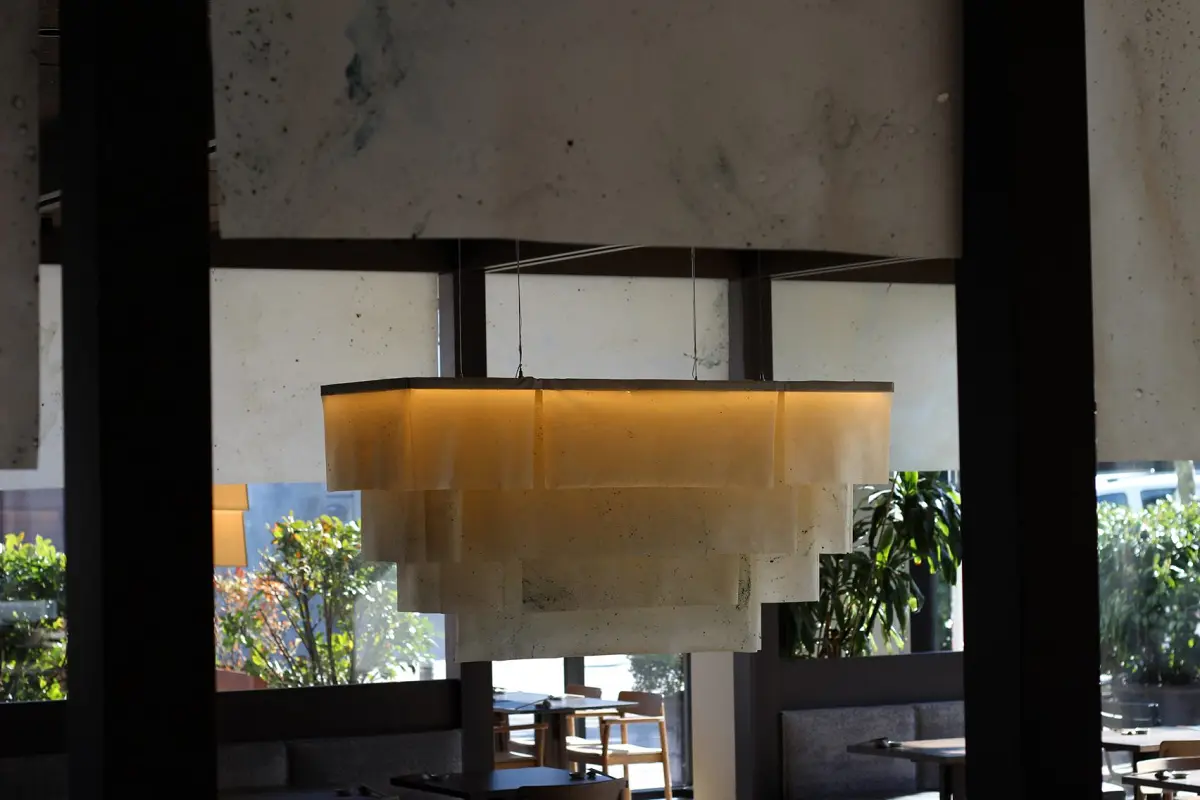
A Circular Design Triumph: Natural Material Studio Crafts Lighting from Leftover Seaweed at Sticks n Sushi Restaurant
Talk in the design studios is getting sharper, and it’s now spilling straight onto the restaurant floor.
Natural Material Studio crafts lighting from leftover seaweed at Sticks n Sushi restaurant, and operators are watching closely. This isn’t a PR stunt. It’s kitchen waste turned into working design.
At the Lyngby location of Sticks n Sushi, the new pendant lights aren’t shipped in. They’re pulled from the prep line, kelp scraps, algae residue, the stuff most kitchens dump.
Now it’s hanging overhead.
And it works.
The move lines up with pressure building across the restaurant industry growth 2026 curve. Guests don’t want “green messaging.” They want proof they can see.
This is proof.
Led by material designer, the studio has built a reputation flipping waste into product. Old bricks. Beer byproducts. Now seaweed.
And this one hits differently, because it starts in the kitchen and ends in the dining room.
Deconstructing the Algae and Kelp Bio-Fabrication Process
The reason Natural Material Studio crafts lighting from leftover seaweed at Sticks n Sushi restaurant is getting traction is simple, low impact, tight execution.
No plastic base. No industrial shortcuts.
Just waste reworked into structure.
Kelp and spirulina are pulled straight from daily service. What’s left after miso prep gets rerouted, not dumped.
Then it goes to the lab.
From Boiling Miso Pots to Dehydrated Powder Bases
First step, clean it, dry it, stabilize it.
The kelp is stripped down and dehydrated until it’s shelf-stable. No decay. No contamination.
Then it’s broken into rough fibers.
Algae waste gets pushed further, ground into a fine powder that holds its natural green tone.
No dyes. No chemical color fixes.
The Custom Procel Protein-Based Biopolymer Compound
Everything feeds into Procel.
A protein-based biopolymer the studio controls tightly.
The mix is poured by hand. Flat tables. No factory lines.
Plant oils are added to keep flexibility. Chalk goes in for strength and fire resistance.
The result, thin sheets that behave like material, not waste.
Fusing Japanese Minimalism with Scandinavian Material Innovation
This wasn’t just about making material. It had to fit the room.
The build was shaped alongside designer Procel, who kept the space clean and controlled.
Minimal lines. Natural tones. Nothing loud.
The material had to sit quietly, and still stand out.
Streaky Textures Echoing Traditional Washi Paper Art
The texture does the work.
Fibers don’t settle evenly. That’s the point.
Once lit, the panels throw soft patterns, close to traditional washi paper.
It ties back to the menu without forcing it.
And the light stays warm. No glare. No harsh spill.
Crafting Custom Noren Dividers for Intimate Floor Layouts
The material doesn’t stop at lighting.
It’s used for dividers too, modern takes on Japanese noren curtains.
They move slightly with airflow. Subtle, but noticeable.
They break the room without boxing it in.
That balance matters in high-turnover dining rooms.
The Sustainable Metrics of Fully Home-Compostable Hospitality
The bigger story behind Natural Material Studio crafts lighting from leftover seaweed at Sticks n Sushi restaurant is what happens after install.
Because this material doesn’t stick around forever.
It breaks down.
Fully compostable. No toxic residue.
No landfill drag.
The Circular Capability of Localized Remelting Networks
And it doesn’t stop at disposal.
If a unit breaks—or the restaurant redesigns, the material can be remelted.
Recast. Reused.
Same input. New form.
That’s a working version of the circular economy, not just a concept slide.
Eliminating the Destructive Extraction of Petrochemical Resources
There’s another layer here.
No petroleum plastics involved.
Seaweed grows fast. Needs no fresh water. No farmland.
And it pulls carbon while growing.
So the raw material does environmental work before it even hits the kitchen.
Future Horizons: Scaling Biomaterials Within Global High Streets
The success of Natural Material Studio crafts lighting from leftover seaweed at Sticks n Sushi restaurant isn’t staying local.
Other operators are watching.
Because this isn’t fragile design, it holds up in a live restaurant.
Heat. cleaning cycles. daily wear.
It passes.
Expanding Into Commercial Furniture and Wall Coverings
The next move is already in play.
Heavier panels. Acoustic boards. Table surfaces.
Even wall systems.
Adjust the mix, change the function.
That flexibility opens doors across retail and hospitality.
Nurturing Collaborative Waste Alliances with Food Giants
But scale needs supply.
And restaurants have it, tons of clean organic waste every day.
If collection systems lock in, this becomes a steady material stream.
Less waste cost for operators.
More raw input for design.
That’s where this goes next, real partnerships between kitchens and makers.
And if that clicks, the line between waste and product disappears fast.