Government Clears PPP Redevelopment of Ashok and Samrat Hotels Under NMP 2.0 with ₹1,200 Crore Investment Plan
The government has approved the PPP redevelopment of Ashok and Samrat Hotels under NMP 2.0, with a planned ₹1,200 crore investment aimed at modernising legacy hospitality assets.
 nishathapa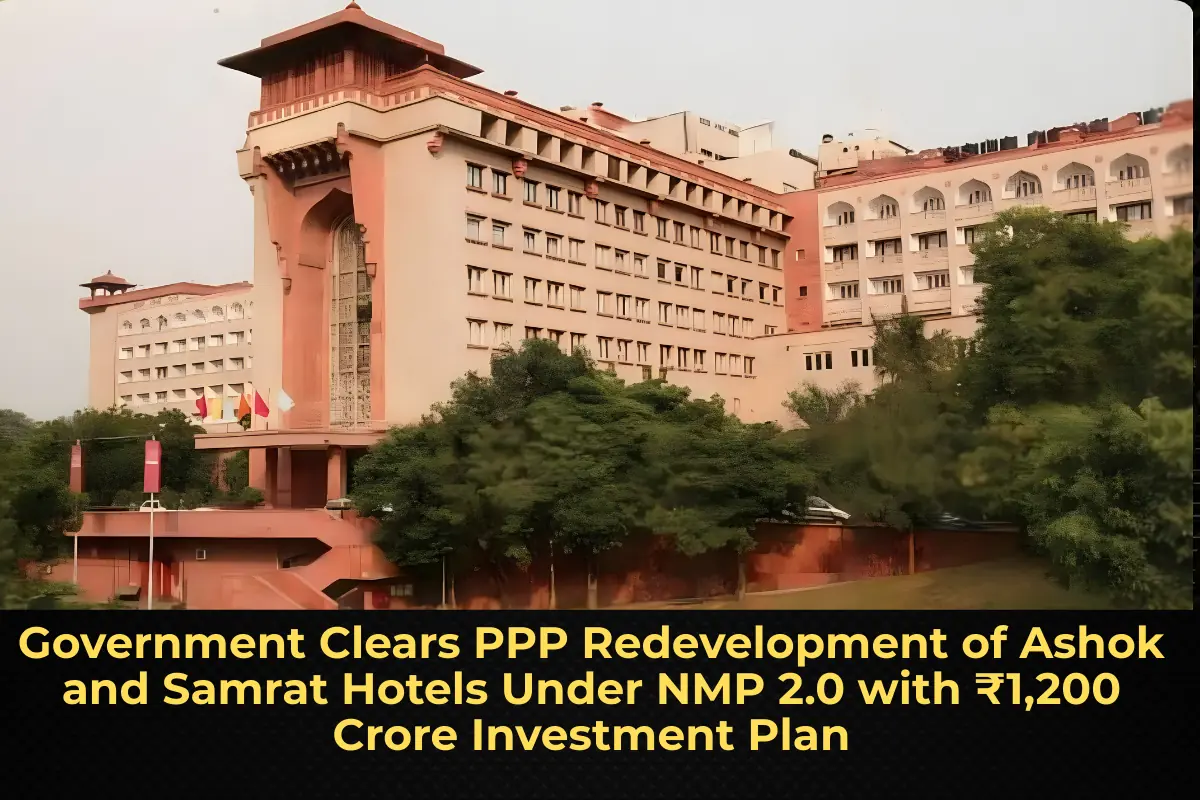

Major Boost for Public Asset Monetisation in Hospitality
The Government of India has approved the public-private partnership (PPP) redevelopment of the iconic Ashok and Samrat Hotels under the National Monetisation Pipeline (NMP) 2.0, with an estimated investment of ₹1,200 crore. The decision marks a significant step in revitalising legacy hospitality assets through private sector participation while unlocking long-term economic value.
The redevelopment initiative is part of the broader strategy to modernise government-owned properties, enhance operational efficiency, and attract institutional capital into public infrastructure assets.
Reimagining Legacy Hospitality Assets
The Ashok and Samrat Hotels have long been recognised as prominent properties within India’s hospitality landscape. However, changing guest expectations, evolving brand standards, and increasing competition from modern hotels have underscored the need for comprehensive upgrades.
Through the PPP model, the government aims to bring in private expertise, capital investment, and global hospitality standards to reposition these assets as competitive players in the contemporary hotel market.
What NMP 2.0 Means for the Hospitality Sector
The National Monetisation Pipeline 2.0 framework focuses on unlocking value from brownfield assets by leasing them to private operators for defined concession periods. Instead of outright sale, the PPP approach ensures that ownership remains with the public entity while operational and financial responsibility shifts to experienced private players.
This structure encourages asset revitalisation without permanent divestment, aligning public interest with commercial efficiency.
₹1,200 Crore Investment to Modernise Infrastructure
The planned ₹1,200 crore investment is expected to fund extensive renovation, structural upgrades, technology integration, sustainability enhancements, and potential repositioning of the hotels under competitive branding strategies.
Modern travellers increasingly prioritise smart-room features, sustainable operations, upgraded food and beverage offerings, and flexible event spaces. The redevelopment aims to bring the properties in line with global hospitality benchmarks.
Strengthening India’s Hospitality Investment Climate
The approval of this PPP project signals growing confidence in India’s hospitality sector as a viable investment avenue. Institutional investors and hotel operators are actively exploring asset-light expansion and brownfield redevelopment opportunities across major cities.
Government-backed initiatives like NMP 2.0 further strengthen investor sentiment by creating transparent frameworks for asset monetisation and operational transformation.
Benefits of the PPP Model
- Operational Expertise: Private operators bring global brand standards and revenue optimisation strategies.
- Capital Efficiency: Public entities unlock value without direct capital expenditure.
- Faster Modernisation: Renovation and repositioning timelines are streamlined under private management.
- Enhanced Competitiveness: Upgraded assets can better compete in metro hospitality markets.
Economic and Employment Impact
The redevelopment is expected to generate employment opportunities across construction, operations, and allied services. Large-scale renovation projects typically stimulate local supply chains, benefiting vendors, contractors, and hospitality professionals.
Upon completion, revitalised properties can attract higher-value corporate events, international delegations, and tourism traffic, contributing to broader economic activity.
Aligning with Urban Infrastructure Growth
As India continues to invest in airports, convention centres, and transport corridors, modernised hospitality infrastructure becomes essential to support business travel and event-driven demand. Upgraded Ashok and Samrat Hotels could play a strategic role in accommodating high-profile events and international visitors.
Long-Term Vision for Public Hospitality Assets
The PPP redevelopment under NMP 2.0 reflects a shift from passive asset ownership to active value creation. By leveraging private sector capabilities, the government aims to transform underutilised or ageing properties into commercially viable hospitality landmarks.
Such initiatives may also serve as a blueprint for future redevelopment of other government-owned hospitality assets across the country.
Conclusion
The approval of the PPP redevelopment of Ashok and Samrat Hotels under NMP 2.0 marks a pivotal moment in India’s hospitality asset monetisation journey. With a ₹1,200 crore investment plan, the initiative aims to modernise legacy properties, attract private capital, and strengthen India’s competitive positioning in the global hospitality landscape.
As the project progresses, it could set new benchmarks for public-private collaboration in the country’s evolving tourism and hospitality ecosystem.