Sacramento Supper Clubs Bring Strangers to the Same Table
Sacramento supper clubs like Good Wilma's and Dinner With Old Friends are rebuilding community one intimate multicourse dinner at a time in private homes across the city.
 RUKAIYA KADIWAL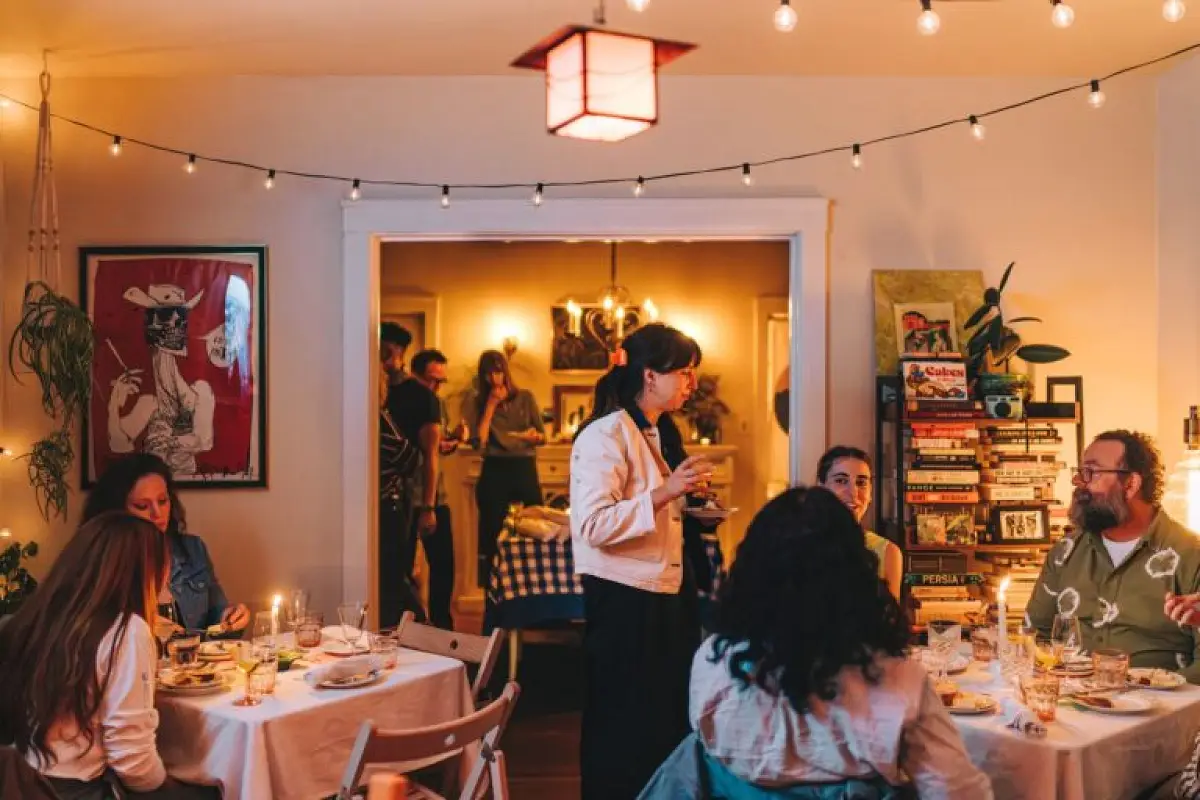
The music stops before every course. That is the rule at Dinner With Old Friends, and it is a rule worth pausing on. In a city full of restaurants where the ambient noise is part of the service, where the playlist is curated to keep energy up and tables turning, Derek Sawyer stops the music so he can speak. He tells his twelve guests why this dish is on the menu tonight. He tells them who grew the produce. He tells them about the farmers who are not making much money from the four or five tomatoes he chose because they were perfect, and why he did not want to cheap out on that either. Then the music starts again, and the food arrives, and the table of strangers continues its slow conversion into something else.
Sacramento Supper Clubs Are Rebuilding Community Over a Shared Table
Sacramento supper clubs have been quietly building a dining culture that operates by different rules from the restaurant industry that most of their hosts came out of. A supper club is a ticketed, multicourse dinner cooked and served out of someone's own home, usually once a month, for a small group of guests. The format is not new. What is new, in Sacramento and in other American cities, is the density of serious culinary talent choosing it as a primary outlet rather than a side project, and the appetite among diners for something that a conventional restaurant dining room cannot provide.
Two of the more established supper clubs in the city take almost opposite approaches to the same idea. Good Wilma's is a wine-filled dinner built around big shared plates, cooked by five friends out of an apartment. Dinner With Old Friends runs an individually plated seven-course menu for twelve guests, led by a fine dining duo and supported by investors from the beginning. Each has a house dog mascot. Wilma at one, Mezcal at the other. Both aim to send guests home exchanging Instagram handles and having made friends they did not have three hours earlier.
How Good Wilma's Came to Be
Jasper Nahid and his fiancée Jessica Parsons run Good Wilma's alongside Esther Kaminsky, Audrey Pardini and Malik Bynum, their friends in Sacramento's food and beverage scene. The five of them arrived at the format through a shared recognition of what they wanted from work that conventional hospitality was not offering. "We all realized that we loved food, and wanted to do something creatively, but not work a line cook position or a traditional restaurant back-of-house job," Nahid said. The answer they found was collective. "Together we are the limbs of an octopus of one really talented chef."
Parsons described how the current version of Good Wilma's emerged from its earlier, more informal iterations. "We started hosting elaborate themed dinner parties for our friends, and our organization and development really stems from that," she said. The transition from private dinners to a ticketed supper club happened when close ones began flooding their direct messages asking to come over, a shift from invitation to demand that tends to mark the moment a project becomes a business, whether or not it is immediately recognized as one.
Dinner With Old Friends and the Idea Behind the Name
Derek Sawyer and Yessenia Ochoa-Sawyer, a husband-and-wife team, arrived at their supper club through a habit they already had. They and their friends used to cook with each other once per month, rotating which home hosted each meal. The name they chose for their public version is the best description of what they want every dinner to achieve. "The whole idea about Old Friends is that you come in as a stranger, but you're going to leave as a new friend at the end of it," Ochoa-Sawyer said.
That ambition is not simply a hospitality philosophy. It is a structural design principle that shapes every decision about the dinner's format, its seat count, its pace, and how the hosts move through the room. A table of twelve strangers becoming friends over the course of an evening requires conditions that most restaurants are not set up to create, and the supper club format provides those conditions almost by default.
Two Formats, Two Rooms, One Underlying Logic
At Good Wilma's, guests arrive to a welcome cocktail and appetizers laid out on a table, with room to mingle before finding a seat wherever they like. The apartment's living room becomes a run of four-top tables for the night, each set with a printed menu pairing every course with a wine. "It was our kind of DIY style," Nahid said. "We're not trying to trick you into feeling like you're in a restaurant." The structure of the menu stays consistent across each dinner, a soup, a raw cold course, a run of hot dishes, then dessert, while the dishes themselves change constantly.
This past summer's menu ran from a sweet corn soup with saffron to a smoked trout churro with cherry mostarda, ending on a stone fruit karpatka, a Polish choux pastry cream cake. The crew's own histories surface in the menu when the occasion allows. A golden borscht traces to Kaminsky's Ukrainian heritage. A kuku sabzi, a Persian herb frittata, connects to Nahid's own background. Parsons' wine expertise, sharpened across years as a cheesemonger and now as wine department manager at Taylor's Market, shapes the pairings. "Since both Jasper and I have cheese and wine backgrounds, it's fairly effortless pairing the wines with our food," she said. "But we're also not very dogmatic about it, and really we're just trying to show off wines that we really like."
At Dinner With Old Friends, the twelve seats split across two four-top tables, one in the living room and one in the dining room, plus four more at the counter. Guests bring their own wine, and Sawyer suggests one or two bottles is plenty. The music stops before every course for a brief explanation of what has arrived and why. This past summer's seven-course menu ran from a farmers bouquet with three kinds of peas to a Frito-less Frito pie built on pork, chicharrónes and a Mexican-inspired slaw. Versions of Ochoa-Sawyer's family recipes appear along the way, drawn from her father's Mexican restaurant in Santa Rosa, a restaurant history that shaped her understanding of hospitality long before she began hosting dinners of her own.
The Economics of Cooking in Your Living Room
A seat at Dinner With Old Friends runs $175. Sawyer is direct about where that money goes and why he will not compromise on it. "You're dealing with these farmers that aren't making a ton of money off of us getting like four or five tomatoes that are perfect," he said. "I don't want to cheap out on that either." Two investors covered startup costs including chairs, linens, and Gabriel-Glas wine glasses used at every dinner, giving the operation a material credibility from the beginning that most supper clubs build toward over time.
Good Wilma's charges $150 per seat, with tip appreciated but not expected, and staff earn roughly $40 per hour. The math of scaling up is not straightforward. "I felt like I wasn't able to interact with each guest as well," Nahid said of dinners that pushed toward twenty guests. Sixteen, the number the apartment comfortably holds, gives him more time with each person. "We've always broken even. We've never lost money doing it." The decision to hold the guest count at a level that protects the quality of interaction rather than maximizing revenue is a business philosophy that most restaurant operators could not afford to hold, and it is one of the defining differences between the supper club format and the conventional dining room.
The Hospitality That Preceded the Supper Club
The culinary backgrounds behind both supper clubs are serious enough to make their choice of format notable. Sawyer sharpened his cooking in lead positions at Sacramento fine dining restaurants including Hawks Public House, Allora, and Localis before starting Old Friends. Ochoa-Sawyer worked as Localis' guest relations and events manager before moving to the Sellands Family Group, where she manages catering and events. Her hospitality instinct is personal rather than professional in its origins. "I love taking care of people. I love getting to know people," she said. "And Sawyer is so good at doing that with food and just making your belly feel like a hug inside."
Nahid and Parsons built their expertise as cheesemongers, Nahid at the Sacramento Natural Foods Co-op and Parsons at Taylor's Market, before Nahid moved on to run the wine program at Ro Sham Beaux and eventually to his current role at Majka Pizzeria and Bakery alongside Bynum. These are not chefs who could not find restaurant work. They are food professionals who found the supper club format better suited to what they actually want to do.
What the Supper Club Trend Reveals About Dining Right Now
The broader context behind Sacramento's supper club moment is documented rather than anecdotal. The Miami Herald has reported that supper clubs are becoming one of the most meaningful ways people are rebuilding community, connecting the format's growth to record-high loneliness rates. The San Francisco Standard found the same dynamic closer to home, identifying a Bay Area full of isolated food lovers craving connection over a shared table. Ochoa-Sawyer articulates the intimacy of the format in terms that the seat count makes structural. "You're literally doing something that you can't do for 100 covers anymore. You're doing it for just that 12," Sawyer said.
Bynum, from the Good Wilma's side, connects the supper club's appeal to something specific about Sacramento's scale. "It's news to nobody that Sacramento is a small city," he said. "Yearning for a dining experience that allows you to taste delicious new things and feel surprised time after time in such a disarming setting is a completely valid wish." The disarming quality he names is important. A dining room that does not try to feel like a restaurant removes the social scaffolding that restaurants provide, the menu in a leather cover, the sommelier's script, the particular distance maintained between server and guest, and replaces it with something that requires a different kind of presence from everyone in the room. That requirement is exactly what makes the format work, and exactly why it cannot be replicated at scale. "You can be yourself here, we want you to be," Bynum said. "And that can be hard to find when you go out to eat nowadays."
What Comes Next for Two Supper Clubs Still Finding Their Shape
Nahid's long-term ambition for Good Wilma's is a brick-and-mortar version of what the apartment dinners have proven, a small retail space built around an open pantry, a wine hall, and a bar. The way he describes it suggests less a business plan than a life philosophy. "I want to open a business where I can sit on a chair and just do that for the rest of my life and not have to retire and literally die there," he said. "That's the litmus test." Sawyer wants to increase Dinner With Old Friends from once a month to once a week, reaching more people, and is considering a supplemental experience for regulars, where repeat guests could access additional courses beyond the standard menu. "I would love to be able to pour my soul into what the food could be with this," he said.
A Table Set for Twelve, and What It Asks of Everyone in the Room
The supper club, at its most effective, asks something of its guests that a restaurant never quite does. It asks them to be present not just as diners but as participants in an evening whose quality depends partly on what they bring to the table alongside the food. When the music stops at Dinner With Old Friends and Sawyer explains which farmer grew the tomatoes, the guests who receive that information become, for a moment, something more than customers. They become people who know something about where their food came from and why it matters. By the time the evening ends and the Instagram handles have been exchanged, that shared knowledge has become the foundation of something that Sacramento's dining room, however good the food, rarely builds. The music starts again. The next course arrives. And twelve strangers continue becoming, in their own small and real way, old friends.
Related reading: Dishoom Borough: inside the eighth restaurant at Hop Exchange