ANA Pokemon Jet Connects Travelers to 14 Regional Airports
ANA Pokemon Jet connects international travelers with 14 regional Japanese airports through Pokémon GO, turning the plane into a tourism strategy.
 Jishan Khan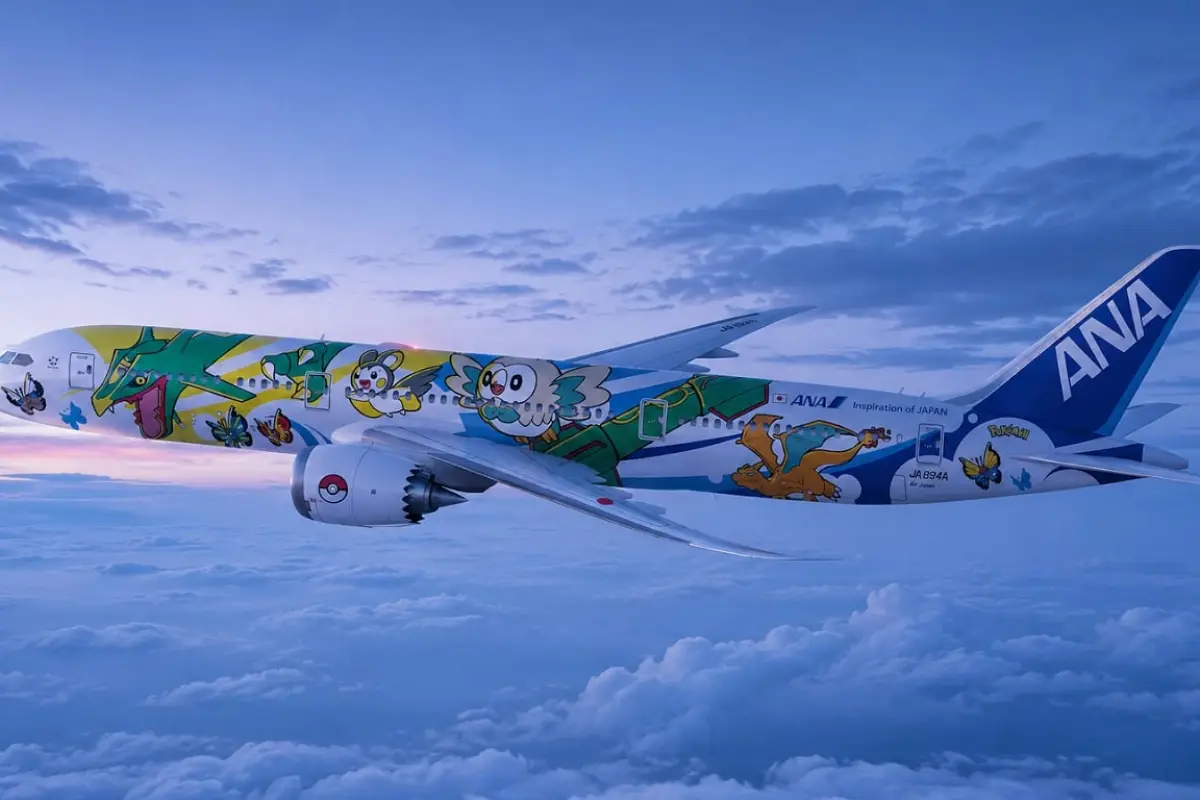
ANA's Pokemon Jet Isn't Really About Pikachu, It's a Trojan Horse for Getting Foreigners to 14 Airports They've Never Heard Of
ANA confirmed the September 18, 2026 international launch of its Green Pokemon Jet, a Boeing 787-9 that will connect Tokyo with Honolulu, Seattle, Vancouver, Sydney, Delhi, Mumbai and six other cities through March 27, 2027, marking the third distinct Pokemon-liveried aircraft the airline has introduced this year alongside a Red Jet already flying domestically and a Blue Jet still to come. The timing is deliberate, it coincides with both Pokémon's 30th anniversary and ANA's own 40th anniversary of international flight operations, giving the airline two separate marketing narratives to fuse into a single campaign.
The genuinely interesting part of this story isn't the aircraft livery. It's what ANA is quietly building alongside it, on the ground, at airports most international travelers to Japan have never set foot in.
The Ground Game Nobody Is Talking About: ANA Pokémon Jet and Pokémon GO Japan Tourism
Buried inside ANA's own press materials is a detail that reveals far more strategic intent than the paint job itself, starting September 18, specially designed ANA PokéStops and Gyms will appear at 14 regional Japanese airports, Kochi, Matsuyama, Takamatsu, Tokushima, Fukuoka, Saga, Miyazaki, Kumamoto, Kagoshima, Nagasaki, Oita, Ishigaki and Miyako, alongside Naha in Okinawa. Every one of those is a secondary or tertiary domestic gateway, not Tokyo, Osaka or Kyoto. This is the second phase of ANA's Pokemon GO collaboration, and it is doing something the aircraft livery alone cannot: giving Pokémon GO's global player base, a franchise that still commands tens of millions of active monthly users across dozens of countries, a concrete, gamified incentive to fly domestically within Japan to airports that otherwise have no reason to appear on a foreign tourist's itinerary.
That is the actual mechanism behind "turning Pokémon into a tourism marketing tool." An international visitor lured to Japan by the novelty of flying a Pokémon-liveried 787 into Haneda or Narita then has a built-in, franchise-native reason to continue on ANA's domestic network to Kagoshima or Ishigaki specifically to unlock exclusive in-game Pokémon encounters tied to those locations. Japan's tourism authorities have spent years trying to solve exactly this problem, overtourism concentrated in Tokyo, Kyoto and Osaka, with regional prefectures desperate for visitor traffic they cannot organically attract. ANA has effectively outsourced part of that regional dispersal challenge to a mobile game.
Why Route Selection Reveals ANA's Actual Target Markets and Regional Airports Strategy
The Green Jet's confirmed routing is not a random collection of major cities, it maps almost precisely onto the international markets ANA and Japan's tourism board have identified as highest-growth-potential. Delhi and Mumbai's inclusion alongside Singapore, Bangkok, Jakarta and Kuala Lumpur signals that ANA is treating South and Southeast Asia as a single growth cluster worth dedicating premium marketing assets to, consistent with this feed's earlier coverage of Lufthansa's own conclusion that Indian outbound premium travel demand has overtaken China's. Sydney and Perth cover Australia's two primary Japan-bound gateways. Honolulu, Seattle and Vancouver anchor the North American Pacific corridor.
What's conspicuously absent is any European routing at all, the Green Jet stays entirely within the Pacific and Indian Ocean rim through its full seven-month deployment window. That is not an oversight; it is ANA concentrating its highest-visibility marketing asset specifically on the markets where inbound Japan tourism growth is fastest and where a culturally resonant franchise like Pokémon carries the most cross-generational brand recognition, anime and gaming culture penetration in North America, Australia and Southeast Asia significantly outweighs its relative marketing value in most European source markets.
A Franchise ANA Has Run Longer Than Most of Its Passengers Have Been Alive: Pokemon Air Adventures
This is not ANA experimenting with character licensing for the first time. The airline flew the world's first Pokémon-themed commercial aircraft in July 1998, timed to the theatrical release of Pokémon: The First Movie, using a Boeing 747-400 and 767-300 that remained in service until 2016, nearly two decades of continuous branding history before the current revival. ANA restarted the concept in June 2023 with the Pikachu Jet NH and Eevee Jet NH under The Pokémon Company's explicitly stated Pokémon Air Adventures initiative, launched in 2021 specifically to help revitalize Japan's pandemic-battered aviation and tourism sectors, with The Pokémon Company waiving licensing costs as part of that national recovery effort.
That history matters because it demonstrates the current three-jet Red/Green/Blue campaign is not an isolated marketing stunt but the continuation of a proven, decades-long pattern where ANA and a globally dominant Japanese entertainment IP have repeatedly found it mutually beneficial to align commercial interests with Japan's broader national tourism recovery goals. Few airlines anywhere in the world have a single character-licensing relationship spanning 28 years across three separate campaign revivals, that longevity is itself a competitive moat, in the sense that a rival carrier attempting to replicate this exact playbook would need to build the equivalent brand trust and IP relationship from scratch.
Why the ANA Pokemon Aircraft Itself Becomes Part of the Destination Story
For most airlines, aircraft livery is a static branding exercise passengers barely register beyond boarding photos. ANA's approach treats the Pokémon Jet as an active component of the travel experience itself, themed headrest covers, paper cups and cocktail napkins carrying original artwork, exclusive commemorative stickers distributed onboard, and now the PokéStop integration that extends the theme from the aircraft cabin into the physical geography of Japan's regional airports. That is a meaningfully different value proposition than simply painting a plane: it converts a seven-hour transpacific flight into the opening chapter of a broader, gamified Japan itinerary rather than a disconnected transportation leg that ends the moment passengers deplane.
Japan's government has targeted 60 million annual inbound visitors by 2030, up from a pre-pandemic peak that never cleared 32 million, a target that requires not just more visitors overall, but visitors willing to disperse beyond the already-saturated Golden Route of Tokyo, Kyoto and Osaka. A themed aircraft alone cannot deliver that dispersal. A themed aircraft paired with location-specific mobile gaming incentives at 14 regional airports plausibly can, at a marketing cost that is a rounding error compared to any government-funded regional tourism campaign attempting the same outcome through conventional advertising.
What Happens When the Novelty Wears Off
The obvious risk in any character-licensing strategy is diminishing returns, a fourth or fifth Pokemon Jet revival will not generate the same media coverage or passenger novelty that the first ANA campaign did in 1998, or even that this year's Red-Green-Blue trilogy is currently generating off the back of Pokémon's landmark 30th anniversary. ANA appears aware of that ceiling, which is likely why this campaign is explicitly bounded, the Green Jet's international deployment runs only through March 27, 2027, not indefinitely, and is tied to a specific anniversary moment rather than positioned as a permanent fleet feature.
That finite window is itself a deliberate scarcity mechanic, the same logic Pokémon GO has used for years with limited-time in-game events: a themed aircraft you can only fly, and PokéStops you can only unlock bonus content at, for a defined seven-month period create urgency that an always-available offering cannot replicate. Whether that urgency translates into measurable inbound tourism gains to the specific regional airports ANA has targeted, rather than simply generating aviation media coverage and social posts from spotters photographing the livery, is the actual test of whether this campaign achieves anything beyond what a conventional aircraft would have done anyway.