Independent Hotels in Europe Unveil a Fortress Strategy
Independent hotels in Europe control roughly 68% of rooms, defending their territory against Marriott, Hilton, Hyatt and IHG through regulation and identity.
 RUKAIYA KADIWAL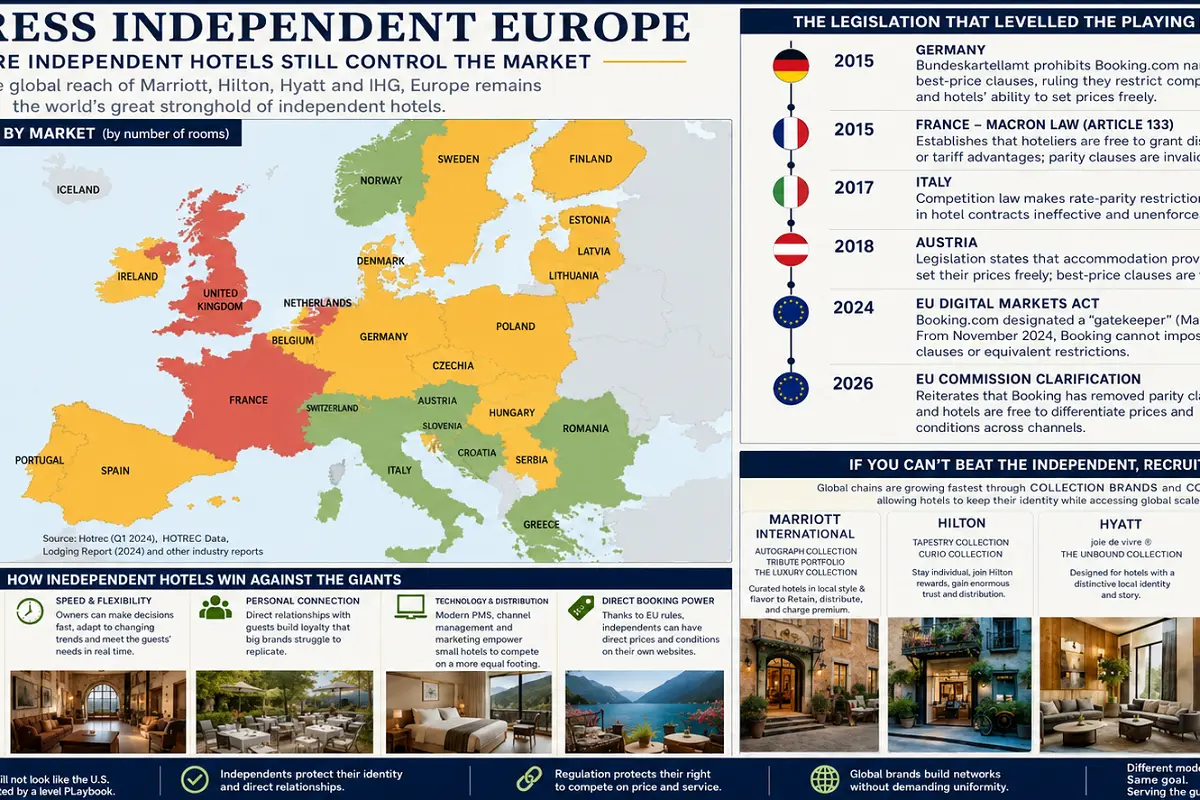
Walk through Florence, Salzburg, Munich or Athens and the difference from an American hotel strip becomes immediately apparent, the names above the doors belong to families, local entrepreneurs, small regional groups, sometimes the same one for generations. There is no glowing Marriott script, no familiar Hilton crest waiting on every corner. This is the enduring reality of Independent Hotels in Europe, a market that has resisted the branding wave sweeping through American hospitality for decades and, remarkably, is still winning.
Sometimes the hotel occupies a converted monastery, a townhouse, a palace, a farmhouse or a railway station whose architecture would make fitting a conventional international brand standard almost impossible. That physical stubbornness, buildings shaped by centuries rather than franchise templates, has become one of the independent sector's quiet advantages against global consolidation.
A Market Structurally Different From America's
In the United States, the interstate highway system, franchising, loyalty programs and national reservation infrastructure combined to produce an extraordinarily branded hotel market. Europe developed along an entirely different path, shaped instead by history, property ownership patterns and distinct urban form.
The European Commission encountered this structural difference directly while reviewing Marriott's acquisition of Starwood. Its 2016 decision recorded that independent operators accounted for approximately 68 percent of hotel rooms across the European Economic Area, including roughly two thirds of both four and five star properties. At the time, the five largest hotel companies combined represented only about 15 percent of EEA rooms, a striking contrast to the branded dominance seen across much of the United States.
Where Independence Runs Deepest
Independence remains particularly entrenched across Mediterranean and Alpine Europe. Italy offers perhaps the clearest example, with Horwath HTL reporting that in 2021 only 5.4 percent of Italian hotels carried chain affiliation, though chains represented 17.2 percent of rooms since branded properties tend to be considerably larger. Academic research using earlier data found Italian chain penetration at just 4.5 percent of hotels, compared with 33 percent in Spain.
Greece, Austria, Switzerland and parts of Germany display variations of the same pattern, thousands of relatively small properties scattered across leisure destinations, historic centers and secondary towns where local ownership remains deeply embedded. A 2025 European hotel technology study found that 89 percent of Austrian hotels in its sample were independent, with a median property size of only 30 rooms, a scale fundamentally incompatible with the repeatable operating templates chains typically rely on.
The Distribution Battle Independents Nearly Lost
Independents suffered a genuine strategic disadvantage during the early internet era. They lacked Marriott's reservation system, Hilton Honors, Hyatt's corporate accounts and IHG's international sales infrastructure entirely. Then online travel agencies arrived, offering a small hotelier in Bavaria, Tuscany or Provence something remarkably close to a global reservation system overnight.
That access proved transformational, but it created another dependency in its place. HOTREC's 2024 European Hotel Distribution Study, based on observations from more than 3,000 hotels, found OTA dependence remained high, particularly among smaller properties. Booking Holdings accounted for approximately 71 percent of the European OTA market in that study, with Expedia trailing at around 15 percent, while direct bookings continued losing share to online distribution.
How Brussels Rewrote the Rules of Best Price
For years, the rate parity clause sat at the center of tension between hotels and booking platforms, restricting a hotel's ability to offer cheaper rooms through its own website even after paying commission on the original OTA reservation. European regulators began challenging that practice one country at a time.
Germany's Bundeskartellamt prohibited Booking.com's narrow best price clauses in 2015, arguing they restricted competition and curtailed hotels' freedom to set prices through their own channels. France went further through Article 133 of the Macron Law that same year, establishing that hoteliers retain freedom to grant customers discounts regardless of contractual provisions to the contrary. Italy followed in 2017, and Austria enacted similar legislation voiding price fixing clauses imposed by booking platforms.
The most consequential development arrived through the European Union's Digital Markets Act, which designated Booking.com a gatekeeper in May 2024. From November of that year, Booking could no longer impose parity clauses preventing accommodation providers from offering better prices through other channels, including their own websites. By February 2026, the Commission confirmed Booking had removed those clauses entirely, freeing hotels to differentiate pricing across channels for the first time in years.
What Independents Can Do That Chains Cannot
The strongest European independents do not attempt to replicate global chains, they exploit precisely what those chains struggle to manufacture. Place becomes the first advantage, since an independent hotel can be intensely local without worrying whether its concept must reproduce across 300 other properties. The restaurant can serve the region rather than the brand, rooms need not be identical, and an owner can redesign the breakfast offering on Monday and introduce it Tuesday without approval from a regional headquarters.
Speed offers a second advantage, since independent owners do not require sign off from brand committees or global procurement teams to alter an experience. Authenticity, a word the hospitality industry has nearly exhausted, still carries genuine commercial weight, as travelers increasingly want hotels that feel as though they could exist only in that particular destination.
The Collection Brand Strategy
The fastest growing weapon deployed by major chains across fragmented European markets is not the traditional hard brand, it is the collection brand. Marriott offers Autograph Collection, Tribute Portfolio and The Luxury Collection, describing them as operating models that provide access to its loyalty programme and global customer base while preserving individual hotel identity.
Conversions have become central to Marriott's European growth strategy, with the company stating in 2024 that it expected to add nearly 100 European properties through conversions and adaptive reuse by the end of 2026, representing more than 40 percent of its expected European development pipeline. Hilton pursues a similar approach through Curio Collection and Tapestry Collection, both of which passed 200 hotels globally in 2026, while Hyatt offers JdV by Hyatt and IHG operates Vignette Collection, each pitched explicitly to owners as a way to retain identity while gaining access to global distribution systems.
A More Complicated Definition of Independence
Consider a century old European hotel whose name still hangs above the entrance, still family owned, still operated by a local management company, with a restaurant and rooms that remain genuinely distinctive. Yet its reservations now feed through Marriott Bonvoy or Hilton Honors. Operationally, it may remain independent. Commercially, considerably less so.
That hybrid model has become the primary battleground for European hotel affiliation, revealing what the major chains actually want. Modern asset light hotel companies profit from franchise, management and system fees rather than direct ownership, meaning they do not necessarily need to own Europe's hotels at all, they simply need to bring hotels and their guests into the network. Full analysis of this shifting landscape is available on the official eTurboNews website.
The Loyalty Advantage Independents Cannot Replicate
An independent hotel can buy technology, hire a revenue manager, distribute through Booking.com and run its own marketing campaigns. What it cannot easily reproduce is a loyalty ecosystem spanning tens of millions of travelers accumulating points across hundreds or thousands of hotels worldwide, the deepest competitive moat Marriott, Hilton, Hyatt and IHG possess.
For travelers choosing between an excellent independent hotel and a similarly priced chain affiliated property, points, status and familiarity can ultimately determine the booking. This same tension between preserving identity and gaining reach echoes across hospitality more broadly, including in how heritage institutions like Ireland's culinary community recently marked their own milestone, as seen in the Euro Toques Ireland 40th anniversary celebration at Ballymaloe House, where tradition and modern relevance were carefully balanced rather than sacrificed.
A War Without a Clear Winner
The future of European hospitality will not likely produce a simple victory for either chains or independents. Chains will continue growing, but their strategy increasingly acknowledges the durability of Europe's independent tradition, creating softer standards and conversion brands specifically designed to absorb hotels that would once have rejected conventional branding entirely. Meanwhile, regulation has handed independent operators renewed control over their own pricing and direct customer relationships.
That creates an unusual equilibrium, one where an independent hotel can use Booking.com for reach without surrendering its direct rate, adopt modern technology without building a global reservation system, or enter a collection brand while attempting to preserve its own identity underneath. The question facing thousands of European owners is no longer simply whether to join a chain, but how much independence they are willing to trade for distribution, and for the hotel down the cobbled street with its own name still hanging proudly above the door, that remains a decision worth making carefully.