India Labour Codes 2026 Reshape Hotel Hiring, Costs, Workforce Models
India’s new labour codes, effective April 2026, are transforming hotel hiring, wage structures, outsourcing practices, and workforce compliance across the hospitality sector.
 nishathapa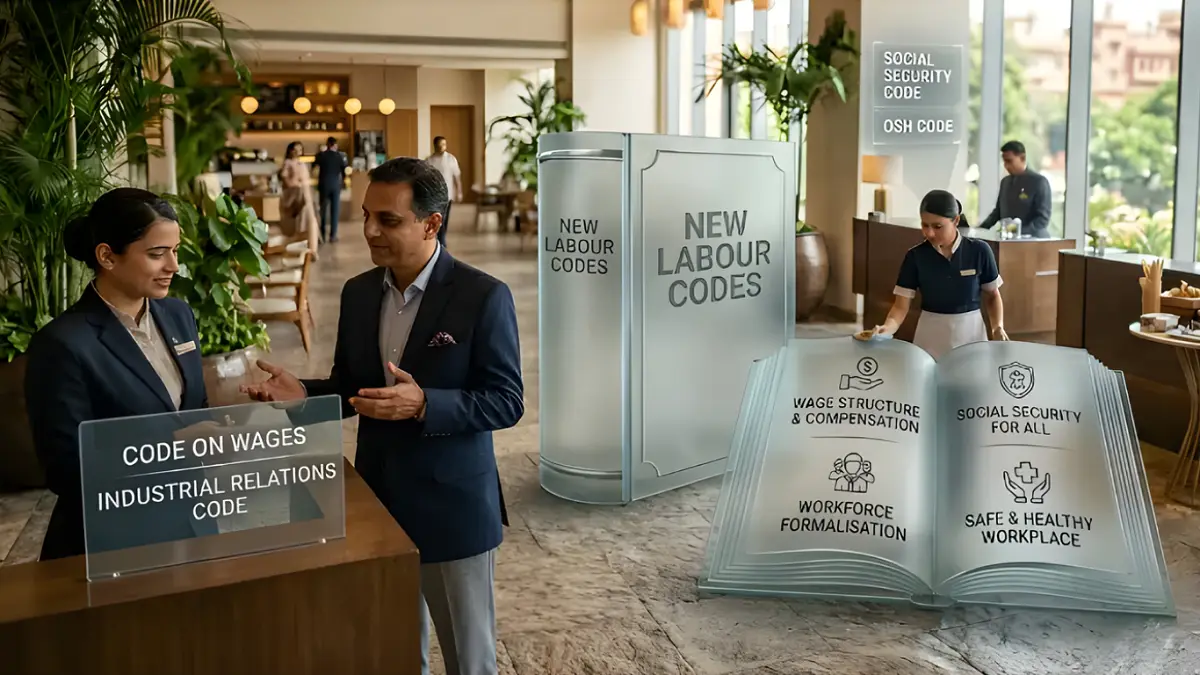
New Delhi, April 2026: India’s hospitality sector is undergoing a structural workforce shift following the implementation of four new labour codes in April 2026, replacing 29 legacy laws. The reform is reshaping hiring practices, wage structures, outsourcing models, and compliance systems across hotels at a time when the industry supports nearly 7.75–8 crore jobs and continues to expand rapidly.
The policy transition coincides with strong growth in travel and tourism, which accounts for approximately 10.75–13 per cent of total employment in India. The hospitality market alone is projected to grow from $24.36 billion in 2025 to $27.96 billion in 2026, with long-term expansion expected to reach $55.67 billion by 2031, reflecting a CAGR of 14.76 per cent from 2026 to 2031.
Wage restructuring increases compliance costs
One of the most immediate impacts of the new framework is the standardisation of wage definitions under the Code on Wages 2019. The reform limits the proportion of allowances in salary structures, increasing the share of basic wages.
For hotel operators, this change directly affects statutory contributions such as provident fund and gratuity, raising overall employment costs even when gross salaries remain unchanged. As manpower remains one of the largest cost components in hospitality, this shift is expected to influence pricing strategies and operating margins.
Industry stakeholders note that while employees benefit from clearer wage structures and improved social security, hotels face higher compliance obligations. The changes also reduce legal ambiguity, offering long-term operational clarity despite short-term financial pressure.
Outsourcing models face structural reassessment
The Industrial Relations Code 2020 introduces restrictions on the use of contract labour in core activities, prompting a reassessment of workforce structures across hotels. Functions such as housekeeping, front office operations, food and beverage services, and kitchen roles may be classified as core activities, potentially limiting outsourcing practices widely used in the sector.
This shift could lead to increased direct employment, bringing more staff onto hotel payrolls and expanding responsibilities related to training, supervision, and compliance. While non-core services such as security and specialised maintenance may continue to be outsourced, the classification of roles remains subject to regulatory interpretation.
The formal recognition of fixed-term employment offers an alternative, allowing hotels to manage seasonality while maintaining parity in wages and benefits. However, the cost advantage traditionally associated with contract staffing is expected to narrow under the new framework.
Expanded social security coverage alters workforce economics
The Code on Social Security 2020 extends statutory benefits to contract and fixed-term employees, significantly impacting flexible hiring practices. Seasonal and short-term workers, commonly employed in hospitality, are now entitled to benefits such as gratuity, provident fund, and insurance coverage under defined conditions.
This expansion of social protection increases compliance requirements and operational costs for hotels, particularly those relying heavily on temporary staffing models. Workforce planning is therefore becoming more strategic, balancing demand-driven hiring with regulatory obligations.
The shift also reflects a broader policy objective of formalising employment across sectors, bringing greater transparency and consistency to workforce management in hospitality.
Operational compliance intensifies under OSH Code
The Occupational Safety, Health and Working Conditions Code 2020 introduces stricter compliance standards for day-to-day hotel operations. Areas such as kitchen safety, handling of cleaning chemicals, contractor welfare, night shift protocols, and incident reporting are now subject to structured regulatory oversight.
While organised hotel chains have historically maintained internal standards, the new code mandates formal documentation, standardised processes, and audit readiness. For smaller and independent properties, this represents a transition towards more system-driven operations.
The move towards unified registration systems, simplified licensing, and consolidated compliance mechanisms is expected to reduce administrative complexity over time, though initial implementation may require system upgrades and process realignment.
Shift from flexibility to formalisation across the sector
The labour reforms mark a broader transition from informal and flexible workforce practices to structured employment models within the hospitality industry. Core roles such as management, guest relations, and specialised services are expected to see increased formal employment, while seasonal roles continue under regulated fixed-term contracts.
Larger hotel chains with established human resource frameworks are better positioned to adapt to the changes, while mid-sized and standalone operators may face challenges in aligning with new compliance requirements related to wages, working conditions, and social security.
The Economic Survey 2025–26 describes the labour codes as a balance between flexibility and worker protection, emphasising formalisation and broader coverage of benefits. For the hotel industry, this translates into increased accountability, improved workforce standards, and a more transparent operating environment.
Despite short-term operational pressures, including higher employment costs and adjustments in workforce planning, the reforms are expected to streamline compliance processes and enhance long-term efficiency. The shift also aligns with evolving expectations around fair employment practices and service quality in a rapidly expanding hospitality market.
As implementation progresses, the extent of impact will depend on regulatory interpretation, particularly around the definition of core activities. For now, the sector is entering a phase where workforce management is increasingly defined by structure, compliance, and standardisation rather than flexibility alone.