Meriton Suites Brisbane Reveals Nine Month Detainee Stay
Meriton Suites Brisbane has housed a high risk immigration detainee for nine months at taxpayer expense after the city's detention centre lacked security.
 RUKAIYA KADIWAL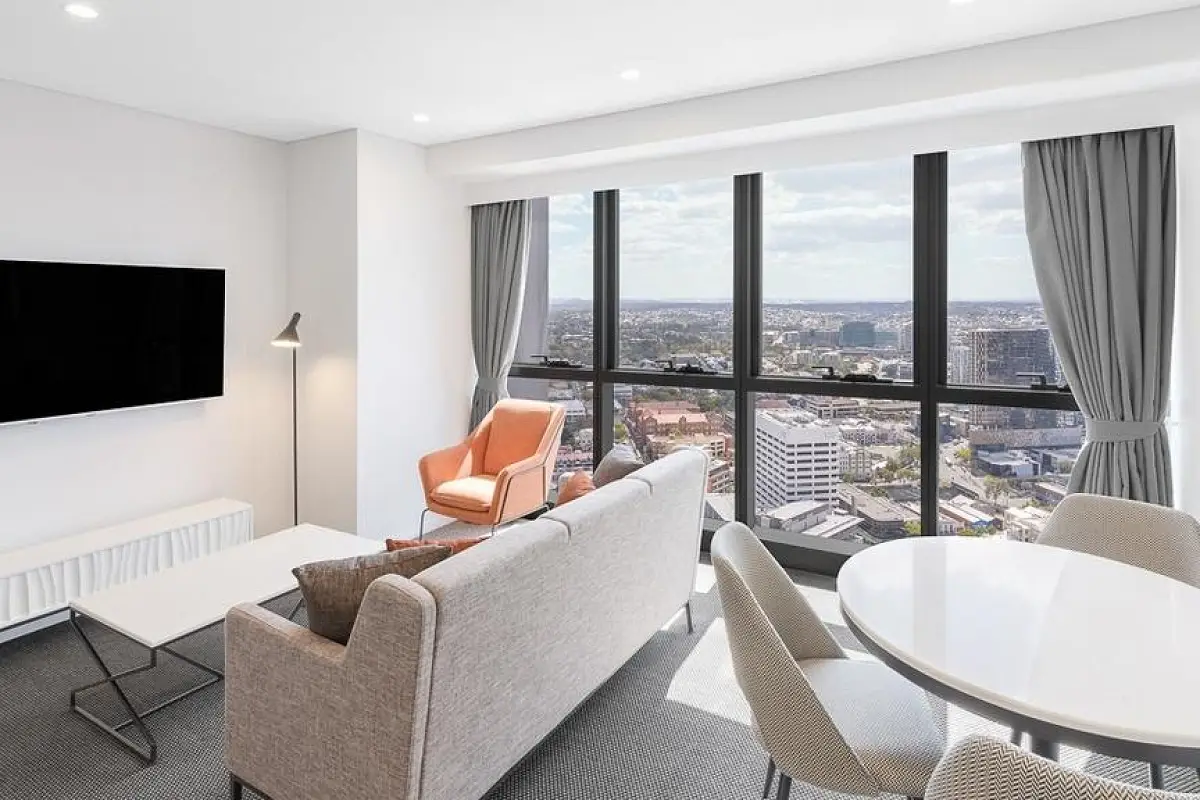
Floor to ceiling windows frame a sweeping view of Brisbane's skyline from a one bedroom suite high above Adelaide Street, soft grey curtains pulled back to let afternoon light spill across a cream sofa and a round dining table set for two. It is the kind of interior more commonly photographed for a weekend getaway brochure than discussed in connection with immigration policy. Yet this particular suite inside Meriton Suites Brisbane has, for nine months, served an entirely different purpose, housing a man facing deportation after being charged with a domestic violence offence, at the Australian taxpayer's expense.
The arrangement, reported by The Australian, stems from a security gap rather than any deliberate choice of comfort. According to the report, the Indian man's continued stay at the high rise hotel resulted directly from insufficient security at Brisbane's immigration detention centre, a facility apparently unable to safely accommodate someone classified as high risk.
A Hotel Suite Standing in for Secure Detention
Meriton Suites' Adelaide Street property offers exactly the kind of accommodation typically associated with business travellers and short term corporate stays, polished interiors, city views and the amenities expected of a modern high rise hotel. That such a space has instead become long term housing for someone the government itself has flagged as high risk represents a striking departure from its intended commercial purpose.
For a hotel operator, housing a government placed detainee under these circumstances raises questions rarely faced by mainstream hospitality businesses, balancing standard guest service protocols against the security and oversight requirements that typically accompany detention arrangements. The situation illustrates how thinly the line between commercial accommodation and government administrative housing can sometimes blur when purpose built infrastructure falls short.
Nine Months and Counting
The duration itself stands out as much as the arrangement. Nine months represents a considerable stretch of continuous hotel accommodation, well beyond what any standard hospitality booking would typically anticipate, and it raises immediate questions about cost accumulation over that period. Extended government funded hotel stays of this length inevitably invite scrutiny, both from a budgetary standpoint and from a broader question of whether existing detention infrastructure remains fit for purpose.
That scrutiny extends beyond this single case. When a nation's immigration detention system cannot adequately house individuals it has itself identified as posing elevated risk, the resulting reliance on commercial hotel accommodation becomes not simply a logistical workaround but a visible signal of capacity strain within the broader system.
What This Reveals About Detention Infrastructure
Brisbane's immigration detention centre, according to the reporting, lacked sufficient security specifically for this individual's classification, a gap that speaks to broader questions about how Australia's detention network is resourced and maintained across its various facilities. Security shortfalls of this kind rarely emerge in isolation, and cases like this one often surface only when an individual's specific risk profile exposes limitations that might otherwise remain unexamined.
For policymakers, situations like this create pressure from multiple directions simultaneously, the immediate need to manage an individual case safely, alongside the longer term question of whether facility upgrades or expanded capacity are required to prevent similar workarounds becoming routine. Full details on the property itself are available on the official Meriton Suites website.
A Broader Pattern in Public Debate
This case arrives amid ongoing scrutiny of Australia's immigration and detention policies more broadly, with related coverage noting government efforts to deport individuals abused within its own care system and continued debate over monitoring regimes for immigration detainees following recent High Court rulings. Together, these threads point to a system under sustained pressure, working through competing legal, security and humanitarian considerations simultaneously.
Within that context, a nine month hotel stay becomes more than an isolated administrative curiosity, it becomes a small but telling data point in a much larger conversation about how well Australia's immigration infrastructure matches the demands placed upon it. Similar questions about how hospitality infrastructure adapts under pressure, whether shaped by policy, market forces or design ambition, echo across the broader industry, including in how new luxury properties like Roswyn in Mumbai are positioning themselves at the opposite end of the hospitality spectrum entirely.
What Happens Behind a Familiar Skyline
Outside the suite's windows, Brisbane continues its ordinary rhythm, traffic moving along Adelaide Street, the city's skyline unchanged by what unfolds nine floors above it. Most guests checking into this hotel on any given evening will have no reason to suspect that one suite has, for the better part of a year, served a purpose entirely unrelated to leisure or business travel.
That quiet incongruity, a well appointed hotel room functioning as an extension of the immigration system, says something larger about how policy gaps can surface in unexpected places, tucked behind curtains and city views rather than confined to courtrooms or detention compounds alone. Whatever resolution this particular case eventually reaches, the underlying question it raises about detention capacity is unlikely to disappear as quickly as a hotel checkout.