Cava Bay Area Restaurants Debut Brings Mediterranean Buzz to San Jose
Cava Bay Area restaurants make their debut at Santana Row in San Jose, bringing the Mediterranean fast casual favorite to Northern California diners.
 RUKAIYA KADIWAL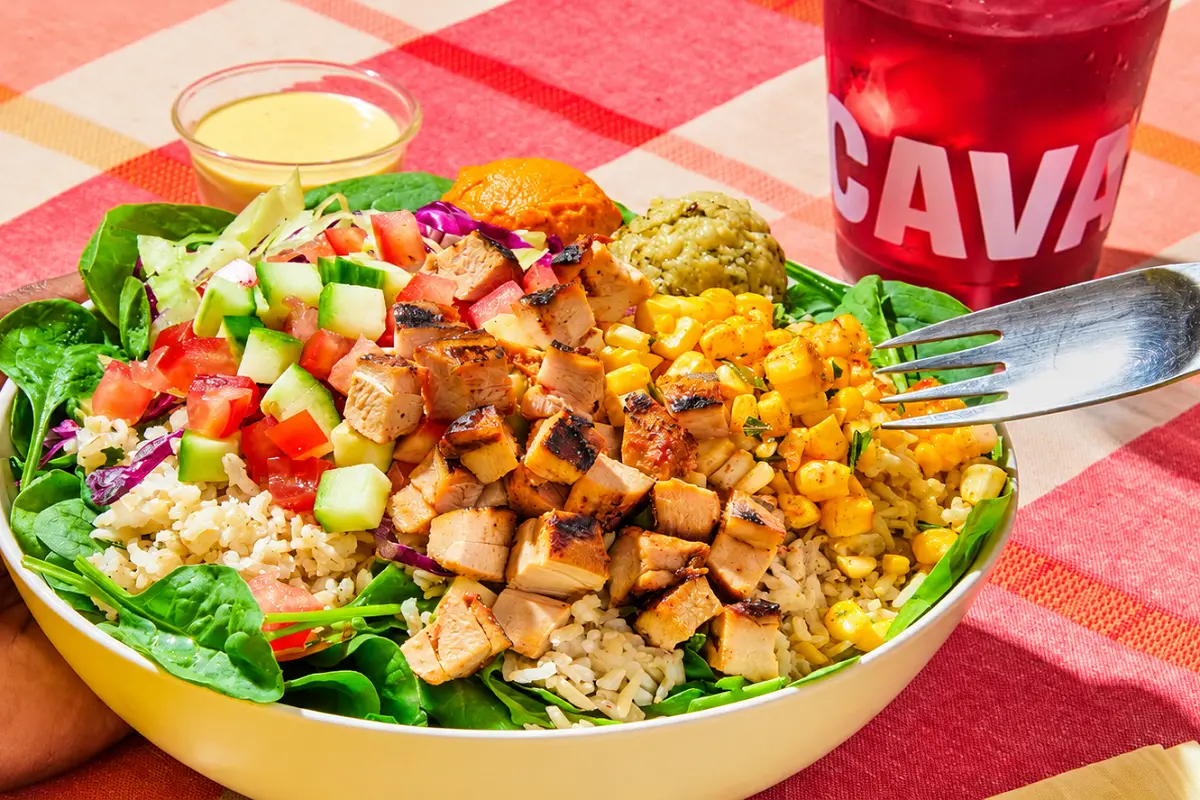
The hand holding the yellow bowl does not hesitate. A fork loaded with grilled chicken, charred corn, and warm rice moves toward a mouth already anticipating the bite, the plaid tablecloth beneath catching a wedge of afternoon light. It is an ordinary lunch moment, repeated thousands of times a day across the country, except that this particular bowl belongs to a brand that has not yet set foot in the Bay Area. That is about to change. Cava Bay Area restaurants are on the way, and the first one is set to open at Santana Row in San Jose.
For a region that prides itself on culinary firsts, the arrival of a national fast casual chain might seem like a modest headline. But for the diners who have watched Cava spread from a single Washington D.C. counter into a household name on the East Coast and beyond, the news carries a different weight. It signals that the wait is finally over. Details on the brand's full menu and locations can be found on the official Cava website.
The Rise of Cava Bay Area Restaurants
Cava began as a small Mediterranean concept built around customizable bowls, grain plates, and pita, the kind of fast, fresh format that has come to define a generation of American lunch counters. Over the past decade, the chain expanded steadily across the East Coast, the South, and the Midwest, gradually building a footprint that made its absence from Northern California increasingly conspicuous.
According to reporting from the San Francisco Business Times, the Washington D.C. based chain is now plotting multiple Bay Area outlets, with Santana Row serving as its opening chapter. The choice of location is telling. Santana Row has spent years cultivating a reputation as one of the South Bay's most walkable, dining forward retail corridors, a place where new concepts are tested against a discerning, well traveled crowd.
The timing also fits a broader pattern. Cava has continued pushing into new geographies this year, including plans for its first Wisconsin location by fall 2026, a sign that the company is treating expansion not as a single campaign but as a rolling, market by market effort. Other regional chains are following a similar playbook, as seen in Sixty Vines' recent San Antonio opening, where a proven concept was brought into a new, high visibility retail destination.
What Diners Can Expect
Anyone who has eaten at a Cava outside California already knows the rhythm. Guests move down an assembly line, choosing a base of greens or grains, then layering on proteins like harissa honey chicken or grilled steak, followed by dips, pickled vegetables, and a rotating selection of house made dressings. The final bowl is colorful, dense with texture, and built for the diner who wants speed without sacrificing flavor.
Locals who have tried Cava while traveling describe the format as familiar in structure, similar to the build your own bowl chains many Bay Area residents already frequent, but distinct in its Mediterranean pantry of tahini, feta, and warm spices. That distinction is part of what has fueled the brand's growth. It occupies a lane between quick service and the sit down Mediterranean restaurants that have long dotted San Francisco and San Jose, offering the speed of the former with the flavor complexity people associate with the latter.
An Industry Watching Closely
The arrival of Cava Bay Area restaurants lands at a moment when fast casual chains are competing intensely for space in dense, high rent markets like San Jose and San Francisco. Real estate along corridors such as Santana Row does not come cheap, and a new entrant must prove almost immediately that it can draw sustained foot traffic in a region already saturated with dining options.
That pressure cuts both ways. Some restaurant industry observers argue that fast casual concepts risk overextending when they expand too quickly into high cost markets before local demand is fully tested. Others see the opposite risk, that hesitating to enter a market like the Bay Area allows competitors to claim the best locations first. Cava's decision to lead with Santana Row, a proven high traffic destination, suggests the company is betting on visibility and foot traffic over a slower, more cautious rollout.
For the South Bay's dining scene, the stakes are also communal. New arrivals like this one tend to reshape expectations, nudging existing operators to sharpen their own offerings while giving diners another reason to treat a shopping corridor as a genuine culinary destination rather than a place to simply pass through.
What the Opening Means Beyond the Menu
There is something quietly significant about a bowl of grilled chicken and rice becoming a talking point among Bay Area food followers, but that is precisely what has happened in the lead up to this opening. Anticipation has built not because the format is unfamiliar, but because it has taken this long for the region to get its turn.
When the doors at Santana Row eventually open, the moment will belong less to Cava's national growth chart and more to the individual diners who step up to the counter for the first time, tray in hand, deciding between harissa and tzatziki. It is a small decision, repeated one bowl at a time, but it is exactly how Cava Bay Area restaurants will quietly become a local habit.