Famous Dubai Restaurants Every First-Timer Must Experience
Famous Dubai restaurants from At.mosphere in the Burj Khalifa to Bu Qtair's legendary seafood define a city where dining is always more than just a meal.
 RUKAIYA KADIWAL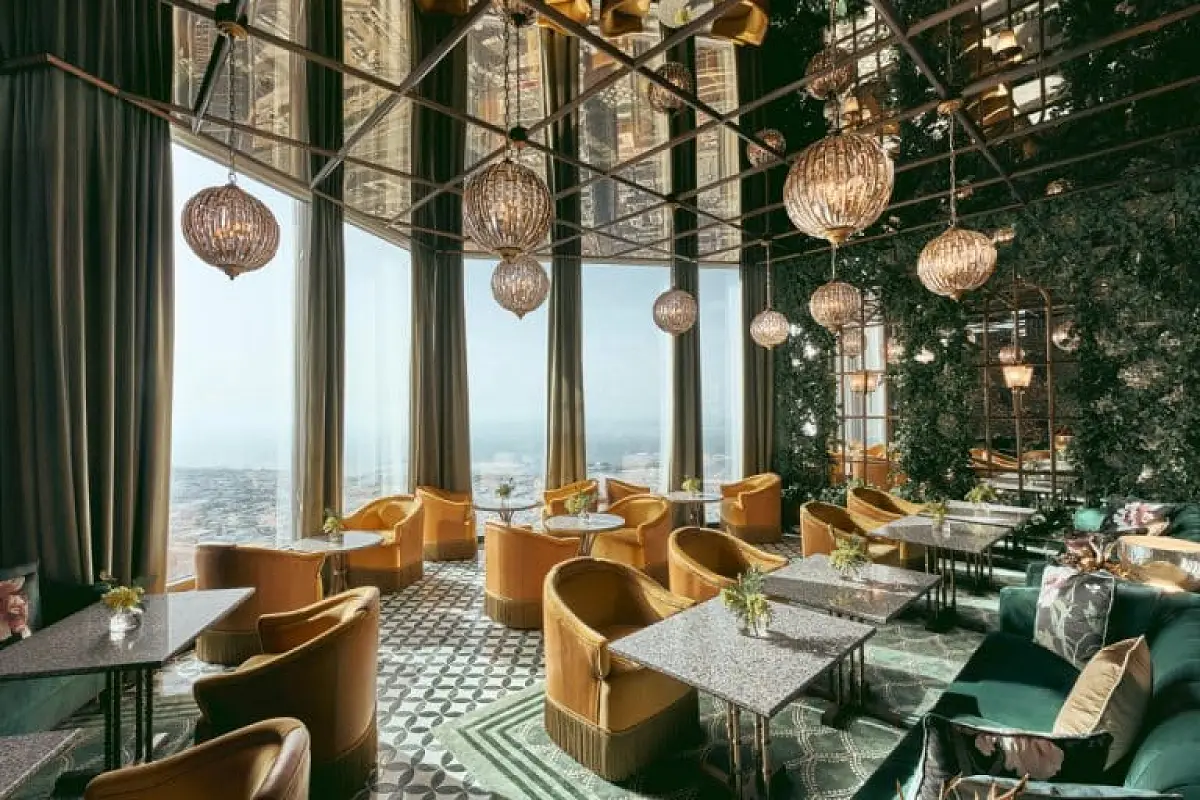
It is three in the morning on Sheikh Zayed Road and the queue outside Zaroob has not shortened since midnight. A taxi driver stands behind a group of people who have come directly from a club, still dressed for it, waiting for the same thing: a shawarma wrapped in foil, perfectly spiced, served under fluorescent light in a city that never quite decides to sleep. This is not a scene that appears in a hotel concierge's curated list of fine dining recommendations. It is, however, one of the most honest expressions of what Dubai's restaurant culture actually is, a city where 122-floor dining rooms and 3am street food share the same civic identity, where the distance between a Michelin-recognised tasting menu and a plastic-tabled biryani is measured not in quality but in occasion.
Famous Dubai Restaurants Define a City Built Around the Act of Eating
The famous Dubai restaurants that have shaped the city's dining identity span a range that few urban food cultures can claim. From the heritage courtyard of Arabian Tea House in the Al Fahidi district, where Emirati breakfasts and tanoor bread have been served since 1997, to the 122nd floor of the Burj Khalifa, where At.mosphere positions a cappuccino above most of the world's commercial aircraft, Dubai has built a restaurant landscape that is simultaneously ancient in its hospitality traditions and entirely contemporary in its ambitions.
Understanding what makes these twelve restaurants necessary rather than merely popular requires understanding what Dubai is asking of its dining rooms. This is a city that receives millions of visitors each year from countries with their own serious food cultures, visitors who arrive with expectations shaped by restaurant scenes in London, Tokyo, New York, and Mumbai. The restaurants that have become genuinely iconic here are the ones that could not exist anywhere else, that are as specifically Dubai as the skyline visible through their windows or the community that has made them a weekly ritual.
The Heritage End of the Spectrum: Arabian Tea House
Arabian Tea House in Al Fahidi has been a peaceful escape since 1997, which in Dubai years makes it a historical institution. The Al Fahidi district that surrounds it is the oldest surviving residential neighbourhood in the city, a collection of wind-tower buildings and narrow lanes that predates the development that transformed Dubai into its present form. Sitting in the courtyard of Arabian Tea House, among white rattan chairs and the sound of Arabic coffee being prepared, is an experience that places a visitor in relationship with the city's roots rather than its ambitions.
The Emirati breakfasts served here, with tanoor bread and Arabic coffee carrying a serious caffeine charge, describe a hospitality tradition built around generosity and welcome in a register quite different from the luxury hospitality that characterises much of Dubai's more recent restaurant development. Both traditions are genuine expressions of the same culture. Arabian Tea House is where the older one is most directly accessible to someone arriving in the city for the first time.
Bu Qtair and the Queue That Tells You Everything
Bu Qtair near Umm Suqeim Fishing Harbour opened in the early 1980s and has operated since on a model that the contemporary restaurant industry would struggle to categorise. There are no reservations. The interior is basic. The queue is long and contains people who drove across the city specifically to join it. The family who runs it has been sourcing fish from the harbour nearby for decades and frying it in a way that has never required improvement.
What the queue at Bu Qtair communicates to anyone willing to stand in it is something about how Dubai's food culture operates beneath its luxury surface. The city that built the world's tallest building and a hotel shaped like a sail also sustains a fish shack whose reputation travels by word of mouth among taxi drivers, residents, and visiting dignitaries with equal democratic authority. Price at Bu Qtair depends on what is caught and how much you order. Satisfaction, by most accounts, is guaranteed regardless.
Orfali Bros and the Tasting Menu That Belongs Here
Chefs Mohamad, Wassim, and Omar Orfali run a thirteen-course tasting menu priced at 850 dirhams per person, and the restaurant that carries their name has become one of the most consistently recognised dining experiences in the city. The menu moves between dishes that have become signatures over time, the ooh la la, the corn bomb, the reworked eggplant bayıldı, and newer preparations including a cream caramel caviar umami custard and a liar swiss chard yalanji that show a kitchen in active development rather than one resting on an established identity.
That combination, the signature dishes that regulars return for and the new preparations that demonstrate the kitchen's continuing evolution, describes a tasting menu restaurant functioning at its intended purpose. Orfali Bros has no alcohol licence, a detail that might seem limiting in a city where licensed dining rooms attract significant spend, but the restaurant has built a following based entirely on what comes from the kitchen rather than what comes from the bar, a fact that speaks to how seriously the food is taken by the guests who make the reservation.
At.mosphere and the View That Cannot Be Replicated
At.mosphere on the 122nd floor of the Burj Khalifa occupies a category of restaurant that exists in very few cities. The building it sits within is the tallest in the world, and the view from its windows encompasses a horizon that extends, on clear days, across the Gulf. Whether the food matches the altitude is a question the restaurant's regulars have answered in its favour often enough that the booking calendar remains consistently full.
Every table at At.mosphere has a camera out, as any honest account of the restaurant will acknowledge, and this is not a criticism. A restaurant at this elevation, in this building, in this city, functions as an event as much as a meal, a specific kind of Dubai experience that has no equivalent elsewhere. The dress code is enforced. Reservations are required well in advance. The cappuccino tastes like a cappuccino. What surrounds it is unlike anything else on earth.
Ravi's and the Democracy of Good Food
Ravi Restaurant in Satwa is the kind of place where the quality of the biryani makes the plastic tables irrelevant. Loud, chaotic in the way that restaurants full of people enjoying themselves are loud and chaotic, and completely indifferent to the luxury positioning that defines so much of Dubai's restaurant conversation, Ravi's has been feeding taxi drivers and celebrities in the same dining room for long enough that its regulars include people who have lived through multiple phases of Dubai's development without changing where they go for chicken tikka and daal fry.
The stack of hot roti that arrives alongside both, eaten under neon light on a Satwa evening, is the kind of meal that reminds Dubai's more aspirational restaurants what hospitality was before it became an industry. Not that the city's ambitious restaurants have forgotten. But Ravi's is the reminder.
Zuma, CARBONE, and the Imported Iconic
Not all of Dubai's famous restaurants are born here. Zuma arrived in DIFC and became one of the pioneering restaurants of that district's now-thriving dining scene, establishing a version of Japanese robata cuisine that draws full rooms daily across lunch, business dining, and dinner service. Its black cod, buttery and sweet and consistently prepared, is among the most recognised dishes on the city's wider menu. The fact that Zuma exists in multiple cities does not diminish what it does in Dubai, where the DIFC setting and the consistent quality of execution have made it more than a branch of a global brand.
CARBONE at Atlantis The Royal carries a different provenance, arriving from a New York original that opened over a decade ago and built a reputation for classic Italian-American cooking served by tuxedo-clad waiters in a dining room designed to evoke 1950s Manhattan. The veal parmesan and the linguine vongole that made the original famous in New York have arrived in Dubai with the same flair and the same deliberate theatricality. Some restaurants travel because their concept is portable. CARBONE travels because its concept is specific, and specificity translates.
Salt, Bubbalicious, and the Two Extremes of the Brunch Economy
Dubai's brunch culture is a genuine civic institution and not a phrase to deploy lightly. Bubbalicious at the Westin Dubai Mina Seyahi covers three restaurants and a large outdoor terrace and offers freshly shucked oysters, roast dinners, stir-fries, fragrant curries, live music, entertainment for children, and a cheese station that requires no further justification. It is one of the largest and most frequently cited brunch experiences in the city, a category in which the scale of offering is itself part of what is being sold.
Salt, by contrast, started as a burger truck on Kite Beach and grew into a retro-cool fixture with sliders, loaded fries, lotus-flavoured soft-serve, and an ocean view that costs nothing extra. Both exist within the same Dubai dining culture. Both are full on any given weekend. The city makes room for both without apparent contradiction.
Time Out Market and the Edited City
Time Out Market at Souk Al Bahar gathers seventeen of Dubai's best homegrown chefs under one roof at the end of a building that faces the Burj Khalifa and the Dubai Fountain. It is a food hall with an editorial principle behind it, curated rather than accumulated, which gives it a different character from a simple collection of food stalls. For a first-time visitor trying to navigate a city with hundreds of serious restaurants, it offers a compressed version of the best of what the city's independent restaurant culture has produced, alongside front-row seats to the Fountain show when it reopens in October.
URLA and the View That Earns Its Menu
URLA at Address Downtown Dubai offers an Aegean menu alongside one of the better Burj Khalifa views available from a restaurant terrace in the city. The combination of a specific culinary identity, rooted in the flavours and techniques of the Aegean coast, and a setting that places the world's tallest building at the centre of the dining room's view is one that Dubai manages to make feel natural rather than incongruous. This is what the city's restaurant geography produces when it is working well: a meal with a specific taste and a view with no equivalent anywhere else on earth.
A City That Eats at Every Hour and in Every Register
The twelve restaurants that define what a first-timer should eat in Dubai describe a city that has not chosen between its heritage and its ambitions, between the plastic table and the white-clothed dining room, between the 3am shawarma and the 122-floor cappuccino. It has made room for all of them, sustained them, and allowed each to become genuinely necessary to the people who return to them. That capacity, to contain Bu Qtair and At.mosphere within the same dining culture without one diminishing the other, is what makes Dubai's restaurant landscape something more than the sum of its most photographed tables. The city eats seriously, at every hour, in every register, and the restaurants that have earned their place in it understand that the people they are feeding are always, in some way, already home.
Related reading: The Athens restaurants named in TripAdvisor's 2026 Best of the Best