Tony Fernandes Rejects $3 Billion AirAsia Funding Reports
Tony Fernandes rejected reports that AirAsia needs US$3 billion, reiterating a fundraising target of up to US$1 billion as the airline focuses on ASEAN and Asia.
 Jishan Khan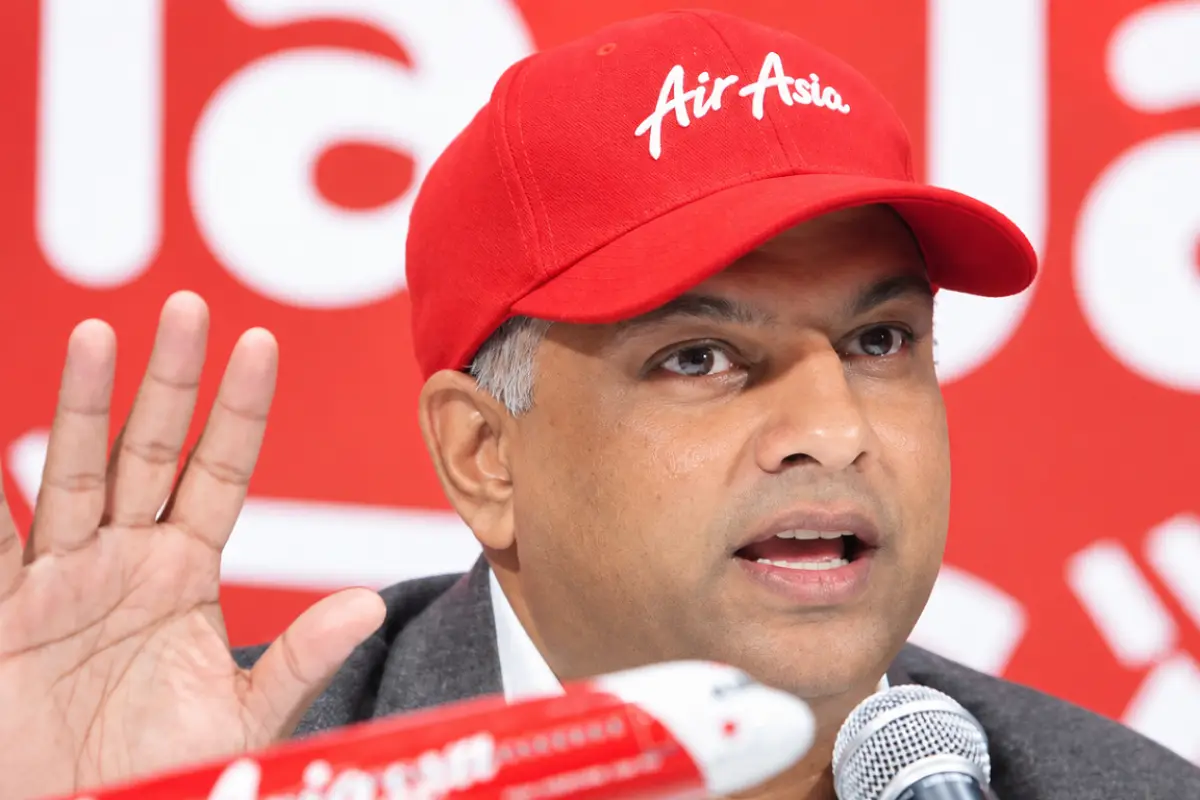
"Where Did This US$3 Billion Come From?", Tony Fernandes Just Spent a Press Conference Trying to Talk Down a Number Nobody at AirAsia Actually Confirmed
AirAsia Group co-founder and adviser Tony Fernandes held a media briefing from Bangkok on September 18, 2026, to directly rebut reports that the airline needed at least $3 billion in fresh capital, the same week AirAsia shares fell 21% to near four-year lows, and the same week this feed covered Malaysia's government quietly discussing contingency plans with Malaysia Airlines and Batik Air over absorbing AirAsia's domestic routes should its finances worsen further. Fernandes' own figure remains unchanged from what AirAsia has stated consistently for weeks: a fundraising target of up to $1 billion, targeted for completion by December 2026 or January 2027, aimed almost entirely at refinancing existing debt rather than funding daily operations. "We have been consistent with US$1 billion, which is mostly to refinance expensive loans and clear some of the creditors. That is it," he said. "Where did this US$3 billion come from?"
That gap between the number AirAsia insists is accurate and the number that just knocked a fifth off its share price in a single day is the actual story here, not the fundraising target itself.
A Signed Term Sheet That AirAsia Is Deliberately Not Signing
The most operationally interesting detail in Fernandes briefing is not that AirAsia has secured Middle Eastern financing interest, it is that AirAsia has a fully signed, funding-date-confirmed term sheet for $1 billion sitting on the table, with most due diligence already complete, and is choosing not to accept it yet. "I'm holding off because I want to try and get the best deal," Fernandes said. "The level of interest is very strong." That is a genuinely unusual position for a company whose own share price has just cratered on solvency concerns to be in: turning down a guaranteed, largely-finalised billion-dollar commitment because it believes better terms are available elsewhere, from a combination of US and European banks and bond investors also reportedly circling the deal.
Whether that confidence is well-placed or simply necessary public messaging to prevent panic is impossible to verify from outside the negotiation, but it does clarify something important about how AirAsia frames its own financial position. A company genuinely on the edge of collapse does not typically reject an already-signed billion-dollar term sheet in the hope of a better one. Either AirAsia's liquidity position is genuinely stronger than the share price crash suggests, or Fernandes is running a considerable amount of reputational risk by publicly declining guaranteed capital while simultaneously trying to convince the market nothing is seriously wrong.
Why the Malaysian Government's Own Contingency Talk Is the Real Trigger Behind This Press Conference
Fernandes briefing arrived directly in response to Reuters reporting, the same reporting this feed covered in detail that Malaysia's government had opened contingency discussions with Malaysia Airlines and Batik Air about absorbing AirAsia's domestic routes if the carrier's position deteriorated. Fernandes did not simply dismiss that story; he offered a specific structural argument for why any such contingency plan would be extraordinarily difficult to execute at the scale being discussed. According to one outlet's reporting on the briefing, replacing AirAsia's domestic footprint would require competitors to deploy roughly 100 aircraft immediately across Malaysian hubs, capacity that neither Malaysia Airlines nor Batik Air currently possesses without starving their own existing regional routes to free it up.
That argument reinforces exactly the structural point this feed's own earlier reporting identified as the central bottleneck in any takeover scenario: Malaysia Airlines and Batik Air had reportedly conditioned any involvement on being able to assume AirAsia's existing aircraft leases, because neither carrier has the standalone fleet capacity to simply absorb AirAsia's roughly 60% domestic market share overnight. Fernandes is not disputing that logic, he is using it as evidence that the entire contingency scenario is closer to theoretical stress-testing than a credible near-term outcome, given how few practical mechanisms actually exist to execute it quickly even if Malaysia's government wanted to.
Why AirAsia Just Walked Away From Bahrain and a Manila-to-West-Coast Route in the Same Breath
The most concrete strategic commitment to emerge from this briefing is not about financing at all, it is Fernandes explicitly confirming AirAsia has no immediate plans to build a hub in Bahrain, nor to operate flights from Manila to the US West Coast, stating plainly: "Currently, we are focused on ASEAN and Asia. That is our strategy. This is also where we are most profitable, especially given the current oil prices." That is a genuinely significant retreat from the kind of ambitious geographic diversification this feed has tracked across nearly every fast-growing Asian and Gulf carrier throughout 2026, Riyadh Air's global widebody build-out, flynas's Syria joint venture, Sun PhuQuoc's leap toward Europe and Central Asia, Vietravel's 50-jet order aimed at markets well beyond Vietnam.
AirAsia is explicitly choosing the opposite path: abandoning distant-market ambitions in favour of doubling down on the region where it already holds genuine structural advantages, its own disclosed 59% share of Malaysian domestic aviation in the first eight months of 2026, alongside its established, decades-deep presence across Thailand, Indonesia, the Philippines and Cambodia. In an environment where elevated fuel costs are punishing every airline's margins simultaneously, contracting the network toward its most profitable, most defensible core markets rather than chasing new, unproven long-haul corridors is a materially more conservative strategy than nearly every other carrier this feed has covered making the equivalent capital-allocation decision this year.
Why "We Never Took a Government Bailout" Is Fernandes' Central Defence, Repeated Almost Verbatim Across Every Outlet
Across nearly every version of this briefing's coverage, Fernandes returns to the same specific claim: unlike many global competitors that received state financial support during crises, AirAsia operated through COVID-19, which he calls the toughest crisis in civil aviation history, spanning four full years, without government bailouts or subsidies, relying instead on internal restructuring and shareholder support. That framing does real rhetorical work in the current moment specifically because it distinguishes AirAsia's current predicament from the government-contingency-planning narrative dominating recent coverage: Fernandes is explicitly arguing that a carrier which survived a genuinely existential four-year crisis without state assistance should not now be treated as fragile enough to require Malaysia's government quietly planning its market exit over a comparatively shorter, fuel-price-driven disruption.
Whether that historical resilience argument actually addresses the present balance sheet concern — RM18.4 billion in disclosed liabilities, a Q2 2026 net loss of RM830.5 million, and shares now trading near four-year lows — is a separate question from whether it is rhetorically effective. It is effective messaging regardless of whether it is a complete answer, precisely because it reframes the current crisis against AirAsia's own most extreme historical comparison point, making today's fuel-cost pressure look comparatively manageable by contrast.
Why the Operational Numbers Fernandes Cited Matter More Than the Financing Headlines
Beneath the financing drama, Fernandes offered specific operational metrics that this feed's own earlier coverage of AirAsia's Q2 crisis had flagged as the genuine test of whether the airline's underlying commercial performance justified confidence in its recovery: a Q3 load factor of 80%, on-time performance improving to roughly 86-88%, and a full-year 2026 passenger target of nearly 70 million, alongside confirmation that AI-driven fuel-efficiency tools are already reducing consumption, with broader applications planned across the airline. Those figures suggest AirAsia's actual flying operation, as distinct from its balance sheet, continues functioning at a scale and reliability level consistent with a carrier managing a serious but survivable cost shock, rather than one experiencing operational collapse.
That distinction between operational health and balance sheet stress is precisely the same gap this feed identified when covering AirAsia's Q2 results directly: the group generated positive EBITDA even amid the fuel shock, and had already recovered roughly 70% of the increased fuel cost through fare adjustments and capacity discipline by that point. Fernandes' September briefing extends that same narrative, the flying business works, the debt structure inherited partly from COVID-era borrowing is the actual problem being solved, and refinancing that debt at lower cost, not covering operating losses, is what the $1 billion raise is designed to achieve.
What a 21% Single-Day Share Price Drop Actually Tells You That the Press Conference Cannot
Whatever the merits of Fernandes' rebuttal, a 21% single-session share price collapse is not something investor relations messaging alone typically reverses. Markets price in genuine uncertainty about outcomes they cannot verify independently, and the gap between AirAsia's own consistent $1 billion figure and the $3 billion reportedly cited in outside reporting, a gap Fernandes has now publicly disputed multiple times without fully explaining where the higher number originated, leaves genuine ambiguity about whether outside analysts are seeing something in AirAsia's financial position that the company's own public statements are not fully addressing, or whether the $3 billion figure was simply an inaccurate estimate that gained momentum faster than AirAsia could correct it.
The December-to-January financing completion window Fernandes has now committed to publicly gives the market a concrete, near-term date against which to judge whose numbers were accurate. If AirAsia closes a genuinely improved $1 billion refinancing deal on schedule, with clearer terms than the currently-shelved Middle Eastern term sheet, Fernandes' insistence that this was a manageable, well-understood refinancing exercise rather than a solvency crisis will look vindicated. If the financing slips, gets scaled back, or ultimately requires government involvement despite his explicit denial that any bailout is being sought, the contingency planning Malaysia's government has already begun quietly running with Malaysia Airlines and Batik Air will look considerably more prescient than Fernandes' Bangkok press conference wanted it to appear.