Emirates Returns in Style to Roland-Garros 2026
Emirates returns to Roland-Garros 2026 with premium lounges, a custom Grand Slam A380 livery, and interactive fan experiences.
 Jishan Khan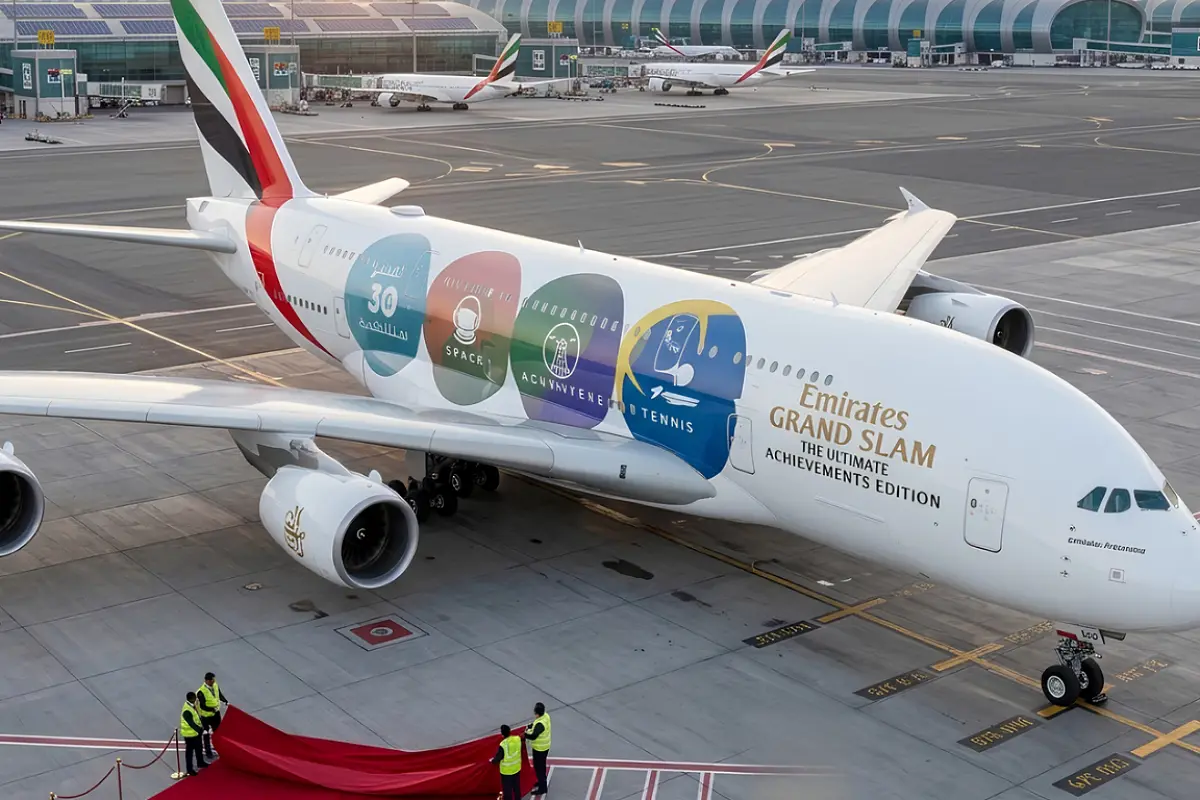
Emirates Is Back at Roland-Garros, And the Way It Shows Up at Sports Events Is a Masterclass in What Airline Sponsorship Should Actually Look Like
Exclusive hospitality suites. A custom A380 livery celebrating all four Grand Slams. An interactive game in the official tournament app. Emirates does not just put its logo on sports events. It builds experiences that make people want to fly.
Most airline sponsorships follow a predictable and largely forgettable formula. The brand appears on a pitch-side board, gets mentioned in the broadcast graphics package, and disappears from memory the moment the final whistle blows. The airline paid for exposure. It received exposure. Nothing deeper happened.
Emirates has been doing something fundamentally different with its sports sponsorship portfolio for years, and Roland-Garros 2026 is one of the clearest examples of what that difference actually looks like in practice.
The Dubai carrier is back at the French Open as a major sponsor, operating two exclusive hospitality spaces at Roland-Garros, the Emirates Lounge in the Hospitality Village and the Salon Philippe-Chatrier. Both offer what the airline describes as exceptional views of the action alongside its signature hospitality product. Some of the greatest athletes of all time are being welcomed into the Emirates Lounge across the two-week tournament. The airline's custom A380, painted in a bespoke livery celebrating all four Grand Slams, is appearing across digital screens whenever fans open the official Roland-Garros app.
And then there is the interactive game embedded in that same app, where users can virtually fly an Emirates aircraft over iconic Australian landmarks, the Sydney Opera House, Uluru, Stadium Australia, the outback, competing for bonus rings and the chance to win two tickets to Roland-Garros 2027.
That last detail is where the strategy becomes visible most clearly.
Why the App Game Is More Strategic Than It Looks
A virtual flying game in a tennis tournament app sounds like a minor activation, a digital gimmick sitting alongside the scores and draw updates that fans actually came to the app to find.
Look at it more carefully and it is doing several things simultaneously that straightforward advertising cannot replicate.
It puts an Emirates aircraft in the hands of a Roland-Garros fan and asks them to fly it, not over Paris, not over Dubai, but over Australia. Sydney Opera House. Uluru. Stadium Australia. The outback. The geographical choice is deliberate. Emirates flies to Australia. The game is a product demonstration disguised as entertainment, placing the user in the role of Emirates pilot while encoding specific destination associations that feed directly into future travel consideration.
The prize, two tickets to Roland-Garros 2027, creates a completion incentive that extends engagement beyond a single session and builds the kind of repeated brand interaction that passive logo exposure never achieves. A fan who plays the Emirates flying game three times across the tournament fortnight has spent considerably more time actively engaged with the Emirates brand than the same fan would spend looking at a pitch-side board across the entire two weeks.
And the data that comes from that engagement, which users played, how often, from which markets, with what completion rates, is the kind of audience insight that traditional sports sponsorship never generated.
The A380 Grand Slam Livery Is Sponsorship Turned Into Product
The custom Emirates A380 bearing a livery that celebrates all four Grand Slams, Roland-Garros, Wimbledon, the US Open, and the Australian Open, is one of those sponsorship activations that crosses the line from marketing into something more interesting.
An aircraft with that livery is not just an advertisement for the sponsorship. It is a physical product that flies routes around the world, carrying passengers, appearing in departure gates, photographed on runways, spotted by aviation enthusiasts, and shared across social media by passengers who board it and look up at the tail. It is a piece of Emirates brand infrastructure that generates organic visibility every day it is in service, not just during the two weeks of Roland-Garros.
Emirates has done this repeatedly across its sponsorship portfolio. Aircraft with Arsenal liveries. Rugby World Cup designs. Grand Slam celebrations. Each one extends the commercial value of the underlying sponsorship deal beyond the event itself and into the daily operation of the airline in ways that no other form of sports marketing achieves.
It also communicates something specific about Emirates' relationship with tennis that a logo deal cannot. You do not put all four Grand Slams on your aircraft if you are a peripheral sponsor hedging your marketing bets. You do it when tennis is genuinely central to how you present your brand to the world, when you want every person who sees that aircraft at any airport anywhere to understand immediately that Emirates and tennis are connected at the deepest level of brand identity.
The Hospitality Strategy and Why Athletes Matter
The detail that some of the greatest athletes of all time are being welcomed into the Emirates Lounge at Roland-Garros is not incidental to the sponsorship strategy. It is central to it.
Sports hospitality at major events is often misunderstood as pure relationship management, a way of thanking existing clients and rewarding loyalty. For Emirates, the lounge at Roland-Garros serves an additional function. It is a brand environment where the association between Emirates and sporting excellence is made tangible and personal for the people who attend.
When a world-class athlete experiences Emirates hospitality at Roland-Garros, they carry that experience back to every subsequent conversation they have about travel, about airlines, and about the tournament itself. Athletes are among the most frequent and most visible travellers in the world. Their authentic brand associations, the airlines they genuinely prefer, the hospitality they remember, carry a weight in their networks and platforms that paid endorsements cannot replicate.
Emirates building genuine relationships with sporting greatness through the quality of its hospitality at events like Roland-Garros is a long game. It is also a game the airline has been playing consistently enough and well enough that the results show up in its brand positioning across every market where sports culture and premium travel intersect.
A Sponsorship Portfolio That Covers Virtually Every Sport That Matters
Emirates sponsorship footprint, tennis, rugby, football, basketball, cycling, golf, horse racing, cricket, sailing, and Australian Rules Football, is not the result of opportunistic deal-making. It is a systematic effort to be present at the events and in the sporting cultures that matter most to the high-value international travellers the airline competes for.
The overlap between people who follow these sports passionately and people who travel internationally in premium cabins is not coincidental. Emirates built its sponsorship portfolio around an insight about its target customer that most airlines have not acted on with the same consistency or commitment.
Roland-Garros sits at the intersection of world-class sport, French cultural prestige, and the kind of international premium audience that makes the two-week tournament one of the most commercially valuable sports properties in Europe. Emirates showing up there with exclusive hospitality spaces, custom aircraft liveries, athlete relationships, and digital activations is the airline doing what it does at every major property in its portfolio, making the association between Emirates and excellence feel earned rather than purchased.
The Fly Better tagline running through the Roland-Garros activation is not just advertising copy. At an event like this, with this level of execution, it is a description of what Emirates is actually trying to deliver, and largely succeeding at, every time it shows up.