Emirates Launches $5.1B MRO Hub Construction in Dubai South
Emirates has broken ground on a $5.1 billion engineering and maintenance complex in Dubai South, designed to handle up to 28 wide-body aircraft by 2030.
 Jishan Khan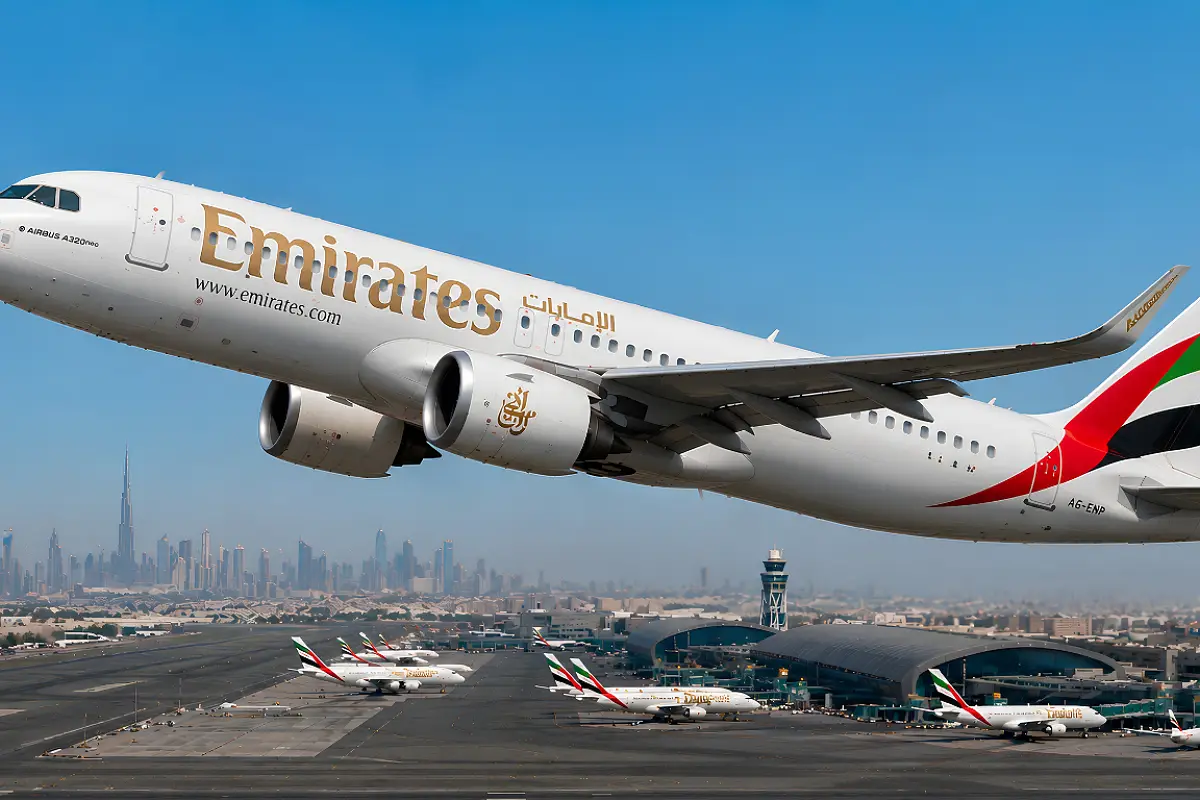
Emirates Is Building a $5.1 Billion Maintenance City in Dubai, And It Is One of the Most Ambitious Aviation Infrastructure Bets Ever Made
1.1 million square metres. 28 widebody aircraft at once. A completion date of 2030. This is not a maintenance facility. It is Emirates declaring that it intends to be self-sufficient at a scale nobody else in aviation is attempting.
When most airlines think about aircraft maintenance, they think about managing costs, finding reliable MRO partners, and negotiating competitive rates with third-party providers. Emirates has apparently decided to think about it differently.
The Dubai carrier has broken ground on a $5.1 billion engineering and maintenance complex in Dubai South that will span 1.1 million square metres, roughly the size of 150 football pitches, and handle up to 28 wide-body aircraft simultaneously when it reaches full operational capacity around 2030. It will include advanced hangars, paint facilities, landing gear workshops, and dedicated logistics zones, essentially creating a self-contained aviation engineering city within one of the world's busiest aviation ecosystems.
To put the scale in perspective, most airlines consider a single large maintenance hangar a significant infrastructure investment. Emirates is building what amounts to an entire MRO district from scratch.
Why Emirates Is Making This Bet Now
The timing of this investment is not accidental. It reflects a specific strategic calculation about where Emirates sees its fleet, its costs, and its competitive position over the next fifteen to twenty years.
Emirates operates one of the largest widebody fleets in the world, predominantly A380s and Boeing 777s, with a significant A350 order and 777X deliveries coming. Maintaining that fleet through third-party MRO providers at the scale Emirates operates is expensive, logistically complex, and increasingly difficult to schedule efficiently as the fleet grows and aircraft become more sophisticated.
Every hour a widebody aircraft spends waiting for a maintenance slot at an external facility is an hour that aircraft is not generating revenue. At Emirates' scale, those hours accumulate into a number that justifies enormous capital investment to control internally.
In simple terms, Emirates is spending $5.1 billion now to stop spending a much larger number on third-party maintenance over the next two decades while simultaneously gaining complete control over the scheduling, quality, and turnaround speed of its own fleet maintenance.
The 28 Widebody Simultaneous Capacity Number Is Staggering
The operational specification that deserves the most attention in this announcement is the ability to handle 28 wide-body aircraft at the same time.
Wide-body aircraft are the largest, most complex, and most expensive jets to maintain. The hangar infrastructure required to accommodate them, the specialised tooling needed, the engineering workforce required, and the logistical coordination involved in running multiple simultaneous heavy maintenance checks are all orders of magnitude more demanding than narrowbody operations.
Most major MRO facilities globally can handle a fraction of that simultaneous capacity. Emirates is building a single complex that will rival or exceed the total widebody maintenance capacity of entire national MRO industries.
That capacity does not just serve Emirates' own fleet needs. It positions Dubai South as a third-party MRO destination for other carriers across the Middle East, Africa, and South Asia who need widebody maintenance capability and proximity to one of the world's most connected aviation hubs. Emirates is building infrastructure for its own operation and simultaneously creating a commercial MRO business that can generate revenue from the region's broader aviation growth.
What This Means for Dubai South and the UAE's Aviation Strategy
Emirates' $5.1 billion commitment to Dubai South is the single largest validation yet of the emirate's long-term aviation infrastructure strategy. Dubai South was conceived as an integrated aviation city, a zone where airlines, logistics companies, aerospace manufacturers, and aviation service providers could cluster around Al Maktoum International Airport and create an ecosystem rather than just a collection of individual facilities.
An Emirates MRO complex of this scale anchors that ecosystem in a way that no other single investment could. It guarantees decades of high-skill employment, technology transfer, and supply chain development in the zone while sending an unmistakable signal to every other aviation company evaluating whether Dubai South is the right location for their own expansion.
The complex also directly supports the UAE's broader ambition to reduce dependence on foreign MRO providers and develop genuine aerospace engineering capability domestically — a strategic priority that sits inside the same framework as Emirates' fleet investment, Etihad's expansion, and the development of Al Maktoum as a complement and eventual successor to Dubai International.
The Workforce Behind the Facility
A complex capable of handling 28 widebody aircraft simultaneously does not run itself. The engineering workforce required to staff this facility at full capacity represents one of the most significant aviation talent investments in the Middle East's history.
Emirates will need licensed aircraft engineers, avionics technicians, composite structure specialists, paint facility operators, landing gear overhaul experts, and hundreds of supporting technical roles, many of which require years of training and certification before a technician can work independently on a commercial widebody aircraft.
Building that workforce pipeline between now and 2030 is arguably as complex a challenge as constructing the physical facility. It requires partnerships with aviation training institutions, structured apprenticeship programs, international recruitment, and the development of type-specific training capabilities for the aircraft Emirates operates.
The investment in the facility and the investment in the people to run it are inseparable. And the UAE's ability to develop genuine aerospace engineering depth, rather than importing finished capability indefinitely, depends on both happening at the same time.
What It Means for the Global MRO Industry
Emirates entering the third-party MRO market at this scale is not neutral news for the existing players in the global aircraft maintenance industry.
Established MRO providers across Europe, Asia, and the Americas have built their businesses partly on the assumption that Gulf carriers, despite their scale, would remain customers for heavy maintenance rather than direct competitors. Emirates' Dubai South complex changes that assumption significantly.
A facility with Emirates' technical standards, Dubai's geographic centrality, and the cost structure advantages that come from UAE operational economics will be a serious competitor for third-party maintenance contracts across a region where aircraft fleets are growing faster than almost anywhere else in the world.
The carriers in South Asia, East Africa, and the broader Middle East that currently route their widebody maintenance to facilities in Europe or Southeast Asia will have a compelling alternative on their doorstep by 2030, one backed by Emirates' engineering reputation and the operational credibility that comes from maintaining one of the world's most demanding widebody fleets.
The 2030 Completion Date and What Comes Between Now and Then
The gap between groundbreaking and completion gives Emirates time to phase the development, sequence the workforce buildup, and align facility readiness with fleet delivery schedules for incoming A350s and 777X aircraft.
It also gives the global MRO industry five years to watch what Emirates is building and recalibrate their own strategies accordingly. Some will seek partnerships. Some will accelerate their own capability investments to maintain competitive differentiation. Some will focus on narrowbody or regional aircraft maintenance where Emirates' widebody-focused complex leaves market space untouched.
What none of them can do is ignore it. A $5.1 billion MRO complex with 28-widebody simultaneous capacity, operated by one of the world's most technically demanding airlines, in one of aviation's most strategically located cities, changes the competitive landscape of global aircraft maintenance in ways that will still be unfolding long after the facility opens.
Emirates did not just break ground on a maintenance hangar. It broke ground on a new chapter in what aviation self-sufficiency looks like at scale.