Qatar Airways Builds City-Specific Chef Roster for Key Routes
Qatar Airways is building a city-specific chef roster, pairing local culinary talent with key routes from London, Los Angeles, Hong Kong, Tokyo and more.
 Jishan Khan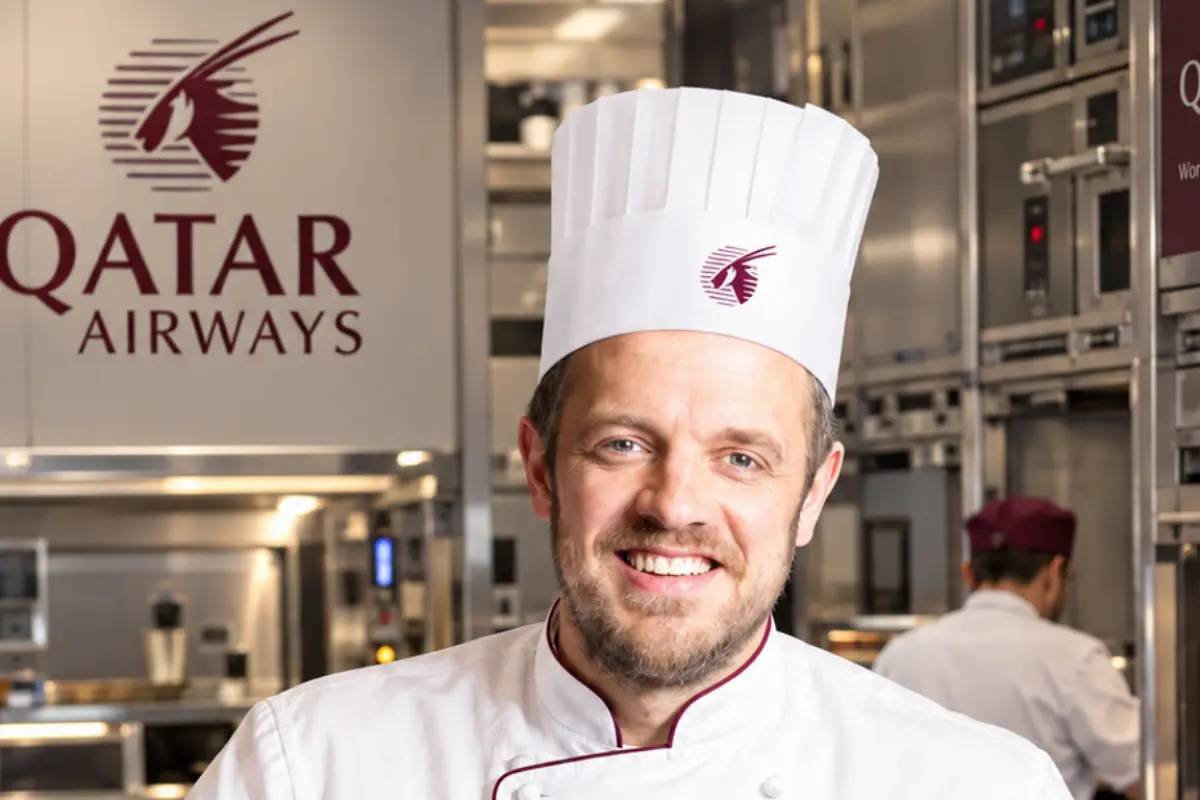
Qatar Airways Didn't Hire One Chef, It's Quietly Building a Global Culinary Roster Matched City by City to Its Own Route Network
Qatar Airways unveiled a new James Knappett-designed menu on its London Heathrow-Doha route this week, featuring four First Class dishes and four Business Class dishes built around Knappett's modern British, seasonality-driven style, smoked blue shell lobster with roasted cauliflower and caramelised mango, Cornish crab salad with warm apple soup, hand-dived scallops with candied lemon. But Knappett is not a standalone hire. He is the latest name in a genuinely extensive "Flavours to Fly For" roster that already includes Ross Lusted for Australia-Doha routes, Curtis Stone for Los Angeles-Doha, Vicky Lau for Hong Kong, Michihiro Haruta for Tokyo, Jordy Navarra for Manila, and Chef Aisha Al Tamimi's Qatari heritage menu served across North America, Asia, Australia, Europe and the GCC. That is not a single marketing partnership. It is a deliberately structured, market-by-market culinary strategy and reading Knappett's launch against that wider roster reveals what Qatar Airways is actually building.
Why Every Chef Is Tied to a Specific Departure City, Not a Global Menu
The structural logic running through every one of these partnerships is consistent: rather than a single standardised premium menu rolled out fleet-wide, Qatar Airways pairs a specific culinary figure with the specific city their menu departs from, Curtis Stone's Gwen-inspired dishes fly only from Los Angeles, Vicky Lau's French-Asian fusion flies only from Hong Kong, Knappett's modern British cooking flies only from London. That is a genuinely more labour-intensive and logistically complex approach than a uniform global menu would require, since it means Qatar Airways' catering operation, largely run through DO&CO's kitchens at each relevant airport, has to source, prepare and replicate a chef's specific style consistently across multiple departure points on that route, city by city, rather than centralising production through a single catering hub.
The commercial logic behind that complexity is straightforward once you consider who is actually flying premium cabins on any given route. A London-based business traveller flying Qatar Airways to Doha and a Los Angeles-based passenger on the same airline's LA-Doha service are, in practical terms, different customer bases with different culinary expectations and cultural reference points. Matching Knappett's Kitchen Table sensibility specifically to the London market, rather than serving the same menu to LA passengers who have never heard of him, treats each premium cabin as a locally calibrated product rather than a single interchangeable global offering.
Why the Timing Ties Directly to Qatar Airways' Own Network Expansion
The Curtis Stone Los Angeles partnership landed at a specific, verifiable moment in Qatar Airways' own capacity growth, the airline increased LA service from four to seven weekly flights in June 2026, part of a broader summer expansion that pushed its total network past 160 destinations, while the Qatar Airways Group carried 41.8 million passengers and maintained an 86% on-time performance rate across the 2025/26 financial year. That sequencing is unlikely to be coincidental. A route receiving a genuine frequency increase, from four to seven weekly flights, effectively moving toward daily service is exactly the kind of route where an airline wants a fresh, differentiated premium product ready to support the added capacity, rather than asking a larger volume of premium passengers to fly the same menu they may have already experienced on the airline's previous LA schedule.
That same logic likely explains why Knappett's London menu arrived now rather than at some arbitrary earlier point: this feed has already documented Qatar Airways' extensive Arabian Travel Market 2026 showcase, Q Search, Infinite Awards, QVerse Island, Qsuite Next Gen, and a Starlink rollout now covering more than 150 widebody aircraft as part of a coordinated push to differentiate the airline's premium experience across every layer of the passenger journey simultaneously. A new signature chef menu on one of Qatar Airways' most important European gateways fits that same pattern: not an isolated culinary gesture, but one more deliberately timed piece of a broader premium-experience refresh running in parallel across digital tools, connectivity infrastructure and now onboard catering.
Why an Independent Reviewer's Verdict Matters More Than the Press Release
Head for Points, a genuinely independent UK frequent-flyer publication with no commercial relationship to Qatar Airways, actually flew the new menu and published a hands-on review, offering something considerably more valuable than the airline's own marketing copy: real context for why this specific hire matters. The review noted candidly that "the food on my Qatar Airways flights last year felt a bit samey, with variations on beef tenderloin and Arabic chicken rice dishes as mains," adding that this is a genuine problem "when the majority of your passengers are connecting and are therefore offered multiple, similar-looking menus per trip." That is a specific, credible criticism of Qatar Airways' prior catering that the Knappett partnership appears designed to directly address, Doha's function as a connecting hub means a passenger flying, say, London to Doha to Bangkok could plausibly eat two or three Qatar Airways meals across a single journey, making menu repetition a genuine, measurable passenger-experience problem rather than an abstract concern.
The reviewer's specific description of the lobster dish, smoked on juniper in Knappett's own restaurant, a process "replicated in the DO&CO kitchens at Heathrow but not, obviously, onboard" confirms Qatar Airways is not simply attaching a celebrity name to existing catering, but genuinely working to replicate a specific chef's signature technique through ground-based preparation before the dish ever reaches altitude. That is a materially more resource-intensive commitment than a superficial branding exercise, and it directly explains why each chef's dishes are described as "adapted for altitude" Knappett's own comment that "we don't do a la carte plates of food at Kitchen Table, we do small plates... but we wanted to take this up into the sky, so we need to add another element" reflects a genuine translation exercise between a tasting-menu restaurant format and a three-course inflight structure, not simply relabelling restaurant dishes onto an airline tray.
Why This Matters Competitively, Not Just Gastronomically
Gulf carrier competition on premium long-haul routes has increasingly moved past hard product alone, this feed has tracked Qatar Airways and Emirates both racing to complete Starlink connectivity across their widebody fleets, and Emirates building an entire digital education and tourism ecosystem around its network. Onboard catering is the remaining differentiator that sits closest to a passenger's direct, sensory experience of the flight itself, something Wi-Fi speed and seat privacy dividers cannot fully substitute for. A premium passenger choosing between Qatar Airways, Emirates and Etihad on a London-Gulf routing increasingly cannot distinguish the three airlines on lie-flat seats or lounge access alone, since all three have converged on broadly comparable hard product standards. A specific, locally relevant, genuinely well-executed chef partnership, one an independent reviewer verifies as tasting authentically like the source restaurant rather than a diluted airline approximation, is a harder advantage for a rival Gulf carrier to simply replicate by copying the concept, precisely because it depends on securing that specific chef's genuine involvement and technical guidance, not just budget.
What the Quarterly Rotation Actually Signals
The confirmation that Knappett's dishes will rotate four times a year, aligned with Qatar Airways' regular menu cycle, indicates this is being built as a sustained, ongoing commitment rather than a single limited-run promotional stunt timed to generate one news cycle of coverage. A quarterly rotation requires Knappett's continued involvement across multiple seasonal menu revisions, sourcing genuinely seasonal ingredients, as his own hyper-seasonal Kitchen Table philosophy demands, which is a considerably deeper and more expensive relationship than a one-off menu design commissioned and then left unchanged for years. Given the parallel, currently-running roster spanning Lusted, Stone, Lau, Haruta, Navarra and Al Tamimi, Qatar Airways appears to be treating "Flavours to Fly For" as permanent premium-cabin infrastructure across its most important departure markets, not a rotating marketing gimmick, but a genuine, sustained investment in matching its highest-value routes with chefs whose reputations and techniques are locally recognisable to the specific passengers boarding there.