Boon Edam India Plans Manufacturing Expansion in India
Boon Edam India: Royal Boon Edam International Chairman Niels Huber and CEO Marc Giese discuss growth, local assembly plans and manufacturing prospects.
 nishathapa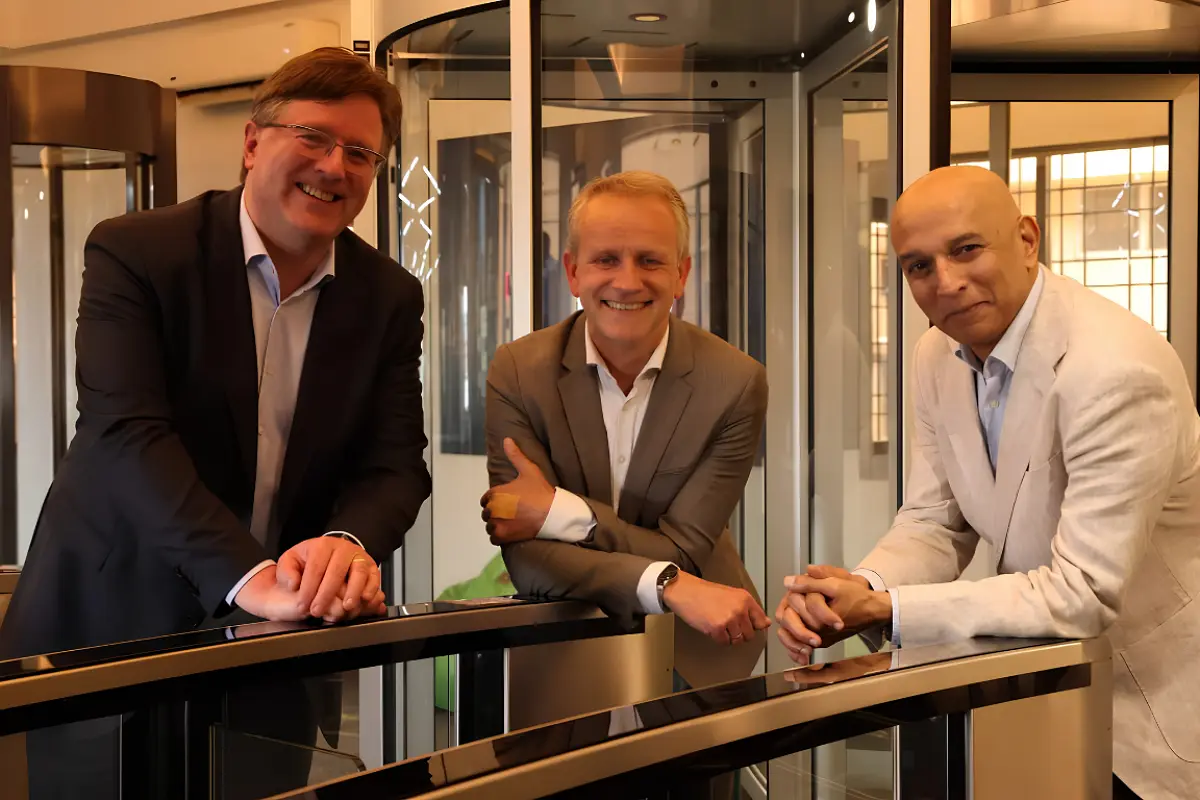
NEW DELHI, May 31, 2026: Royal Boon Edam International BV, the Netherlands-headquartered global manufacturer of entrance security solutions, revolving doors, security barriers, speed gates and turnstiles, has outlined an expanding India strategy built around local assembly, long-term partnerships and the possibility of establishing a full manufacturing facility in the country. Chairman Niels Huber and CEO Marc Giese, speaking to Hotelier India alongside Capt Edwin Saldanha, Managing Director of Boon Edam India, described a market they see growing faster than almost anywhere else in the world, and one they intend to be a significant part of as that growth continues.
Boon Edam has been operating in India for more than 25 years, a tenure that predates most of the commercial infrastructure it now supplies into. The company has watched the Indian market transform from a relatively modest distributor relationship to a direct presence with offices in Mumbai and Delhi and a local assembly operation built specifically to serve the speed and scale of India's current infrastructure construction cycle. What Huber and Giese are describing is the next phase of that commitment.
Boon Edam India sees Infrastructure Development as Comparable to China 20 Years Ago
Niels Huber, who began his career at Boon Edam in 1990 and has spent three decades building the company's international operations across 15 countries and more than 60 distributor relationships globally, was direct about the scale of what he is observing in India.
"The Indian market was already growing rapidly earlier, but today it is growing even faster. Every time I visit India, I see major developments. I travel extensively across the world and what is happening in India is extremely impressive. I do not know many places in the world developing at such speed."
— Niels Huber, Chairman, Royal Boon Edam International BV
Marc Giese, CEO, placed that observation within a specific historical parallel.
"The scale of the Indian market is enormous. We are seeing developments in India comparable to the growth patterns seen in China around 20 years ago."
— Marc Giese, CEO, Royal Boon Edam International BV
The China comparison is not throwaway language from a visiting European executive. It is a specific and informed reference point from a company that operates manufacturing facilities in China, the United States and Europe, and has therefore watched the full arc of China's commercial infrastructure build-out from inside the supply chain. Calling India's current development trajectory comparable to China two decades ago is a statement about the scale, speed and duration of the opportunity the company is positioning for.
Data Centres, Hotels, Airports and Offices Are All Driving Demand
The demand for entrance security solutions in India is being generated across multiple simultaneously expanding segments. Giese was specific about where the growth is concentrated.
"Demand for security solutions is increasing worldwide, especially from data centres. Hospitality, offices, airports and office security will continue to generate demand. We supply products to data centres globally and also in India, and this trend will continue over the next decade."
— Marc Giese, CEO, Royal Boon Edam International BV
India's data centre sector has been one of the most aggressively expanding segments of its commercial infrastructure landscape over the past three years, with hyperscale investments from global technology companies and domestic operators reshaping industrial land use patterns across multiple cities. Each of those facilities requires high-security entrance control infrastructure — and the specifications demanded by global technology companies in their Indian data centres are identical to what those same companies specify in their US and European facilities. That is a direct channel into a premium, specification-driven segment that is growing independently of the general Indian commercial market.
Hotels and airports represent the other anchor segments. India's hotel construction pipeline, with more than 250,000 rooms across various stages of development, combined with the expansion of terminal infrastructure at Adani, GMR and AAI-operated airports creates a sustained demand base for entrance solutions that has years of runway ahead of it. For a company whose products are designed to operate for 10, 15 or 30 years, getting into buildings during their construction phase is the most commercially durable position available.
Local Assembly Is Already Running, Full Manufacturing Is the Next Question
Boon Edam currently assembles products locally in India, a deliberate strategy to stay close to the market and deliver faster turnaround times than import logistics allow. The supply chain question, Huber noted, has become more acute globally as every region seeks to reduce dependence on single-source manufacturing.
"Deliveries are under pressure because the world depended heavily on one region for production. Now every region wants more autonomous supply chains and manufacturing capabilities. In India, we already assemble products locally to stay close to the market and ensure quicker turnaround times."
— Niels Huber, Chairman, Royal Boon Edam International BV
On the possibility of full manufacturing in India, Giese was measured but positive.
"Manufacturing in India is certainly a possibility. At present, we are assembling products in India and the supply chain here is excellent. Our experiences in India have been positive and we are building strong momentum in the market."
— Marc Giese, CEO, Royal Boon Edam International BV
The distinction between assembly and manufacturing matters commercially. Local assembly reduces lead times and import dependencies but still relies on components manufactured elsewhere. Full local manufacturing would give Boon Edam India the ability to serve the market at full volume with fully domestic supply chain resilience, and would position the company within India's Make in India framework in a way that creates both commercial and regulatory advantages for public sector and government-adjacent projects.
A 30-Year Product Lifecycle Demands a Long-Term Commitment to Service
One of the defining characteristics of Boon Edam's business model, and the one that shapes its India strategy most directly, is the product lifetime. Revolving doors, security barriers and entrance control systems are not replaced every five years. They are expected to operate for a decade or more, which means the service and maintenance relationship with a customer is as commercially significant as the initial sale.
Huber was explicit about this being a founding principle of how the company approaches markets.
"Our products are long-life systems expected to operate for 5, 10, 15 or even 30 years, so whatever we develop must also be serviceable over the long term. We are committed for the long term and see it as our responsibility to ensure systems remain operational. We focus on delivering the best value for money, not simply the cheapest product."
— Niels Huber, Chairman, Royal Boon Edam International BV
Giese reinforced the point from the customer relationship perspective.
"Many of our global customers in India expect the same level of service they receive in the United States or Europe. Customers are also increasingly focused on long-term partnerships and total cost of ownership rather than just product cost."
— Marc Giese, CEO, Royal Boon Edam International BV
The total cost of ownership framing is the correct one for entrance security infrastructure in a commercial building, and it is increasingly how procurement teams at hotel groups, real estate developers and data centre operators in India are evaluating purchase decisions. A revolving door that costs less to buy but requires expensive maintenance, generates frequent breakdowns and cannot be serviced locally creates a total cost profile that is worse than a premium product with 30 years of supported service life. Boon Edam's positioning on quality, service and long-term partnership is a direct response to exactly that calculation.
The India Opportunity in Context of a Global Security Infrastructure Shift
What Huber and Giese are describing in India is not an isolated market opportunity. It is India's share of a global structural shift in how commercial and institutional buildings approach security at the point of entry. Access control has moved from being a back-of-house operational concern to a front-of-house design and brand statement, particularly in luxury hotels, premium office campuses and high-security data centre facilities, where the entrance experience is the first physical expression of how an organisation thinks about its guests, employees and assets.
India's fastest-growing commercial real estate segments, premium office campuses in Bengaluru, Hyderabad and Pune, luxury hotel developments across leisure and business destinations, the expanding airport terminal infrastructure programme and the data centre clusters being built around major cities, are all demanding entrance solutions at specifications that match global standards. A company that has been operating in this space across 15 countries for more than two decades, with local assembly already running and manufacturing under active consideration, is building the infrastructure to capture that demand at the scale and service quality India's top-tier commercial projects require.