Buknari Resort Georgia Opens on the Black Sea Coast
Buknari Resort Georgia opens on the Black Sea coast north of Batumi, offering a pine forest setting, sea terrace dining, and Adjaran cuisine by Lisi Development.
 RUKAIYA KADIWAL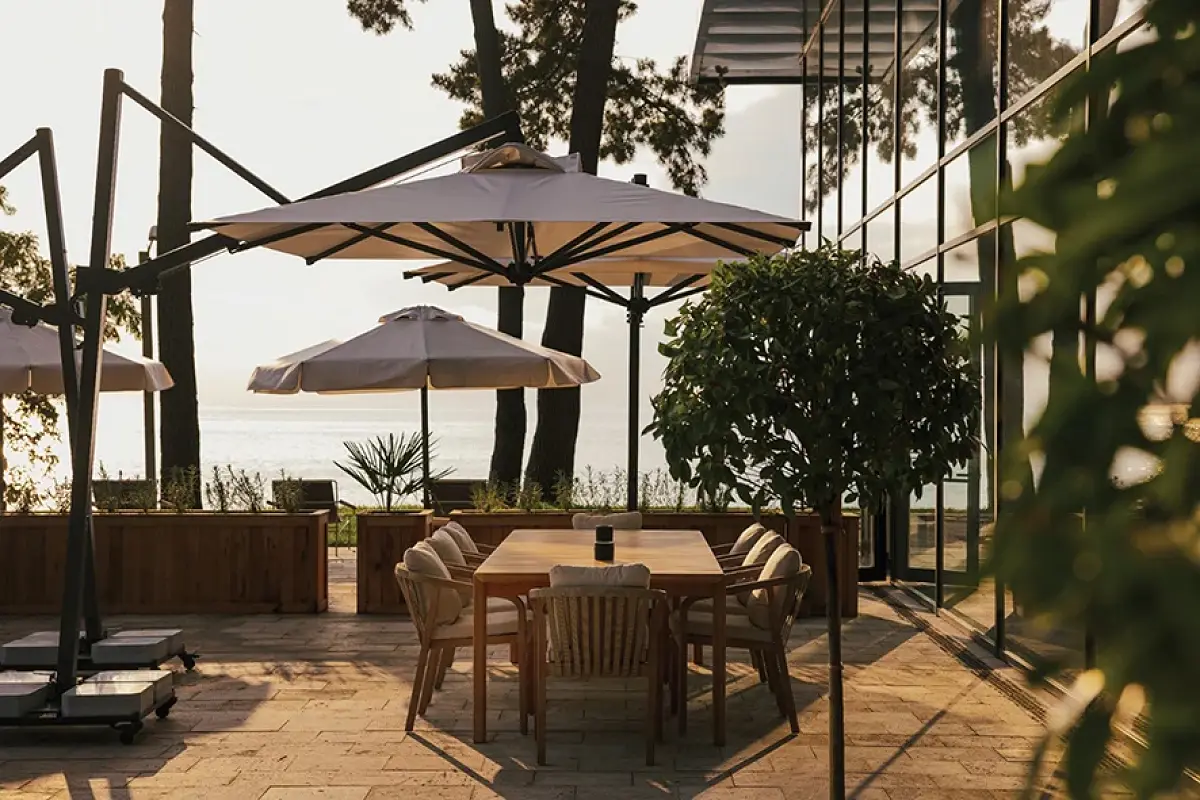
The terrace at Buknari Resort Georgia sits where the pine forest ends and the Black Sea begins. Teak chairs face the water. Umbrellas filter the late afternoon light. The sound arriving from the garden is the kind that has no urban equivalent, wind through old trees and the specific quiet of a coastline that has not yet been fully discovered. This is the effect that Lisi Development built toward when it chose Buknari, a village roughly eighteen kilometres north of Batumi in Georgia's Adjara region, as the site for its most ambitious Black Sea hospitality project.
The resort has now opened, bringing a property of considered design and local grounding to a stretch of the Georgian coast that most international travelers still navigate past rather than to. That is the bet behind the project: that Buknari's combination of forest, sea, and relative quiet represents something the Batumi hotel strip, with its towers and casino architecture, cannot replicate regardless of the investment it receives.
Buknari Resort Georgia and the Location That Defines It
Buknari sits within Adjara, the autonomous republic on Georgia's southwestern Black Sea coast whose regional capital Batumi has developed into one of the South Caucasus's most active tourism destinations over the past fifteen years. The city's growth, fueled by liberalised gambling regulations, significant foreign investment, and Georgia's visa-free access for citizens of more than 95 countries, has produced a Batumi skyline that bears little relationship to the Adjaran landscape surrounding it.
The villages to the north of Batumi, Buknari among them, have retained a different character. Pine forests run down toward the shore. The water is calmer than the open Batumi seafront. The pace of the villages matches the landscape rather than competing with it. Lisi Development chose this setting deliberately, and the architecture of the resort responds to it, glass walls that bring the forest interior into the building, terraces that face the sea without imposing on it, and a design language that uses local natural materials rather than importing the aesthetic of a European luxury brand.
Buknari Hotel Georgia: Dining at the Water's Edge
The resort's restaurant programme reflects the same local-first philosophy that governs its design. Georgian cuisine provides the foundation, with the Adjaran regional tradition, distinct from the styles of Tbilisi or Kakheti, given particular attention. Adjaran khachapuri, the boat-shaped bread filled with cheese, butter, and egg that has become Georgia's most internationally recognized dish, originates in this region, and a kitchen operating on this coastline carries an obligation to the dish that a Tbilisi restaurant does not.
The dining terrace, visible in images that place it at the intersection of stone, timber, and glass against a backdrop of water and trees, operates as both a breakfast setting and an evening destination. The long horizontal view from the terrace, pine trees framing the Black Sea in the middle distance, changes across the day in ways that make the same table feel different at 8 in the morning and 8 in the evening. That quality, a setting that actively participates in the meal rather than simply framing it, is what separates a well-located restaurant from a genuinely good one.
Lisi Development and the Vision Behind Buknari Resort
Lisi Development is a Georgian real estate and hospitality group whose previous projects have included residential and commercial developments in Tbilisi. The move to coastal hospitality at Buknari represents a different kind of commitment, one that requires sustained operational capability rather than the completion milestone that defines a residential project. A resort on the Black Sea coast must perform across seasons, retain staff through the quieter months, and build a guest relationship that generates repeat visits rather than single-occasion stays.
Georgia's hospitality development has attracted increasing attention from investors across the South Caucasus and beyond, as the country's tourism numbers have grown consistently and its regulatory environment has remained welcoming to foreign capital. The coast north of Batumi has been identified as a development corridor with potential comparable to sections of the Turkish or Bulgarian Black Sea coast that now draw significant leisure tourism from across the region.
Adjara Tourism and the Regional Context
Adjara received more than two million visitors in the years immediately before the pandemic disrupted regional travel patterns, with the majority arriving through Batumi's international airport, which connects the region directly to Istanbul, Moscow, Kyiv, and several Middle Eastern cities. Recovery since 2022 has been shaped by the geopolitical disruption affecting Russia-sourced travel, which historically accounted for a significant share of Adjaran tourism, and the partial offset from increased visitors from Turkey, the Gulf, and European markets.
New hotels near Batumi and north along the coast have been an active part of the recovery, with properties opening across a range of formats from large resort complexes to smaller boutique hotels of the kind that Buknari represents. The diversity of new supply reflects a maturing market where the all-inclusive tower and the design-conscious boutique resort are beginning to serve genuinely different audiences rather than competing for the same guest.
What Buknari Resort Georgia Offers Against the Competition
The Batumi seafront offers volume and variety. Buknari offers something that volume and variety tend to erode: quiet. That distinction is a genuine competitive advantage in a coastal market where the development pace of the past decade has made the central waterfront considerably noisier than it was when the first wave of post-Soviet investment arrived. Travelers who have visited Batumi once and found the casino towers dissonant with the Adjaran landscape they came to experience represent a natural audience for a property positioned eighteen kilometres away in a pine forest by the sea.
The challenge that quietness creates is the same challenge any destination-dependent resort faces. The product is inseparable from the place. That is the strength in season. It requires genuine effort to sustain through the months when the Black Sea coast is cold and the forest is wet and the terrace views are impressive in a different, less commercially appealing way. How Buknari Resort Georgia manages those months will determine whether it builds the kind of year-round operation that gives a coastal property genuine durability.
How Buknari Resort Fits a Broader Pattern in Hospitality Investment
Resorts that build their identity around natural settings and quiet rather than amenity volume are finding audiences across multiple markets simultaneously. The same preference for place-led hospitality over infrastructure-led hospitality that has driven boutique resort development in Georgia is visible in projects across very different coastal markets. Coverage of how Naples Grande Beach Resort is repositioning as Signia by Hilton on Florida's Gulf Coast shows how established coastal resorts are responding to the same demand shift, investing in quality of product rather than volume of amenity to justify premium positioning in a competitive market.
In both cases, the underlying bet is the same. A guest who can choose anywhere is choosing a specific quality of experience rather than a list of facilities. Buknari Resort Georgia has made that bet on a Black Sea coastline that is still becoming rather than already arrived.
What the Black Sea Coast Is Becoming
Buknari sits at a specific and temporary moment in a coastline's development. The village is still quiet enough that the resort's forest setting feels genuinely remote. The eighteen kilometres from Batumi is enough distance to matter. The design of the property, its glass walls and teak terraces and pine backdrop, fits a landscape that has not yet been overwritten by the development pressure that eventually reaches every coastline that attracts this level of investment attention.
Whether it still feels this way in ten years will depend on decisions that extend well beyond Lisi Development's property boundary. The Georgian coast north of Batumi is being watched by developers who understand what the Batumi strip could not prevent: the conversation that follows when a well-designed resort opens in a quiet place and begins showing other investors what the quiet was worth.
Learn more at Buknari Resort's official website.