Dubai Hotels for Locals: How They Became a Way of Life
Dubai hotels for locals go far beyond tourism, serving as everyday spaces for coffee, spa days, brunches and staycations woven into resident life.
 RUKAIYA KADIWAL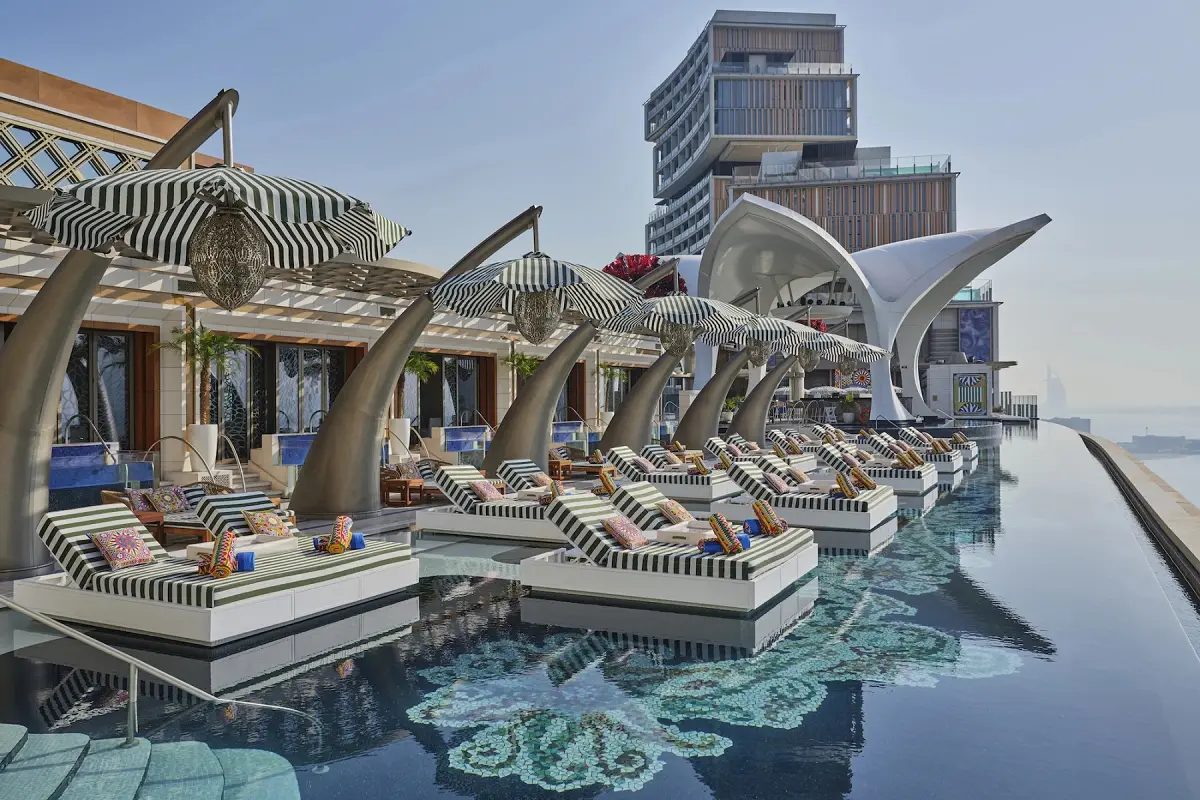
On a Sunday afternoon in Dubai, a woman slips into a rooftop pool club not because she is staying the night, but because it is simply where her week resets. A few floors below, another resident sits in a hotel lobby waiting for a friend, coffee in hand, treating the marble floor and soaring ceiling as though it were her own living room. This is the quiet, unremarked upon rhythm behind Dubai Hotels for Locals, a city where the grandest addresses are rarely reserved only for guests passing through.
Dubai is known for hotels that chase superlatives, the tallest, the highest infinity pool, the most waterslides, properties built as architectural landmarks and tourist attractions in their own right. Writer Sarah Khan, in a piece for AFAR, describes checking into the Atlantis the Royal and feeling as though she had entered a particularly shiny train station, crowded with slackjawed visitors moving through the lobby. But beneath that spectacle sits a far quieter truth about how the city actually uses its hotels.
Woven Into Everyday Life
In Dubai, hotels are not cosseted spaces reserved for out of towners on a dizzying sprint through the city. They are woven into the fabric of daily routine, places residents visit for a fiftieth anniversary dinner, a weekly pedicure, a quick coffee meeting or a long beach club afternoon. Locals pop in to pick up birthday cakes or linger for hours over the city's famously decadent Sunday brunches, treating these properties less as destinations and more as extensions of their own neighborhoods.
Khan, who lived in Dubai in 2021 and 2022 before relocating to New York City, describes the contrast starkly. In New York, she rarely spends time in hotels beyond an occasional work event. In Dubai, she used them constantly, browsing art in the galleries at the XVA Art Hotel, having breakfast during a staycation at the Park Hyatt, getting her hair done at a salon tucked inside a modest three star property, and even getting engaged at Al Maha, a desert resort just outside the city.
Why Hotels Became Public Spaces
Isabella Craddock, editor of Middle Eastern travel magazine Near and Far and the Middle East Academy Chair for the World's 50 Best Hotels, traces the pattern back to Dubai's earliest development. "We have such a high concentration of hotels and resorts that they almost act as public spaces," Craddock said. "I think this goes back to the beginnings of Dubai as we know it, when international luxury hotels like the Burj Al Arab, Jebel Ali Hotel, and One&Only Royal Mirage became these mini worlds within a rapidly growing city. In some cases, the hotel arrived before the neighborhood around it did, becoming a destination and social hub in its own right." The comment matters because it explains why hotels in Dubai carry a different social weight than in most cities, functioning as anchors around which neighborhoods later formed, rather than amenities layered onto an already established urban fabric.
That role was reinforced further by regulation. In Dubai's early years, alcohol licenses were largely restricted to hotels, pushing much of the city's expat social life into their restaurants and bars. Though those rules have relaxed over time, the pattern persists in the city's dining scene, with 13 of Dubai's 19 Michelin starred restaurants still attached to resorts. Tehzeeb Ahmed, a PR strategist born and raised in Dubai, remembers the earlier era clearly. "Growing up here, the only places you could go to, especially places that were licensed, were at hotels," Ahmed said. Today, she gets her hair done at the Shangri-La or Fairmont, buys cakes for occasions at the Jumeirah Beach Hotel, and treats the lobbies of the Four Seasons or Mandarin Oriental as casual meeting points, even using the hotels themselves as landmarks when giving directions.
Amenities Open to Everyone
Unlike many cities, where hotel amenities remain firmly off limits to nonguests, Dubai takes a different approach. Locals mingle freely with visitors at coworking spaces inside 25Hours Hotel Dubai One Central, gym memberships at the wellness focused SIRO One Za'abeel, and the yacht club at Bulgari Dubai. Even the elaborate breakfast buffet at Atlantis the Royal, served across a labyrinthine series of rooms, is open to nonguests willing to book a table.
Apps such as Privilee and Supper Club have made that access even easier, offering day passes to pools, spas and other hotel spaces that might otherwise feel closed off. "All the stuffiness and ambiguity to whether external guests can enjoy the amenities is removed," Craddock said. "It's as easy as booking a restaurant." For a city built around this level of openness, understanding how guests actually rediscover and return to these properties has become its own area of focus within the hospitality industry, echoed in ongoing conversations around hotel guest re-engagement strategies shaping the sector more broadly.
A New Kind of Work Life Balance
Kiran Ali, a lawyer turned tech executive who founded the community group American Women of Dubai after relocating from Washington, D.C. three years ago, describes hotels as a kind of pressure valve for otherwise ordinary weekday routines. "We live and we work very normal lives, kids, school, after-school activities, work," Ali said. "But on the weekends, or if we want any kind of a treat, hotels are the anchor." She has spent spa days at the Banyan Tree and Palazzo Versace, booked day passes through Privilee at the One&Only Royal Mirage and Raffles the Palm, and taken advantage of resident rates on staycations at Atlantis the Palm and Address Beach Resort, often at a fraction of what similar experiences would cost elsewhere.
"You don't have to necessarily invest tons of money to go on a trip somewhere to get that little dose of unwinding and relaxing," Ali said. "You have opportunities to do it every weekend if you want to." In a city where the gap between visitor and resident experience can so easily disappear, Dubai's hotels stand as a reminder that hospitality, at its best, is not something reserved for those simply passing through. It is, for those who live there, simply a way of life.