Malecon in Puerto Vallarta Unveils a Pacific Promenade
Malecon in Puerto Vallarta stretches along the Bay of Banderas with bronze sculptures, plazas and restaurants where the city opens directly onto the Pacific.
 RUKAIYA KADIWAL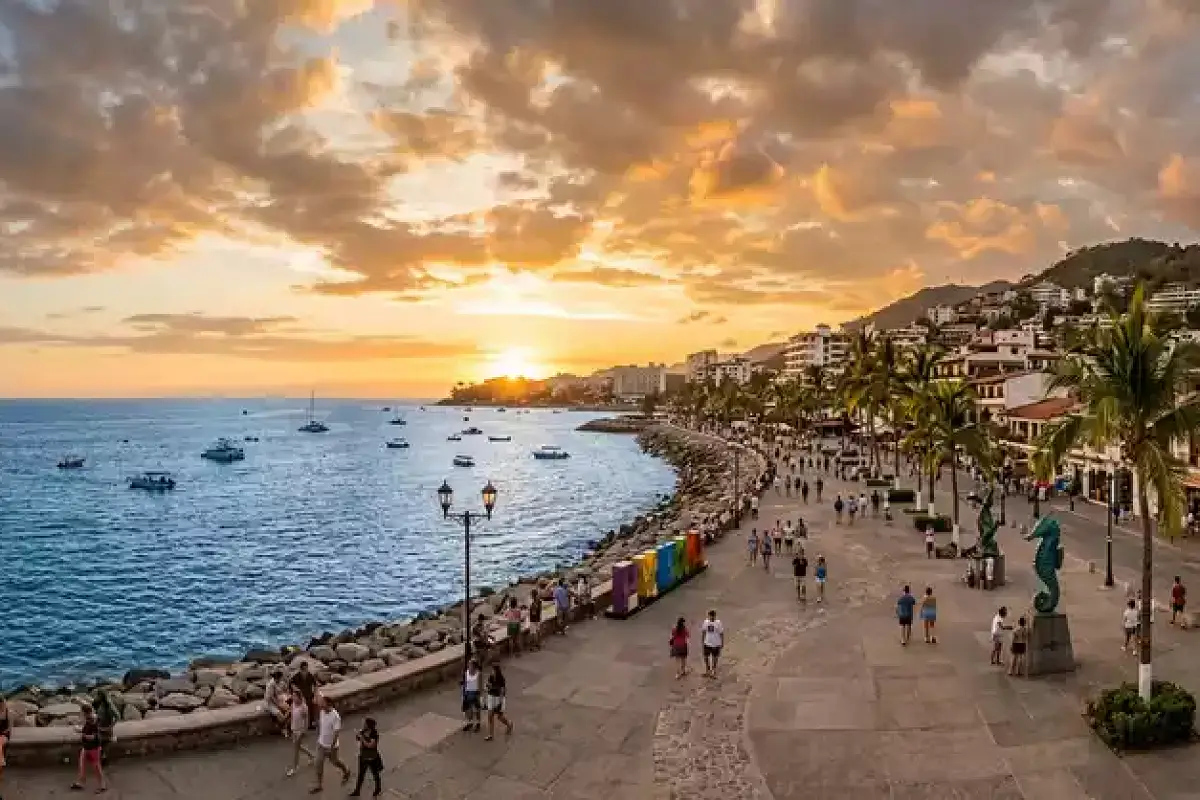
The sun drops low over the Bay of Banderas, spilling orange light across a curved stretch of paving where fishing boats bob offshore and families amble past bronze statues still warm from the day's heat. Palm trees lean gently toward the water, their silhouettes framing a scene that has drawn residents and visitors alike to this exact spot for generations. This is Malecon in Puerto Vallarta, an oceanfront promenade where the city meets the Pacific on a curve of beach, boardwalk and public art that never quite steps indoors.
Malecon runs through the Centro and Zona Romántica districts of this Mexican resort city, set on the Bay of Banderas within the state of Jalisco on Mexico's Pacific coast. Unlike waterfronts defined primarily by hotels and resort walls, Malecon keeps the city itself directly connected to the sea, an esplanade where the promenade and the sand sit almost flush against one another.
A Curved Boardwalk That Never Loses the View
Malecon is laid out as a paved oceanfront boardwalk following a gentle curve along the bay, keeping the sea in constant view for its entire length. The built edge and the narrow strip of sand below sit close enough together that walking the promenade feels less like strolling a city street and more like tracing the very edge of the water itself, a relationship between pavement and shoreline that remains genuinely unusual for an urban waterfront.
The central stretch runs between the historic Hotel Rosita at the northern end and the amphitheatre near Plaza de Armas at the southern end, where the boardwalk meets the open air arches known locally as Los Arcos. Along the way, the promenade crosses the Río Cuale on a low bridge, linking the older downtown grid with the southern waterfront and marking the exact point where Centro gives way to Zona Romántica.
Bronze Figures Marking Every Few Steps
One of Malecon's most distinctive features is its line of bronze sculptures accompanying the walkway, set on plinths beside the paving and the sand. More than twenty such sculptures line the promenade, including pieces titled Caballito de Mar, La Nostalgia, Friendship Fountain, In Search of Reason, Millennium and The Rotunda of the Sea, each having become a fixed point on the route for both longtime residents and first time visitors.
Those sculptures are mapped at various intersections with downtown streets such as Corona, Aldama and Galeana, underlining just how closely the public art is woven directly into the city's own street grid rather than existing as a separate, curated gallery experience set apart from everyday urban life.
Plazas Where the City Grid Meets the Water
Malecon opens into several plazas and small squares where the inland city grid meets the water, including Plaza de Armas beside the cathedral with its distinctive crown topped tower, and the amphitheatre positioned at Los Arcos. The boardwalk itself measures around 760 metres, roughly 2,500 feet, for its original section, with later extensions lengthening the continuous walk considerably beyond that initial stretch.
These plazas function as natural gathering points along the route, spaces where the promenade's steady rhythm pauses momentarily to accommodate street performers, vendors, and simply the crowds who linger longer at these particular junctions than anywhere else along the walk.
From Breakwater to Beloved Public Space
Malecon's transformation into today's pedestrian waterfront unfolded gradually across the twentieth and early twenty first centuries. Its origins trace back to the 1930s, when it began as a simple breakwater protecting the downtown waterfront, with later phases gradually turning it into a genuine boardwalk and public space as Puerto Vallarta developed into a resort city along the Pacific.
In the early 2000s, the waterfront underwent a major redesign that produced the present pedestrian form of Malecon, removing motor traffic entirely from the main boardwalk and completing a continuous paved route between Hotel Rosita and the amphitheatre. That redesign transformed what had once been a functional sea edge into an exclusively pedestrian space filled with sculptures, local artists, restaurants and a genuinely lively urban atmosphere along the shore. Full visitor information on Puerto Vallarta is available on the official Visit Puerto Vallarta website.
What Makes Malecon Genuinely Distinctive
Among oceanfront promenades worldwide, Malecon stands out for how completely its curved boardwalk, narrow beach, public art and civic plazas sit side by side, creating a continuous urban waterfront where the city and the Pacific quite literally share the same edge. That seamlessness, rather than any single landmark or attraction, is what defines the promenade's character most enduringly.
This kind of thoughtfully preserved public waterfront increasingly shapes how destinations distinguish themselves within a competitive global tourism market, where travelers increasingly seek genuine civic character over purely manufactured resort experiences, a preference reflected across hospitality more broadly, including in how established luxury properties similarly draw on authentic local heritage to define their own guest experience, a theme explored recently in Bvlgari Hotel Milano and Bvlgari Hotel Roma's own deep connection to Italian heritage.
Practical Details for Visitors
The boardwalk itself is level and paved, with steps appearing where side streets meet the promenade and a modest drop from the walkway down onto the narrow beach below. Puerto Vallarta sits on the Bay of Banderas along Mexico's Pacific coast, reached by air via Licenciado Gustavo Díaz Ordaz International Airport, or by road along highways crossing the state of Jalisco.
Spanish remains the official language and the Mexican peso the local currency, while entry requirements vary depending on nationality, with UK travellers advised to check FCDO travel guidance and Irish travellers directed toward the Department of Foreign Affairs for the latest entry information before planning a visit.
A Shoreline That Stays Open to Everyone
As evening deepens over the bay, the same bronze sculptures that caught the afternoon sun now catch strings of lamplight instead, while the boardwalk fills with a different crowd, couples pausing for a slow walk, vendors packing up for the night, musicians finding their spot near the amphitheatre. Malecon remains freely accessible at all hours, a public waterfront that asks nothing of those who walk it beyond the willingness to slow down and notice where a city quietly, deliberately, chose to meet the sea rather than turn its back on it.