Travel And Tour World Lists Top 50 Convention Centers Across Americas and Caribbean for 2026
Travel And Tour World releases its 2026 ranking of the top 50 convention centers across the Americas and Caribbean, highlighting infrastructure, sustainability, and business travel growth.
 Pratyaksha Singh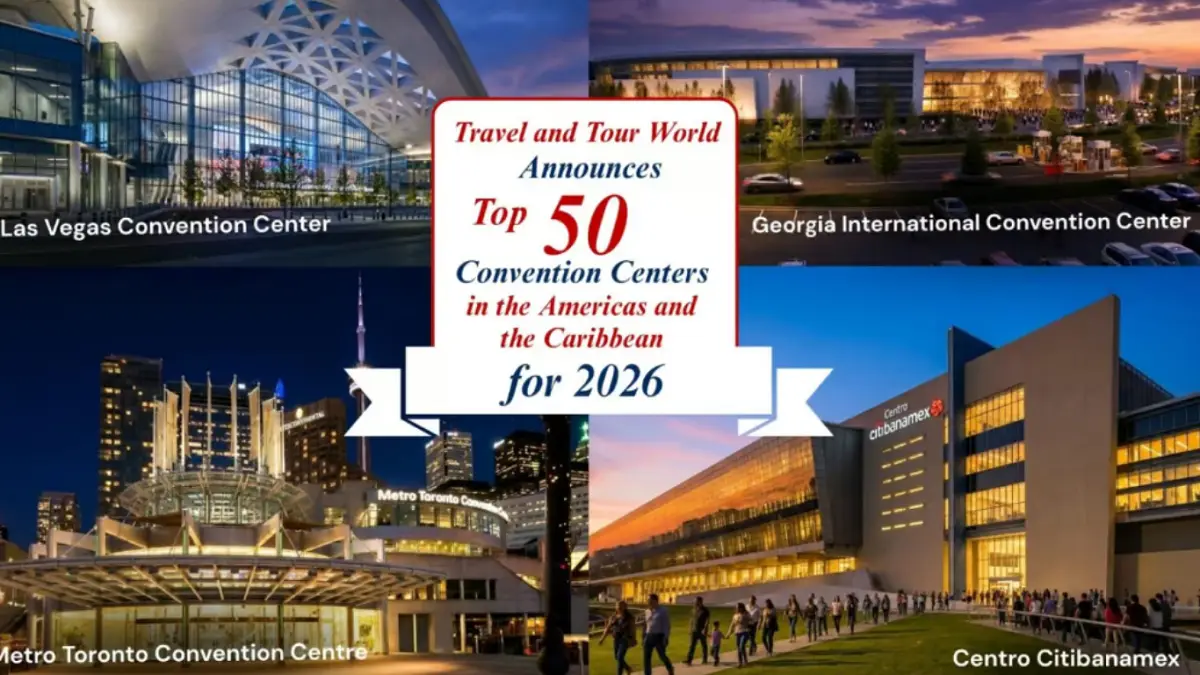
Travel And Tour World (TTW) has released its 2026 ranking of the top 50 convention centers across the Americas and Caribbean, highlighting large-scale venues driving international meetings, exhibitions, and business tourism, alongside rising investment in infrastructure, sustainability, and digital innovation.
The study evaluates convention centers across North America, Latin America, and the Caribbean, focusing on their role in facilitating global trade, corporate travel, and cross-border collaboration. The ranking reflects how modern venues are integrating advanced technologies and scalable infrastructure to support evolving demands in the Meetings, Incentives, Conferences, and Exhibitions (MICE) sector.
North America Dominates with High-Capacity Venues
Convention centers in the United States and Canada account for a significant share of the top-ranked venues, led by the Las Vegas Convention Center, Georgia International Convention Center, and Metro Toronto Convention Centre. These facilities are recognized for their large exhibition capacities, advanced digital systems, and ability to host mega-scale global events.
Other prominent North American venues include the Orange County Convention Center, McCormick Place in Chicago, and the Vancouver Convention Centre. These properties support multiple industries including technology, healthcare, and manufacturing, and are designed to accommodate high visitor volumes and simultaneous large-scale events.
The report notes that proximity to airports, integrated hotel infrastructure, and seamless urban connectivity are key factors contributing to the continued dominance of North American convention hubs.
Latin America and Caribbean Markets Show Growth
Latin America and the Caribbean feature strongly in the ranking, with venues such as São Paulo Expo in Brazil, Centro Citibanamex in Mexico City, and Expo Guadalajara emerging as major players in the regional MICE ecosystem. These facilities are increasingly attracting international trade shows and corporate events.
In the Caribbean, destinations including the Montego Bay Convention Centre in Jamaica and the Baha Mar Convention Center in The Bahamas are gaining traction as business tourism hubs. The report highlights projected growth in the Caribbean MICE market, which is expected to reach USD 12.5 billion by 2033.
Regional growth is supported by infrastructure upgrades, improved connectivity, and the integration of leisure tourism offerings, reflecting the rise of bleisure travel where business and leisure experiences intersect.
Business Travel Spending Drives Demand
The report outlines strong recovery and expansion in global business travel, with spending projected to reach USD 1.57 trillion in 2025. This growth is attributed to the resurgence of corporate events, trade shows, and conferences across global markets.
Latin America is expected to contribute significantly, with business travel expenditure projected to reach USD 63.9 billion in 2025, representing a 3.2 percent increase despite economic challenges. Brazil remains a key market, ranking among the top ten globally for business travel activity.
The findings underscore the role of convention centers as critical infrastructure supporting corporate mobility and international business engagement.
Technology and Sustainability Shape Venue Development
The ranking identifies technological integration and sustainability as core factors influencing the competitiveness of convention centers. Many of the top venues have adopted hybrid event platforms, smart venue management systems, and high-speed connectivity to support digital and in-person participation.
Sustainability initiatives are also central, with over 70 percent of the listed venues implementing energy-efficient systems, green certifications, and environmentally responsible operations. These measures are becoming key differentiators in attracting global events and corporate clients.
The study emphasizes that modern convention centers are evolving into digitally enabled ecosystems, designed to deliver efficient, scalable, and environmentally sustainable event experiences.
Convention Centers as Economic and Trade Catalysts
According to TTW, convention centers are playing an increasingly strategic role in driving economic activity by facilitating trade, innovation exchange, and industry collaboration. These venues are often integrated within broader urban ecosystems that include hotels, transport networks, and entertainment infrastructure.
The report highlights how destinations are aligning airport connectivity and hospitality infrastructure to create seamless travel experiences for delegates, exhibitors, and corporate travelers. This integrated approach is helping destinations strengthen their position in the competitive global meetings industry.
TTW notes that the expansion of convention infrastructure across the Americas reflects a shift toward more flexible, experience-driven venues capable of hosting diverse international audiences. These developments are enhancing the overall quality of business events while reinforcing the importance of MICE tourism in regional and global economies.
The study is based on a comparative evaluation of venue size, infrastructure, event scale, technological capabilities, sustainability initiatives, and connectivity. Data was compiled from industry reports, official sources, and benchmarking analysis to ensure consistency and reliability in rankings.