Tuju Restaurant São Paulo: The Untold Secret Behind Its Rain-Led Menu
Tuju Restaurant São Paulo builds its Michelin three-star menu around rainfall, not the calendar a quiet act of climate adaptation in fine dining.
 RUKAIYA KADIWAL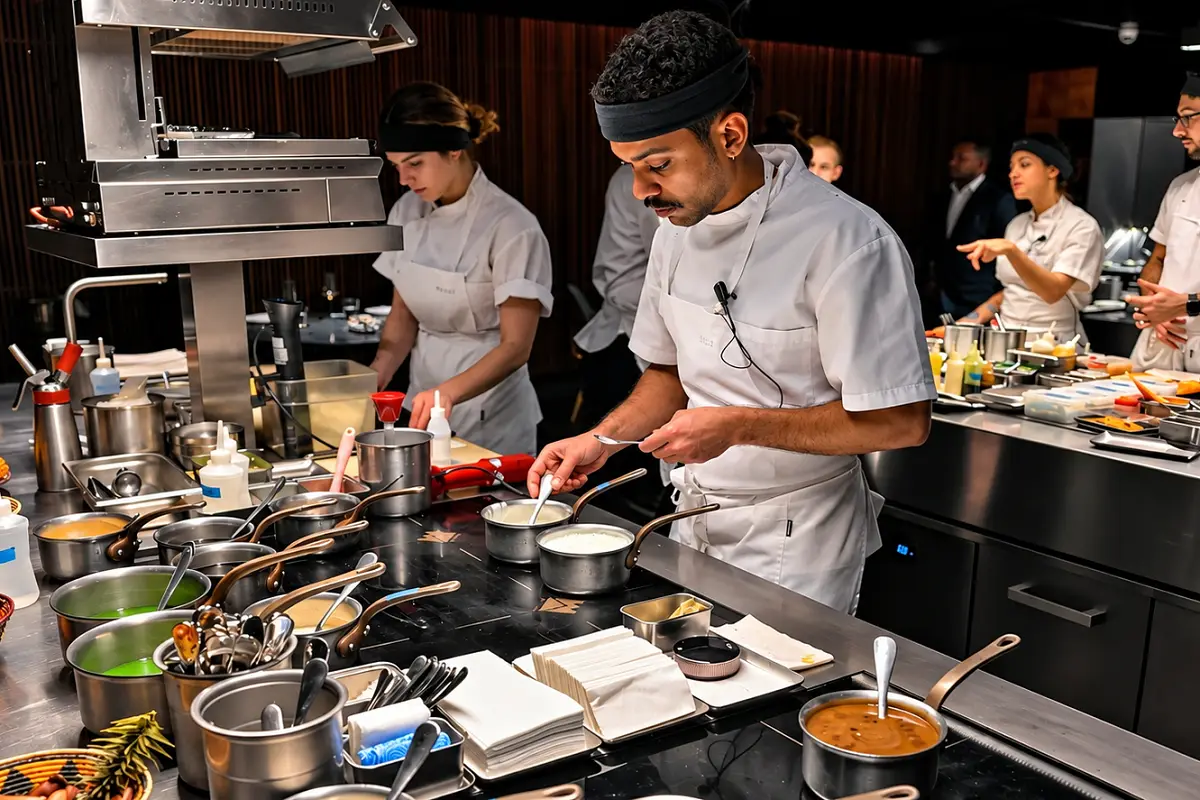
Tuju Restaurant São Paulo does not run on the clock. It runs on the sky. The spoon moves without hurry. In the low light of Tuju's open kitchen, a chef leans over a small pot of cream. He tastes it. He adjusts it. He tastes it again. Around him, seven other cooks work in a silence so complete it feels rehearsed. No one raises their voice. No one seems to need to.
Along the steel counter, dozens of small pans sit lined in formation. Some hold pale custards. Others hold a green so vivid it looks almost edible before it is even plated. Baskets of dried corn, persimmons, chestnuts, and rosemary sprigs sit at the counter's edge like a still life someone forgot to put away. Nothing here is decorative. Everything on that counter arrived because of what the sky did, or didn't do, in the weeks before.
Sao Paulo does not look, at first glance, like a city built for this kind of restaurant. It is a megalopolis of twelve million people, thick with traffic and concrete. It is more famous for the size of its economy than the rhythm of its seasons. And yet inside a quiet dining room built around nine tables of green marble, chef Ivan Ralston has built something that runs less on ambition than on weather.
Tuju Restaurant São Paulo: The Restaurant That Watches the Rain
Tuju does not print four seasonal menus tied to a calendar the way most fine-dining restaurants do. It offers four menus named for atmospheric conditions "Humidity," "Rain," "Gale," and "Drought" and none of them arrive on a fixed date. They arrive when the weather says they should.
"Sao Paulo is usually dry in July, but this year it stayed somewhat wetter because of El Nino, so mushroom season lasted almost twice as long," Ralston explained. "You always have to stay alert and adapt."
It is a small sentence that carries a large idea. In most professional kitchens, adaptability means responding to a supplier's delivery running late or a walk-in cooler failing overnight. At Tuju, it means restructuring an entire ten-course tasting menu because a reservoir filled faster than expected, or because a storm delayed a harvest by two weeks. The restaurant does not resist the unpredictability of Brazil's climate. It has built its identity around surrendering to it.
This April, that surrender was rewarded in the most traditional currency fine dining recognizes. Tuju Restaurant São Paulo received its third Michelin star. It became, alongside fellow Sao Paulo restaurant Evvai, one of the first two establishments in all of Latin America to reach the guide's highest honor. Readers can learn more about the restaurant directly through its official site, https://tuju.com.br.
Two Years of Listening Before Cooking
To understand how Tuju arrived here, it helps to go back to a closed restaurant and two people with no menu to serve.
Ralston opened Tuju in 2014 and earned his first Michelin star within months. A second star followed not long after. Then the pandemic arrived, and the restaurant that had been building momentum simply stopped. Rather than reopen quickly once restrictions eased, Ralston and his partner, gastronomic researcher Katherina Cordas, chose to spend two years studying Brazilian ingredients before serving another plate.
"It takes a lot of flexibility," said Cordas, 38, who now runs the culinary research center the pair founded alongside the restaurant. Her role extends far past pairing wines or greeting guests. She is, in effect, the translator between the unpredictability of Sao Paulo state's small farms and the precision a Michelin kitchen requires. The two years were not spent perfecting techniques so much as understanding a landscape which producers could be trusted through a dry winter, which fruit trees responded to erratic rain, which fishermen's sardine catches shifted with ocean temperature.
When Tuju reopened in 2023, it did so with a different relationship to its ingredients than it had before the closure. The restaurant's name, taken from a Latin American bird, took on a fitting resonance: something migratory, attentive to conditions, built to move with rather than against its environment.
Inside the Dining Room
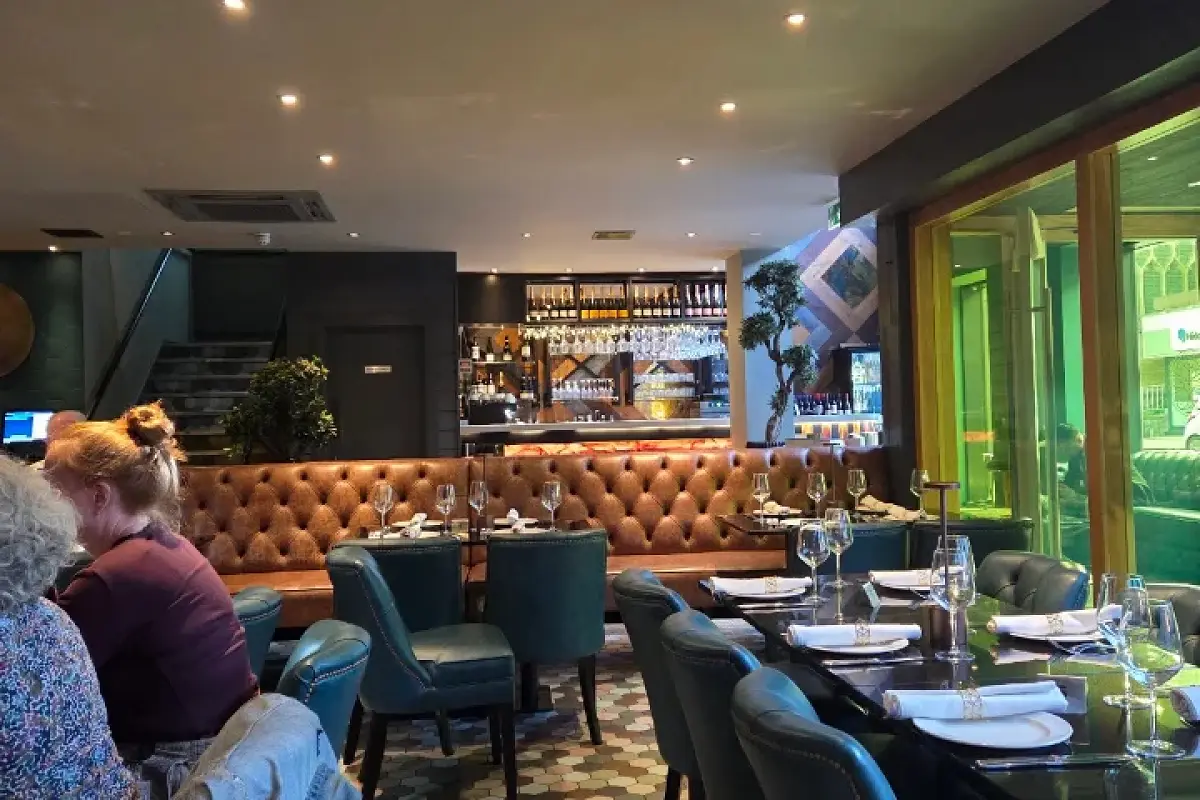
The evening at Tuju begins outdoors, beneath the canopy of a jabuticaba tree, before guests are led inside to the nine marble tables where Cordas moves quietly from group to group. The dining room is minimalist by design, dramatically lit around the open kitchen at its center, so that the eight young chefs most of them women become part of the performance without ever seeming to perform.
The tasting menu draws almost entirely from small producers across Sao Paulo state: sardines, artichokes, chestnuts, grapes, guava, capers. Michelin's own citation praised the kitchen for preparing these ingredients "with the most modern techniques, emphasizing creativity and the research work behind the scenes." The ten courses cost 1,650 reais, about $320, and the night does not end at the table. It concludes on a rooftop terrace with sweeping views of the city, over chocolates and honey harvested from native stingless bees.
For Ralston, the son of restaurateurs who trained in some of Spain and Japan's most demanding kitchens, the accolades sit uneasily against what he actually wants guests to take from the experience. "The pursuit of perfection is superficial," he said. "What we promise is a genuine experience."
What Gets Lost When Dinner Becomes Content
That tension between recognition and meaning surfaces again when Ralston talks about how some guests now behave at his tables. He has watched diners move through a ten-course menu with more attention paid to their phones than their plates, treating the meal as raw material for social feeds rather than something to be experienced in the moment it happens.
"Eating is a moment to pay attention to details," he said. "My advice would be: stop working on the marketing of living and enjoy life a little more."
It is a rare moment of open frustration from a chef otherwise careful in how he discusses his restaurant's success, and it points to a broader unease running through fine dining globally the sense that the pursuit of a shareable moment has begun to compete with the experience itself. For a look at how a very different American restaurant is building its own community-driven story, see this related feature on Sei Bella Italian Restaurant in Bristol, CT.
A Star System Built on Unequal Ground
Sao Paulo now holds more Michelin-starred restaurants than any other city in Latin America, though the guide currently limits its ratings on the continent to cities in Argentina, Brazil, and Mexico. Ralston does not romanticize why his city has become the region's culinary center. He attributes it plainly to money. "The size of Sao Paulo's economy there's a lot of money here," he said.
It is a candid acknowledgment of a harder truth sitting beneath the city's culinary rise. Sao Paulo is also a city where roughly half a million families live in extreme poverty, a contrast that runs directly against the image of a $320 tasting menu built around climate-conscious sourcing. Ralston does not resolve that tension in conversation, and it would be dishonest reporting to pretend the restaurant does either. What Tuju offers is not a solution to that inequality but a small, deliberate act of attentiveness within it paying real producers real prices for ingredients grown on real, changing land, rather than importing uniformity from elsewhere.
The Weather as a Business Partner
There is an operational cost to building a restaurant around unpredictability that rarely appears in a review. Menus tied to fixed dates allow kitchens to plan labor, pricing, and supply chains months in advance. A restaurant that redesigns its offering around rainfall patterns is, in effect, running a much harder logistics problem than its peers one where a delayed storm or an early drought can quietly rewrite a week's worth of planning.
Ralston's kitchen absorbs that uncertainty through structure: eight chefs moving in what visitors describe as near-total silence, each responsible for a narrow set of tasks that can flex as ingredients shift. It is a culture built less on hierarchy and shouted commands, the traditional image of a professional kitchen, and more on quiet coordination a style that mirrors the restaurant's broader philosophy of responsiveness over control.
Different Tables, Different Truths
Not everyone in Brazil's dining scene agrees that climate-driven menus represent the future of the industry rather than a boutique indulgence available only to restaurants wealthy enough to absorb the unpredictability. Critics of the ultra-fine-dining model note that a ten-course menu at 1,650 reais remains inaccessible to the overwhelming majority of the city it claims to represent, regardless of how thoughtfully its ingredients are sourced. Others counter that Tuju's approach small producers, transparent sourcing, adaptive planning offers a working model that larger, more commercial kitchens could learn from, even if they never adopt its price point. Both views can be true at once, and neither cancels the other out.
A Bird That Waits for the Right Wind
Late in the evening, the terrace lights dim over the city. What stays with a visitor to Tuju Restaurant São Paulo is not the third star, or the price, or even a single dish. It is the quiet discipline of a kitchen built to change its mind. This is a restaurant that has decided perfection is not a fixed target to be hit night after night. It is a moving relationship with a place, its people, and its weather. In a city defined by scale and speed, Tuju has chosen instead to listen. Somewhere beyond its dining room, a reservoir is filling or emptying. A mushroom season is stretching longer than expected. The menu, once again, is waiting to hear what the sky decides.