How Zomato Ratings and Reviews Drive Restaurant Sales in India
Zomato ratings directly shape restaurant visibility, customer trust and sales in India. Learn how reviews affect cloud kitchens and dining brands in 2026. Read more.
 Prajakta Sanjay Warwadkar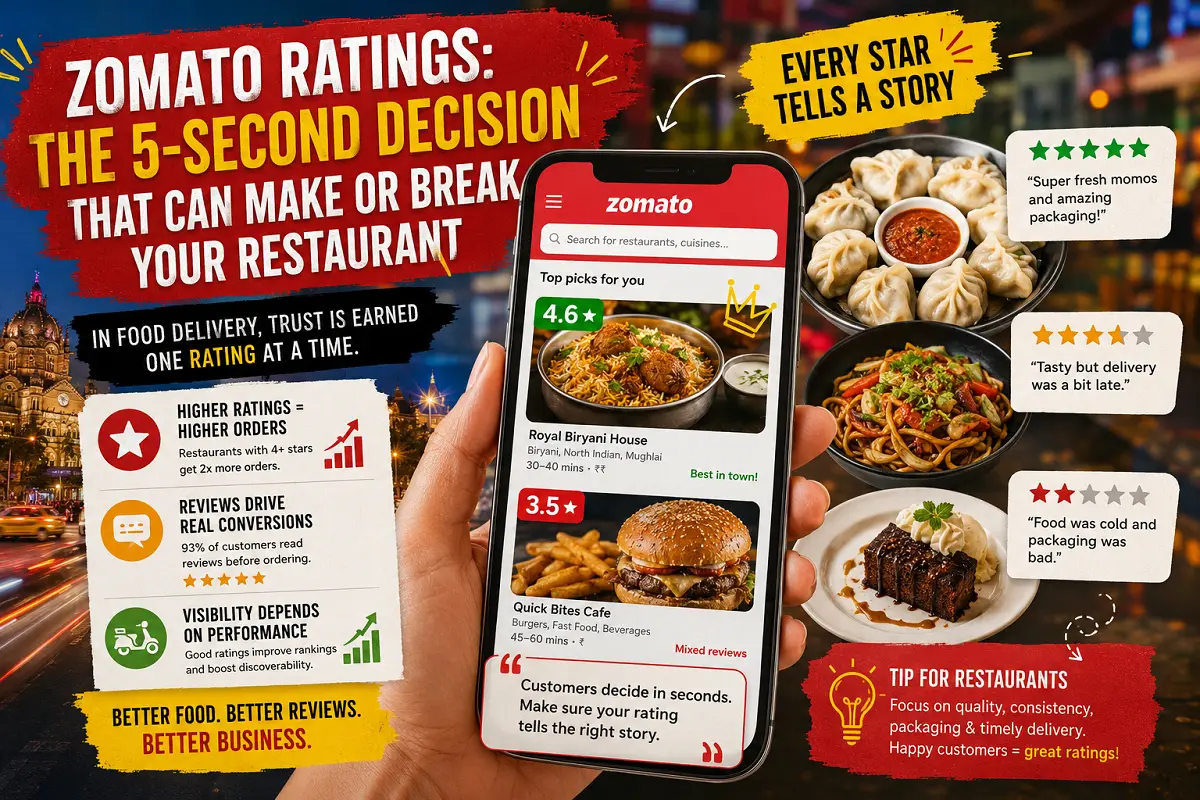
MUMBAI, May 23, 2026 — A hungry customer opens a food delivery app late at night, sees two restaurants on the screen, one with a 4.6-star rating and glowing reviews, the other sitting at 3.5 stars with complaints about late delivery and poor packaging, and makes a decision in under five seconds. For most restaurants operating across India's food delivery ecosystem in 2026, that five-second window is where sales are won or lost, and Zomato ratings sit at the centre of it.
What changed the restaurant industry's relationship with online reviews is not just technology, it is consumer psychology. Customers today treat a high Zomato rating as a shortcut for trust. Nobody wants a bad meal after a long workday, and a visible star score reduces the uncertainty of spending money on something they cannot touch, smell or see before it arrives.
Zomato Ratings Have Become the Fastest Trust Signal in Food Delivery
The shift toward online food ordering as a daily habit in India, driven by work-from-home culture, faster delivery expectations and the sheer convenience of apps, has compressed the decision-making window for customers to a matter of seconds. In that window, a restaurant's star rating does more persuasive work than its menu description, its food photographs or even its pricing.
Customers browsing Zomato typically assume that a restaurant with a strong rating will deliver better food quality, smoother delivery, higher hygiene standards and a more reliable experience overall. Even a small gap in scores, the difference between 4.4 and 3.8 stars, can shift ordering behavior meaningfully, even if the actual food quality difference is negligible. The rating has become a proxy for the entire restaurant, for better or for worse.
Reviews Function as Real-Time Word-of-Mouth for Every Restaurant
Beyond the star score itself, written reviews have taken on the function that personal recommendations once held. Before placing an order, many customers scroll through recent comments to look for specific signals, "good packaging," "fresh food," "arrived hot," "worth the price" on one side of the ledger, and "stale," "late delivery," "quantity was less" or "poor packaging" on the other.
Customer-uploaded photographs add another layer to this process. A restaurant's professionally shot menu images attract attention, but user-generated photos of what actually arrived carry more weight with many customers, particularly younger diners in the Gen Z demographic who have developed a trained scepticism toward polished promotional content. A genuine photograph of a properly packaged, fresh-looking meal does more conversion work than a studio shoot in many cases.
The Zomato Algorithm Connects Ratings Directly to Restaurant Visibility
The commercial stakes of ratings extend well beyond individual customer decisions. Zomato's recommendation system factors in customer ratings, review volume, delivery speed, order acceptance rate, repeat order frequency and customer engagement when determining which restaurants appear first in search results and category listings within the app. A restaurant that consistently earns strong feedback and manages high delivery performance rises in visibility. More visibility generates more clicks. More clicks generate more orders. More orders generate more reviews. The cycle compounds in either direction.
For smaller restaurants and cloud kitchens without marketing budgets to compete against established brands on sponsored listings, this cycle is the primary path to growth, or the primary obstacle to it. A new cloud kitchen with limited reviews may struggle to appear in front of customers regardless of how good its food is, simply because the algorithmic signals that drive discovery have not yet accumulated.
Cloud Kitchens Feel the Impact of Ratings More Acutely Than Dine-In Restaurants
For a restaurant with a physical presence, a dining room, a visible shopfront, foot traffic walking past, online ratings are one signal among several. For a cloud kitchen, they are almost the only one. There is no ambiance to assess, no service interaction to judge, no kitchen to look through the window. The Zomato rating and the reviews beneath it constitute the entire first impression.
This is why cloud kitchen operators in India have invested heavily in the variables that directly feed into customer feedback, packaging quality, food presentation at the point of delivery, preparation consistency, complaint resolution speed and delivery accuracy. A single recurring complaint about soggy packaging or leaking containers showing up in reviews is not just a negative comment, it is an operational signal that operators treat with urgency because its downstream effect on ratings and repeat orders is measurable.
Negative Reviews Create Problems That Go Beyond the Single Customer
The challenge with the review ecosystem is that not every negative rating reflects a restaurant's actual performance. Delivery delays caused by traffic or rider shortages, app glitches and weather disruptions all occasionally generate one-star reviews directed at the restaurant rather than the platform or the logistics chain. Restaurants absorb these reviews regardless of where the fault lies, and the aggregated effect on their score is real.
There is also a growing concern around manipulated reviews, fake positive reviews used by some operators to inflate scores, and fake negative reviews used by competitors to damage them. Platforms like Zomato work to filter these, but the issue creates additional pressure on restaurant owners who are trying to protect a reputation they cannot fully control. For a loyal repeat customer who suddenly sees a string of suspicious recent reviews, the erosion of trust can be rapid.
Restaurants Are Investing in Reputation Management as a Core Business Function
The industry response to the rating economy has been a shift toward treating online reputation as a formal business function rather than an afterthought. Larger restaurant chains and cloud kitchen groups now use CRM software, point-of-sale analytics, AI-driven sentiment analysis tools and customer feedback dashboards to monitor reviews in something close to real time, identifying patterns, flagging complaints and responding quickly before individual negative experiences compound into a ratings trend.
The data from this monitoring feeds directly into operational decisions. A menu item that consistently attracts complaints about portion size gets redesigned or removed. A dish that earns repeated specific praise in reviews gets pushed to the front of promotions. Staff are trained to handle complaints quickly not only because it improves the experience for that customer but because a resolved complaint is more likely to result in an edited review than an unaddressed one.
The Concern Beneath the Numbers: Are Ratings Becoming Too Powerful?
Across India's food delivery industry, a wider concern has been building. Many restaurant operators argue that the Zomato rating system, alongside the commission structures and sponsored listing mechanics of delivery platforms, has created an environment where algorithmic visibility sometimes matters more than food quality itself. Smaller independent operators without marketing budgets or the ability to absorb heavy discounting find themselves competing not on the plate but on a screen metric that favours scale and spending power.
The concern is not that ratings are bad, most operators acknowledge that they encourage standards and give customers a useful filter. It is that the system, taken to its current level of commercial significance, creates an asymmetry between restaurants that can work the platform and restaurants that are simply good at making food. As India's food-tech market continues to grow, that tension between digital reputation and actual culinary quality is one the industry has not yet fully resolved.
More information about Indian cuisine and its regional diversity can be explored through Indian cuisine history and traditions.
Businesses monitoring hospitality expansion trends can also explore restaurant industry growth trends for 2026 to understand how regional food concepts are shaping dining markets.