How Guest Experience Impacts Hotel Revenue: A Proven Data Study
Explore our 2026 data-driven study revealing how guest experience impacts hotel revenue. Uncover the proven link between digital reviews and profitability.
 Ahmed Mainul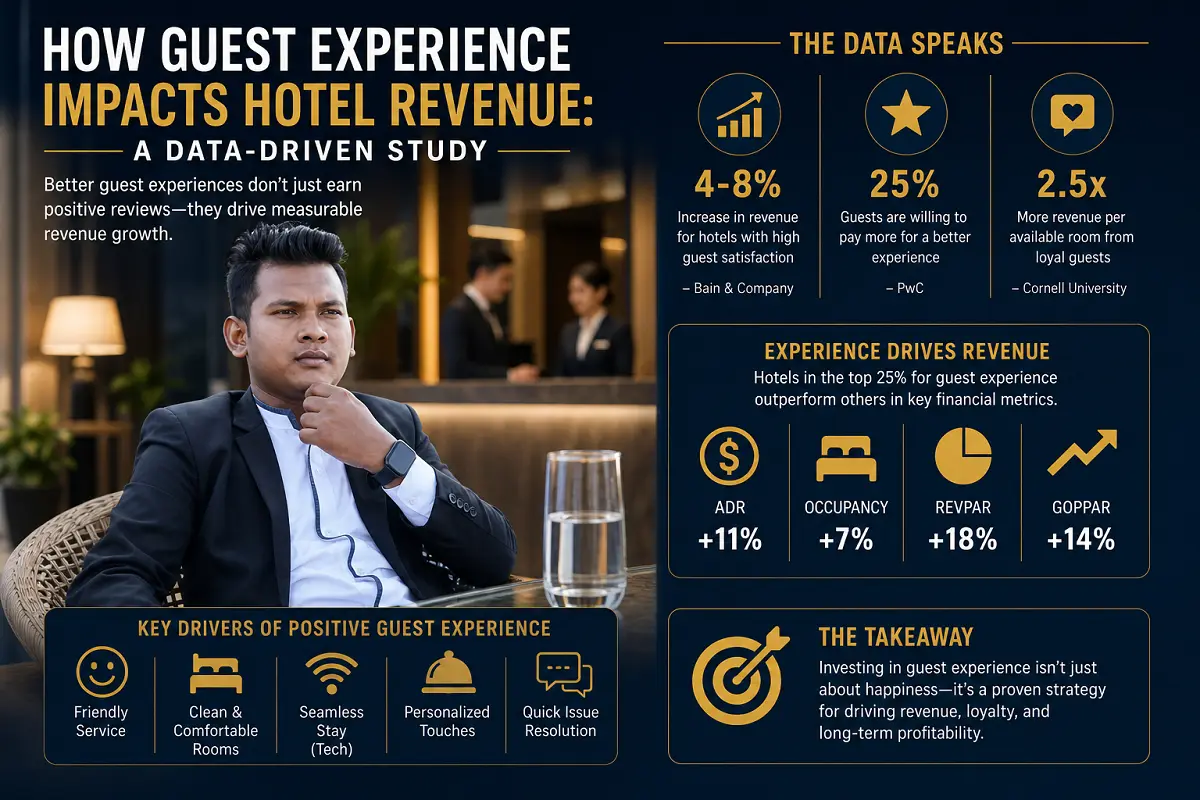
The hospitality industry has evolved significantly from traditional pricing models to advanced, experience-driven systems where guest experience impacts hotel revenue and overall financial performance. In this research, I, Ahmed Mainul, explore this connection, showing how modern revenue strategies are no longer limited to room pricing but are deeply connected to digital reputation and service quality. Based on industry data, empirical studies, and my practical understanding of hospitality operations, I establish a clear relationship between customer satisfaction and key financial metrics such as ADR, RevPAR, and overall profitability, highlighting the growing importance of guest experience in today’s competitive hospitality landscape.
The Evolution of Revenue Generation in the Hospitality Sector
The commercial architecture of the global hospitality industry has undergone a profound structural transformation over the past several decades. The industry has systematically evolved from rigid, inventory centric pricing models into highly dynamic, experience driven revenue ecosystems. Historically, the foundational principles of revenue management originated not within hotels, but within the commercial airline industry during the 1970s. Initially operating under the nomenclature of "yield management," this embryonic framework prioritized a singular operational directive: the maximization of yield per available seat through stringent capacity utilization.
When these early mathematical frameworks were subsequently adapted and integrated into the hotel industry during the mid to late 1980s spearheaded by early academic models developed by Orkin (1988), Kimes (1989), and Relihan (1989) the conceptual parameters were fundamentally expanded. The industry witnessed a paradigm shift wherein the optimization of physical room inventory transitioned to a broader strategic level. It became increasingly apparent that redefining yield as "revenue per available inventory" was necessary to capture the complexities of a multi-faceted service environment.
In contemporary operating environments, revenue management transcends mere capacity allocation and static pricing algorithms. It is now inextricably linked to the qualitative dimensions of the guest experience. The modern consumer landscape is heavily mediated by digital platforms, shifting the locus of pricing power away from unilateral corporate dictates and placing it firmly within the realm of public consensus, online reputation, and peer-to-peer validation. Consequently, the core purpose of contemporary revenue management, while still fundamentally focused on enhancing revenue potential is permanently tethered to the prioritization of customer satisfaction.
The quantification of this relationship represents one of the most critical imperatives for modern hotel operators, investors, and stakeholders. Academic literature and empirical industry benchmarks continuously demonstrate that underlying service delivery processes, whether structurally robust or critically flawed, manifest directly in digital review scores. These digital artifacts subsequently dictate global search visibility, consumer purchase likelihood, and ultimate financial performance. Consistent service delivery translates to higher overall review scores, whereas highly variable reviews—indicative of unstable and unpredictable service delivery processes demand urgent operational restructuring, as they severely diminish a property's pricing elasticity. As the international economy sees an increasing consolidation of hotel and restaurant chains, the ability to measure, predict, and optimize the correlation between subjective guest experiences and objective financial key performance indicators (KPIs) has become the definitive competitive advantage.
Analytical Frameworks and Statistical Modeling
To establish a definitive, causal link between the qualitative nature of a guest's stay and the quantitative financial output of a property, the industry relies heavily on advanced statistical modeling and predictive forecasting. In the realm of hospitality data analysis, regression modeling serves as the primary analytical framework. Regression analysis is a statistical method utilized to examine the exact mathematical relationship between a dependent variable (such as Revenue Per Available Room or overall profitability) and one or more independent variables (such as aggregate guest satisfaction scores, online review volume, or the specific lead time of a booking).
By leveraging linear, multiple, and logistic regression models, data scientists and hospitality researchers can isolate the exact financial impact of specific experiential variables. For example, a multiple linear regression analysis applied to a comprehensive dataset of hotel enterprises operating within the Republic of Croatia between 2002 and 2018 successfully revealed a strongly significant link between hotel operational excellence and broader macroeconomic indicators. The study proved that independent variables representing high-quality hotel operations act as significant predictors of gross domestic product (GDP) within the accommodation and food service sectors, confirming that the micro-level execution of guest satisfaction aggregates into macro-level economic development.
Furthermore, accurate demand forecasting remains a critical input for any successful hotel revenue management system. However, the methodology used to predict transient arrivals the guests who represent the most elastic and lucrative segment of the market must be rigorously tested. Extensive comparative studies utilizing vast datasets from Choice Hotels and Marriott Hotels have evaluated various forecasting methods. The empirical results utilizing Choice Hotel data demonstrated that pickup methods and sophisticated regression analysis produced the lowest margin of error. Conversely, simpler booking curve and combination forecasts produced highly inaccurate results. A more granular, in-depth evaluation utilizing Marriott Hotel data further validated that exponential smoothing, pickup tracking, and moving average models are the most robust frameworks for predicting future transient demand. Without accurate forecasts generated by these advanced models, the rate and availability recommendations produced by revenue management systems become dangerously inaccurate, potentially pricing a property out of the market or leaving significant revenue on the table.
The Macro Economics of Satisfaction: Quantifying the Reputation Revenue Nexus
The hypothesis that consumer sentiment directly and proportionally influences financial yields has been definitively proven through rigorous empirical evaluation. The most comprehensive academic efforts to quantify this specific relationship have been spearheaded by the Cornell University School of Hotel Administration, alongside longitudinal industry data compiled by ReviewPro, TrustYou, and extensive analytical models developed by hospitality researcher Ahmed Mainul and the Hospitality Career Profile institute.
Through a matched-sample data analysis integrating the Global Review Index (GRI), a proprietary aggregate online reputation score encompassing major travel sites and online travel agencies (OTAs) with transactional performance data from STR, researchers successfully isolated the financial elasticity of online reputation. The analysis determined that online reviews are directly responsible for rate swings exceeding 10%, fundamentally altering the baseline demand curve for room inventory.
The empirical findings dictate that a mere 1% escalation in a hotel’s Global Review Index score correlates directly with substantive increases across all primary revenue metrics. Specifically, this singular percentage point increase grants operators the leverage to increase the Average Daily Rate (ADR) by up to 0.89%, while simultaneously driving a 0.54% increase in total occupancy. The compounding effect of elevated pricing power and increased demand culminates in an aggregate 1.42% boost to Revenue Per Available Room (RevPAR).
However, the financial elasticity derived from guest satisfaction is not uniform across all tiers of the hospitality spectrum. Granular segmentation of the data reveals that the impact of online reputation varies profoundly depending on the chain scale and service level of the specific property.
Elasticity of Hotel Performance Metrics Relative to a 1% Increase in Global Review Index (GRI)
| Chain Scale Classification | Average Daily Rate (ADR) Elasticity | Occupancy Rate Elasticity | RevPAR Elasticity |
|---|---|---|---|
| All Scales Combined | 0.80% | 0.20% | 0.96% |
| Luxury | 0.44% | 0.09% | 0.49% |
| Upper Upscale | 0.57% | 0.30% | 0.74% |
| Upscale | 0.67% | 0.19% | 0.83% |
| Upper Midscale | 0.74% | 0.42% | 1.13% |
| Midscale | 0.89% | 0.54% | 1.42% |
The pronounced asymmetry in financial elasticity, where midscale properties experience a 1.42% RevPAR surge compared to the luxury segment's 0.49% is attributed to the psychological mechanisms of perceived service quality uncertainty. Consumers inherently possess high confidence in the baseline service standards of luxury and upper-upscale establishments. Consequently, positive reviews in the luxury sector serve merely to confirm pre-existing expectations. Conversely, the midscale segment is historically characterized by high service volatility. A critical mass of highly rated reviews functions as a powerful risk-mitigation tool for potential guests navigating the midscale market. This radically reduces uncertainty and grants mid-tier operators disproportionate pricing power relative to their baseline market position.
Further supporting this dynamic is point-of-purchase transactional data extracted directly from platforms such as Travelocity. Analysis of booking behavior reveals that a one-point swing on a standardized five-point rating scale (for example, advancing from a 3.3 to a 4.3 overall rating) allows a hotel to elevate its room rates by an extraordinary 11.2% while entirely maintaining its existing occupancy levels and market share. This metric unequivocally demonstrates that positive guest experiences do not merely drive volume; they fundamentally increase the financial premium that consumers are willing to pay for perceived reliability.
Market Maturation, Consumer Behavior, and the Pricing Tolerance Threshold
The hospitality sector is currently navigating a period of profound macroeconomic shifting, characterized by elevated operational costs, evolving consumer behaviors, and record-breaking demand volumes. According to the comprehensive 2024 North America Hotel Guest Satisfaction Index (NAGSI) Study conducted by J.D. Power, the industry has reached unprecedented pricing thresholds. In May 2024, the Average Daily Rate (ADR) for a U.S. hotel room reached $158.45, representing the second-highest monthly average in recorded history.
This aggressive rate expansion has directly influenced consumer travel patterns. The data indicates that North American hotel guests are currently taking fewer trips overall, averaging nine trips per year, down from ten in 2023. However, while the frequency of travel has slightly compressed, the duration of the experience has expanded, with average stays increasing to 3.43 days from 3.36 days the previous year. Because consumers are traveling less frequently but staying longer at significantly higher price points, the expectations for flawless service delivery have never been higher.
Remarkably, despite these severe pricing pressures, global satisfaction metrics have shown extraordinary resilience. TrustYou's global performance score analysis indicates that aggregate satisfaction is steadily increasing; the Q1 2024 global score reached 81.7 (out of 100), surpassing the 80.8 score recorded in Q1 2023. This growth indicates that guests are actively accepting and validating the efforts of properties that invest heavily in the guest experience, even in the face of inflationary pricing. Regional analysis further underscores this trend. The EMEA region (Europe, Middle East, and Africa) demonstrates exceptional operational maturity, recording a performance score of 86.2 in Q1 2024. This significantly outpaces the global average and highlights the superior structural service baseline established by operators in these markets.
The 2026 Guest Experience Benchmark report, analyzing over 9,500 hotels worldwide and encompassing over 3 million reviews, confirms this narrative of market maturation. Globally, the Guest Review Index reached a record 86.7% in 2025, which represents a 0.5 percentage point year-over-year increase and places the global standard 1.3 points above pre-pandemic highs. Crucially, this rise in satisfaction occurred concurrently with a 2.1% growth in review volume. This statistical decoupling fundamentally challenges legacy assumptions that high volume inevitably strains service delivery and erodes quality. The data proves that modern hotel operations have learned how to successfully scale quality through advanced process maturity and technology.
A critical sub-trend within this landscape is the aggressive realignment of the digital platform hierarchy. For the first time since the pandemic disruption, Google has decisively overtaken TripAdvisor as the preeminent global review aggregator. In 2025, Google accounted for 12.4 million tracked mentions compared to TripAdvisor's declining 10.3 million. This platform shift alters the tactical landscape for operators, as Google’s algorithms prioritize velocity, high-frequency local search behavior, and immediate mobile integration. Consequently, operators are adapting by dramatically decreasing their response times to satisfy the demands of instantaneous digital ecosystems.
The Luxury Segment Paradox
While the broader industry enjoys rising satisfaction, the luxury sector is currently navigating a unique operational paradox. The luxury market is experiencing substantial volume growth with review volumes expanding by 4.4% yet overall guest satisfaction scores within this top tier have stagnated, particularly in the mature markets of North America and Europe. The J.D. Power study notes that while full-service and luxury brands have seen steady satisfaction year-over-year, they are operating on a razor's edge due to their sharp rate increases.
The modern luxury guest, paying unprecedented financial premiums, possesses zero tolerance for operational friction. Detailed segment analysis from major European luxury hubs, such as Madrid, starkly illustrates this dynamic. Within Madrid's luxury segment between January and October 2023, properties like the Intercontinental Madrid and Mandarin Oriental Madrid showed notable improvements, yet a staggering 95.4% of all negative review mentions directly cited "price" as the primary grievance. Crucially, this dissatisfaction was rarely directed at the core room rate itself. Instead, guests penalized the properties for the perceived extortionate pricing of ancillary services, including parking, restaurant meals, breakfast, and airport transfers. This data indicates that the luxury segment has reached the upper limits of consumer pricing tolerance. Operators can no longer rely on brand prestige alone to justify continuous, aggressive markups on secondary services.
Advanced Financial Metrics: Deconstructing RevPAR, TRevPAR, and GOPPAR
As the definition of the hospitality product expands beyond mere overnight accommodation, the statistical instruments utilized to measure financial health must concurrently evolve. Recognizing that 82% of hospitality executives believe standard metrics are no longer sufficient to gauge true performance, the industry is shifting its analytical focus. Historically, Revenue Per Available Room (RevPAR) has served as the undisputed benchmark of operational success. Calculated by multiplying the occupancy rate by the Average Daily Rate (ADR), RevPAR provides a standardized metric for evaluating a property's ability to fill its core inventory at profitable price points.
However, focusing exclusively on RevPAR creates a dangerous analytical blind spot known as the "Profitability Paradox." For instance, a property maintaining a 90% occupancy rate at an $80 ADR generates a RevPAR of $72. A competing property maintaining a 70% occupancy rate at a $120 ADR achieves a higher RevPAR of $84. Analyzed in a vacuum, the second property appears superior. Yet, if the high-occupancy property operates with streamlined, hyper-efficient cost structures, it may actually capture significantly higher net profit despite its lower RevPAR. Furthermore, optimizing solely for RevPAR often incentivizes aggressive discounting, which maximizes room revenue at the direct expense of long-term brand equity and holistic guest satisfaction.
To achieve a comprehensive evaluation of financial performance and guest capitalization, sophisticated asset managers integrate two advanced metrics: Total Revenue Per Available Room (TRevPAR) and Gross Operating Profit Per Available Room (GOPPAR).
Total Revenue Per Available Room (TRevPAR)
TRevPAR represents a holistic expansion of standard RevPAR methodologies. While RevPAR isolates room revenue, TRevPAR aggregates all income generated by the property, encompassing ancillary spending across food and beverage (F&B) outlets, spa services, in-room dining, retail operations, and event space rentals.
The tracking of TRevPAR is deeply interconnected with the qualitative guest experience. Happy guests exhibit a significantly higher propensity to utilize on-site facilities, extending their financial footprint within the property's ecosystem. Empirical studies analyzing the correlation between guest satisfaction programs and financial outputs consistently demonstrate significant increases in TRevPAR alongside rising customer satisfaction indices. By optimizing the entirety of the guest journey from the lobby bar to wellness centers hotels can radically boost their bottom line without fundamentally altering their core room inventory offerings. Longitudinal data spanning from 2010 to 2017 confirms a global upward trajectory in TRevPAR, heavily influenced by location, service integration, and star rating classifications.
Gross Operating Profit Per Available Room (GOPPAR)
While TRevPAR captures the sum total of incoming capital, it remains a gross metric unadjusted for the cost of service delivery. High revenue does not unilaterally equate to high profitability. To ascertain the true operational health of a hotel, industry leaders rely on GOPPAR.
GOPPAR factors in the comprehensive spectrum of operational expenses, ranging from labor and utility costs to marketing expenditures and administrative overhead. In the context of the contemporary economic landscape—characterized by escalating inflation, severe labor shortages, and spiking utility costs GOPPAR has emerged as the most critical metric for institutional investors. It effectively normalizes profit by available room count, allowing for accurate, comparative benchmarking across properties of varying physical sizes and market classifications.
The correlation between GOPPAR and guest satisfaction is critical. Providing an exceptional guest experience necessitates financial investment in staffing, premium amenities, and rigorous maintenance. Regular GOPPAR analysis allows management to evaluate whether the capital deployed to enhance the guest experience generates a proportional return on investment. A landmark academic study by Banker et al. (2005) analyzed the implementation of customer satisfaction incentive plans within the hospitality sector. The findings demonstrated a significant increase in both TRevPAR and GOPPAR as a direct result of these plans; because the incentive payouts were capped as a percentage of operating profit, the initiatives successfully covered their own expenses and produced a net profit increase, confirming that targeted investments in customer satisfaction yield a significant positive impact on holistic profitability.
The Asymmetrical Financial Attrition of Negative Feedback
While the optimization of guest satisfaction yields substantive financial premiums across TRevPAR and GOPPAR, the economic consequences of negative guest experiences exhibit a severe, asymmetrical downside. The proliferation of digital transparency means that operational failures are no longer isolated incidents confined to the immediate guest; they are permanently codified into the property's digital footprint. The financial attrition caused by negative online reviews functions as a compounding liability that rapidly erodes profit margins, diminishes asset valuation, and necessitates aggressive, margin-destroying corrective pricing strategies.
Consumer behavior data indicates that an overwhelming 97.7% of travelers analyze online reviews pertaining to accommodations, amenities, and previous guest experiences prior to authorizing a transaction. More critically, 94% of consumers report definitively abandoning a booking due to the presence of negative reviews. The direct correlation between negative public feedback and lost revenue is stark. According to a comprehensive analysis by Convergys Corp., a single negative online review drives away approximately 30 potential customers. The accumulation of more than three negative reviews acts as a severe deterrent, leading to a catastrophic loss of up to 70% of potential new customer acquisition.
The immediate financial impact of this attrition can be modeled mathematically. For a standard property operating with an Average Daily Rate (ADR) of $125, the presence of a single negative review can result in a monthly revenue hemorrhage of approximately $15,494.
Estimated Revenue Attrition Correlated with Negative Review Accumulation (Assuming $125 ADR Baseline)
| Volume of Negative Reviews | Estimated Monthly Revenue Loss | Estimated Annual Revenue Loss |
|---|---|---|
| One (1) Negative Review | $15,494.00 | $185,928.00 |
| Four (4) Negative Reviews | $59,533.69 | $714,404.28 |
Beyond the immediate forfeiture of direct booking revenue, negative reviews generate a sophisticated snowball effect that damages the structural integrity of the property's financial model. As occupancy levels inevitably decline in response to a poor digital reputation, revenue managers are frequently forced into reactionary, defensive postures. To remain competitive and artificially stimulate demand to fill vacant inventory, operators slash room prices. While discounting may provide a short-term injection of occupancy, it inflicts severe long-term damage on the hotel’s brand positioning. Premium, high-yielding guests systematically migrate to competitors, leaving the distressed property entirely reliant on budget-conscious, highly price-sensitive demographics. This demographic shift further compresses margins, as budget-oriented guests historically generate significantly lower ancillary spending across food, beverage, and spa outlets, dragging down TRevPAR.
Furthermore, the cost of negative reviews permeates the internal operational ecosystem. Chronic exposure to public guest dissatisfaction devastates internal staff morale. When frontline employees are subjected to continuous digital reprimands particularly concerning systemic issues beyond their immediate control job satisfaction plummets. This dynamic directly fuels high staff turnover rates. Given the acute labor pool shortages currently challenging the global hospitality sector, high turnover requires substantial financial outlays for recruiting, onboarding, and training new personnel. Consequently, the true cost of a negative review encompasses not only lost room revenue but also the tangible inflation of human resources and operational expenditures.
In conjunction with reputational damage, the quiet erosion of revenue is further exacerbated by fragmented technological systems and poor data quality. Discrepancies in data synchronization across booking channels result in massive rate leakage. Analytical assessments from the Expedia Group B2B Distribution Study indicate that 98% of hotels suffer direct revenue losses due to rate misuse every four days. When pricing data is inconsistently distributed to unintended partners or unauthorized resellers due to manual rate-loading errors, revenue strategy devolves into guesswork, and the meticulous pricing power gained through positive guest experiences is structurally undermined.
Strategic Digital Engagement and the Voice of the Customer for Guest Experience Impacts Hotel Revenue
Recognizing the immense financial leverage wielded by user-generated content, sophisticated hospitality operators have transitioned from passive observation to active digital engagement. The strategic implementation of Voice of the Customer (VOC) programs and proactive review management functions as a non-operational and highly cost-effective mechanism for boosting financial outcomes. However, empirical evaluations of management response protocols indicate a highly nuanced, non-linear relationship between response frequency, guest perception, and subsequent revenue generation.
The foundational step in digital reputation management involves the active solicitation of feedback. Properties that utilize automated post-stay communication tools to actively encourage guests to post reviews experience immediate, substantive improvements in their digital standing. By transitioning a silent majority of satisfied guests into vocal digital advocates, properties dramatically increase their review volume. Comparative testing indicates that the implementation of active review solicitation can propel review volume indices from 86.1 to 224.4, simultaneously driving positive review percentages from 99.9 to 102.9. This surge in volume elevates the property's algorithmic ranking on major review platforms, directly increasing organic visibility during the consumer's critical travel research phase.
Once reviews are published, management response strategies become paramount. Constructive engagement from hotel management signifies an institutional commitment to the guest experience, fostering consumer trust. Transactional data verifies that robust management responses directly correlate with an increase in consumers clicking through from review aggregators to the hotel's direct booking engines or specific OTA listings.
However, operators must navigate the strict mathematical parameters governing the efficacy of management responses. The relationship between response volume and revenue is governed by the economic principle of diminishing marginal returns. Data delineates that revenue improvements tied to management responses peak at a response rate of approximately forty percent. Beyond this threshold, the financial efficacy of the responses degrades.
More critically, excessive digital engagement can trigger negative elasticity. If a hotel management team responds to more than eighty-five percent of all published reviews, the property's financial performance drops below the baseline metrics achieved by properties that offer zero responses. This paradoxical outcome is driven by consumer psychology. Prospective guests value authenticity. When management responds to every single review particularly positive ones with generic, repetitive acknowledgments, the engagement is perceived as automated, insincere, and corporate. Statistical modeling indicates that while actively encouraging reviews can boost a property's score by 1.65%, the practice of responding to all positive reviews with repetitive gratitude can initiate a subsequent score drop of 2.46%.
The data unequivocally dictates that management resources must be deployed asymmetrically. Consumers extract the highest value from observing how management navigates adversity. Consequently, constructive, empathetic, and solution-oriented responses to negative feedback yield substantially higher reputational dividends than simple acknowledgments of positive praise. By demonstrating a tangible commitment to rectifying service failures, properties effectively neutralize the toxicity of a bad review, reassuring prospective buyers that management is actively listening and dedicated to continual operational refinement.
Operationalizing the Experience: Standard Operating Procedures and the My Frameworks
The macro-level statistics defining RevPAR, TRevPAR, and the Global Review Index are ultimately the cumulative result of thousands of micro-interactions executed daily by frontline personnel. The structural consistency required to minimize the coefficient of variation (CV) in guest reviews is entirely dependent upon the rigorous implementation of Standard Operating Procedures (SOPs) across all departments. Extensive research models and operational frameworks developed by industry leader Ahmed Mainul, widely published through the Hospitality Career Profile institute, provide a blueprint for how technical proficiency at the ground level directly dictates top-line revenue.
Evaluations of these operational frameworks consistently point to two primary vectors of service delivery that dictate the trajectory of guest satisfaction: Front Office interactions and Food & Beverage (F&B) service standards.
Front Office and the Psychology of Arrival
The front desk serves as the operational nerve center and the primary mechanism for establishing the psychological tone of the guest journey. Industry polls and procedural analyses curated by Mainul dictate that the overwhelming majority of guest satisfaction hinges on the efficiency of this specific touchpoint. Data reveals that 61.6% of frontline operational focus must be dedicated strictly to the flawless mechanics of check-in and check-out procedures, while 28.1% is devoted to managing real-time guest inquiries.
When check-in protocols are executed with precision, the guest is insulated from the internal administrative friction of the hotel. A premier example of this operational excellence is found in the integration of the Guest Experience Index (GEI) at properties such as The Westin Dhaka. As highlighted in regional case studies, advanced front office teams utilize the GEI to deeply analyze guest profiles prior to arrival. By merging feedback from previous stays directly into the guest's profile, the front desk can anticipate needs and fulfill specific preferences before the guest even vocalizes them. This structural consistency ensures that the guest feels valued immediately, effectively creating a psychological buffer of goodwill that insulates the property against minor operational hiccups that may occur later in the stay. Conversely, chaotic, prolonged, or error-prone check-in procedures instantly elevate guest anxiety, establishing a negative confirmation bias that virtually guarantees a depressed digital evaluation upon departure.
Food & Beverage (F&B) Service Classifications and Revenue Optimization
While the room rate dictates the baseline RevPAR, the Food and Beverage department serves as the primary engine for driving TRevPAR and shaping the qualitative distinction necessary for a five-star rating classification. In highly competitive regions such as the Asia-Pacific (APAC) market, F&B operations have evolved to match global dining standards; however, they concurrently face severe margin compression due to rising food costs and specialized labor shortages in the kitchen.
To overcome these macroeconomic headwinds, properties must rely on uncompromising SOPs. Comprehensive service training guides authored by Mainul emphasize the critical nature of product classification ranging from the detailed dichotomy of alcoholic versus non-alcoholic beverage service to the precise mechanics of order taking and table management. When staff are thoroughly trained on the ultimate classification of beverages and culinary offerings, they transition from mere order takers to consultative culinary guides. This expertise allows for seamless, non-intrusive upselling. A waiter who can expertly pair a locally sourced vintage with the evening's special organically increases the average check size. This micro-interaction directly boosts the property's TRevPAR while simultaneously elevating the guest's perception of the service value, directly translating to the five-star review mentions that drive global visibility.
Technological Intermediation and Predictive Market Intelligence
To consistently execute rigorous SOPs across massive, fluctuating volumes of guests, the hospitality industry is undergoing a rapid, structural integration of Artificial Intelligence (AI) and advanced property technology. Technology is no longer viewed merely as an administrative back-end tool, it is the primary conduit for service delivery. Recent industry reports highlight that the integration of tech stacks to boost guest engagement is central to modern hospitality strategy, strongly emphasizing the blending of business and leisure travel (bleisure) and the growing imperative of sustainability.
The immediate application of this technological pivot is the automation of the Voice of the Customer (VOC). Research indicates that over 50% of hospitality providers are currently utilizing, or actively integrating, AI protocols to revolutionize customer experience management. Machine learning algorithms are deployed to automatically program dynamic survey questions, ingest and summarize thousands of open-ended guest responses, track interaction patterns, and analyze call center audio. TrustYou's Customer Experience Platform (CXP) and Customer Data Platform (CDP) exemplify this shift, leveraging predictive market intelligence and forward-looking search data to increase predictability, accuracy, and response times. By systematically processing this massive influx of unstructured data, AI platforms identify macro-trends and micro-failures in real time. This permits hotel managers to deploy proactive interventions, resolving guest grievances before the individual departs the property, thereby intercepting and neutralizing potential negative online reviews before they can be published.
Furthermore, AI is rapidly intermediating direct guest communications and revenue capture. Advanced conversational AI and automated chatbot platforms, seamlessly integrated into messaging ecosystems like WhatsApp and native booking engines, are providing 24/7, multilingual guest assistance. Platforms such as HiJiffy not only resolve basic facility inquiries and trigger in-house maintenance tickets, but they also execute sophisticated revenue-generating operations. Custom algorithmic flows automatically process group booking requests, instantly passing pre-qualified leads directly to the reservations department, ensuring that high-value inquiries are never lost to slow response times.
Simultaneously, these AI platforms deploy automated, personalized upselling campaigns. Prior to arrival or immediately post booking, guests receive dynamic offers for room upgrades, late check outs, or specialized F&B packages via integrations with upselling platforms like Oaky. By removing the friction from the purchasing process and allowing the guest to customize their stay via mobile interfaces, hotels simultaneously maximize their TRevPAR yields and cater to the modern consumer's demand for high-tech, contactless autonomy.
Empirical Case Studies in Revenue Optimization
The theoretical frameworks connecting guest experience, standard operating procedures, and advanced revenue metrics are definitively validated through real world, empirical case studies. An analysis of major portfolio realignments, strategic market interventions, and specific property data models provides concrete evidence of the financial upside associated with prioritizing guest satisfaction.
Strategic Redevelopment: Newport Hospitality Group
The portfolio metrics of the Newport Hospitality Group (NHG)—which manages 37 hotels encompassing 3,651 rooms across 12 U.S. states demonstrate the long-term viability of experience-centric asset management. Over a 19-year longitudinal tracking period, NHG has maintained a continuous 2.9% RevPAR Index premium and a 5.5% RevPAR Compound Annual Growth Rate (CAGR).
A primary driver of this success is the strategic redevelopment of distressed assets to meet modern consumer expectations. A definitive example is the total redevelopment of a functionally obsolete Holiday Inn in Blacksburg, Virginia. Recognizing the asset's inability to compete in the contemporary market, the property was demolished and re-conceptualized into a dual-branded, 333 room complex featuring a Hyatt Place and a Residence Inn, complete with over 5,000 square feet of meeting space. By recruiting and training local talent to execute precise brand SOPs, the new development rapidly captured dominant market share. The operational success is objectively validated by the Residence Inn Blacksburg earning the Marriott Silver Circle Award, a distinction reserved exclusively for properties whose Guest Satisfaction Scores (GSS) rank in the top 20% of the entire global brand. The capitalization on this top-tier guest satisfaction resulted in sustained high occupancy and a massive increase in aggregate asset revenue.
Similarly, the development of the 175 room Hilton Garden Inn & Home 2 Suites in Brunswick, Georgia, utilized a dual-brand strategy to target segmented demand generators along the I 95 corridor. By applying stringent value engineering and procurement strategies during development, the property minimized foundational costs. Upon opening, rigorous adherence to Hilton's service standards resulted in exceptionally high service delivery levels, ensuring robust GOPPAR margins despite competitive regional pressures.
Rebranding and Dynamic Market Positioning
The correlation between brand perception, guest satisfaction, and financial performance is further evidenced by a paired-samples analysis of the Holiday Inn Singapore Orchard City Centre. Following a comprehensive rebranding initiative aimed at elevating the property's market positioning, researchers evaluated pre- and post-rebranding metrics. The empirical results revealed that the rebranding effort successfully resonated with the consumer base, generating statistically significant increases in both total occupancy and RevPAR. While the Average Daily Rate and Overall Guest Satisfaction (OSAT) demonstrated non-significant increases potentially depressed by anomalous demand lulls during regional holidays the definitive surge in RevPAR proves that realigning a physical property to better fulfill contemporary guest expectations creates immediate, quantifiable improvements in asset liquidity and market performance.
Furthermore, adaptive market positioning through dynamic pricing and experiential marketing has proven vital for independent properties navigating severe seasonal demand fluctuations. Case studies of heritage assets, such as The Luxe Grand Palace in Jaipur, and seasonal resort properties, like The Hillside Retreat in Manali, illustrate this dynamic. Facing extended off-peak periods, these properties successfully maintained baseline revenues by utilizing advanced search engine optimization (SEO) to attract niche demographics, simultaneously pairing these digital efforts with specialized promotional packages. By pivoting the operational focus from mere accommodation to culturally rich, curated experiences such as offering exclusive heritage-themed dinners featuring regional folklore these properties successfully protected their TRevPAR metrics during periods of low macro-economic demand.
Data visualization and statistical analysis of independent property portfolios further confirm the mechanisms of revenue optimization. For instance, data models reviewed by an industry analyst mapping hotel revenue growth revealed a consistent positive correlation between ADR and booking lead time (averaging 77.09 days). Despite managing a cancellation rate of 7.28% and offering discounts scaling to 25.80%, the property maintained consistent year-over-year revenue growth reaching $10.23 million. The analysis dictates that to sustain this growth, the property must leverage the positive ADR-lead time relationship to implement dynamic pricing that maximizes yield during peak seasons while explicitly focusing on expanding physical facilities and reinvesting in customer experience protocols to ensure high levels of repeat business.
Strategic Directives and Industry Outlook
The exhaustive data presented throughout this study confirms an irrefutable axiom: within the modern hospitality economy, digital reputation and the guest experience are not merely qualitative marketing assets; they are the fundamental, load-bearing pillars of structural revenue generation. The historical methodology of siloing revenue management into strict mathematical pricing algorithms, divorced from the human realities of operational service delivery, is entirely obsolete.
To thrive in the impending operational cycles of 2026 and beyond, hospitality asset managers, ownership groups, and operational directors must execute against the following strategic directives:
First, executive evaluations must shift away from the superficial metrics of RevPAR and raw occupancy. Asset health must be continuously audited against Gross Operating Profit Per Available Room (GOPPAR) and Total Revenue Per Available Room (TRevPAR). This ensures that the capital expenditures required to maintain high guest satisfaction are translating directly into verifiable net profitability across all operational departments, from the front desk to the dining room.
Second, operators must deploy asymmetrical review management strategies. The mathematical reality of digital engagement dictates that properties must actively solicit reviews to build algorithmic dominance on platforms like Google, yet exercise strict restraint in management responses. The optimal strategic threshold is an approximate 40% response rate, heavily skewed toward providing constructive, operational solutions to negative feedback, thereby mitigating reputational damage and preserving long-term pricing elasticity.
Third, properties must invest heavily in preventative technological infrastructure. The adoption of predictive, AI-driven Voice of the Customer (VOC) platforms, data-driven Customer Experience Platforms (CXP), and conversational interfaces is mandatory. By identifying internal service failures and resolving guest grievances in real-time before departure, operators preemptively protect their Global Review Index (GRI), subsequently shielding their ADR from forced, defensive discounting in the open market.
Finally, standard operating procedures must be ruthlessly reinforced amidst scaling volume. While experiential elements such as F&B conceptually drive five-star ratings and ancillary revenue, the core infrastructural metrics of room cleanliness and physical integrity remain highly vulnerable to high-volume stress. Management must heavily reinvest in the human capital of the housekeeping and engineering departments, recognizing that a failure in these foundational areas exerts a catastrophic, mathematically disproportionate drag on overall digital reputation and subsequent revenue capture.
Ultimately, the empirical evidence dictates that the properties commanding the highest financial premiums in the modern era will be those that engineer a seamless, frictionless guest journey. By perfectly aligning advanced technological frameworks with rigorous, empathetic human service delivery based on proven operational models, hotels can decisively optimize their digital reputation, achieving absolute supremacy in both market share and total asset profitability.