Tangdi Kabab Hariyali Recipe That Grills Vibrant, and Perfectly Juicy
Make vibrant tangdi kabab hariyali at home with this authentic green herb marinade recipe. Juicy chicken legs, smoky finish, restaurant-style. Get the full recipe now.
 Tripti Srivastava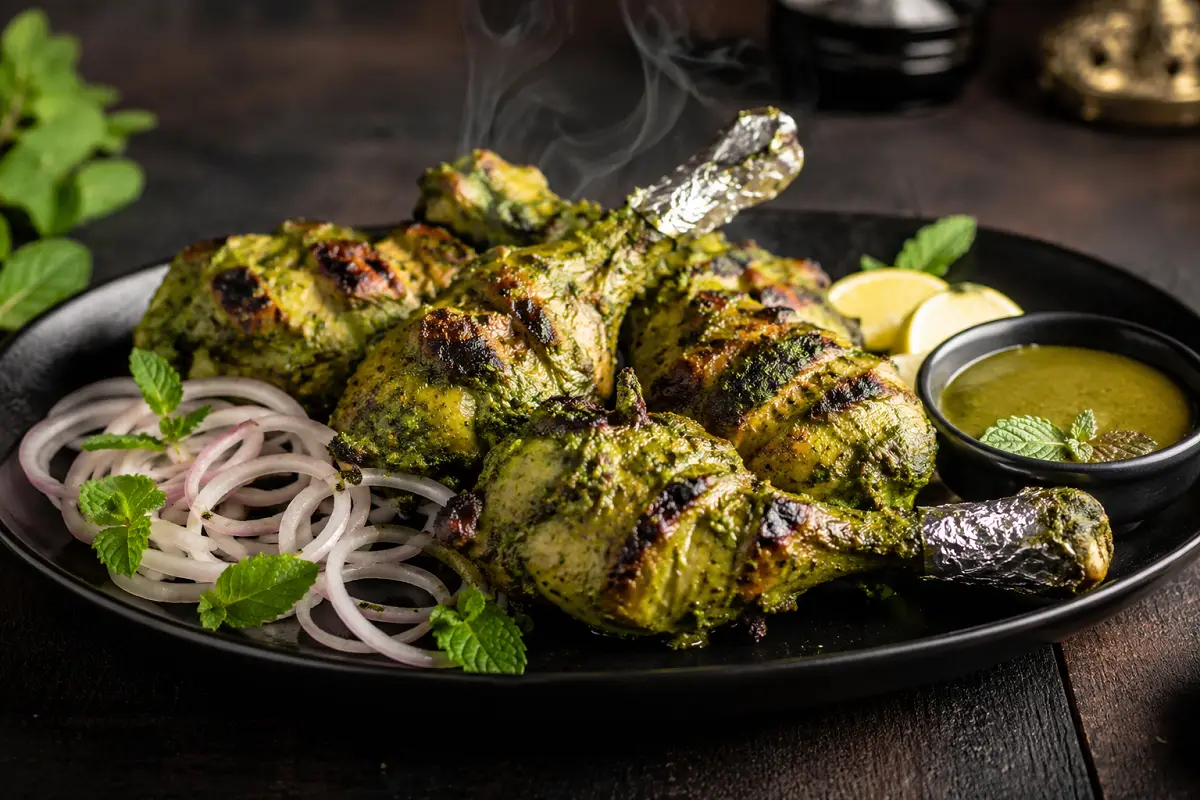
There are some dishes that look as good as they taste and tangdi kabab hariyali is one of the most visually striking things you can put on a party table. Those deep green, herb-coated chicken legs, blistered at the edges from high heat, the bone tip wrapped in a crisp foil frill, arranged on a dark slate board with a bowl of bright red chutney alongside it, are the kind of platter that makes guests stop mid-conversation and reach for their phones.
The word "hariyali" means greenery in Hindi, and the marinade earns that name completely. Blended fresh coriander, mint, spinach, and green chillies form the vivid base, tempered with yoghurt, roasted cashews, and fragrant spices. The result is a marinade that is herby, gently spiced, slightly nutty, and absolutely unlike anything you get from a red tandoori coating.
What makes this recipe genuinely special is the technique. Tangdi kabab means "chicken leg kabab" and cooking on the bone is what gives this dish its edge. The bone conducts heat from the inside as the marinade chars and caramelises on the outside, producing chicken that is simultaneously crispy-edged and fall-off-the-bone tender at the joint. If you have only ever made boneless chicken tikka, this recipe will completely change your approach to grilling chicken.
What Makes This Tangdi Kabab Hariyali Special
Green marinades are not new, but this one is built differently. Here is what sets it apart from a standard hariyali coating:
- Spinach in the marinade: Most hariyali recipes use only coriander and mint. Adding a small handful of fresh spinach deepens the green colour significantly it goes from pale, dull green to a vivid, jewel-toned coating that holds its colour even after cooking. Spinach also adds body to the blended paste without changing the flavour.
- Roasted cashew paste: Dry-roasting the cashews before blending adds a warm, toasty depth that raw cashews do not have. This is what gives the hariyali marinade its slight nuttiness and helps it adhere to the chicken through the cooking process.
- Double scoring technique: Deep scores cut all the way to the bone on each chicken leg, not just shallow surface cuts. This allows the marinade to penetrate deeply into the meat and ensures the thickest part of the leg cooks through at the same rate as the outer layers.
- Charcoal dhungar finish: Even oven-cooked hariyali tangdi benefits enormously from a 45-second coal-smoking step; it adds a smoky dimension that makes the herby marinade taste like it came off a live charcoal grill.
- Classic foil frill presentation: The signature bone-tip frill is not just decorative; it protects the guest's fingers when holding the leg and is the detail that tells everyone at the table this dish was made with care and proper technique.
Ingredients Overview
The hariyali paste is the heart of this recipe a blend of fresh coriander, mint leaves, baby spinach, green chillies, ginger, and garlic with a squeeze of lemon juice. The ratio matters: coriander and spinach form the bulk of the green paste, while mint adds fragrance and chilli adds heat. Too much mint and the paste tastes medicinal; too little and the freshness disappears. The ratio in this recipe is calibrated to get the balance exactly right.
Chicken legs: the full drumstick and thigh attached give the best result for tangdi kebab. If your butcher separates them, use drumsticks only and reduce cooking time slightly. Skin-on legs give a better caramelised crust; skinless legs absorb more marinade flavour. Both work; the choice depends on your preference.
The marinade uses hung curd as its dairy base, which binds the blended herb paste and the roasted cashew paste into a thick, uniform coating that grips the scored chicken and does not slide off during cooking. If hung curd is unavailable, thick Greek yoghurt is a direct substitute. A tablespoon of roasted besan in the marinade acts as the professional binder; it is the reason restaurant hariyali tangdi has that thick, set coating rather than a thin, watery green film. Hariyali chicken is a beloved staple of North Indian restaurant menus and home celebrations alike.
How to Make It
Score the chicken legs deeply, apply a quick first marinade of lemon juice and salt to open up the meat, then coat generously in the thick hariyali paste and refrigerate for at least 4 hours. Cook over high heat oven grill, charcoal, or a grill pan basting with butter halfway through. Finish with the dhungar coal smoke if available, rest for 3–4 minutes, add the foil frill, and serve immediately.
The active work is about 30 minutes. The overnight marinade does everything else.
Also Read: Mutton Boti Kebab Recipe
Tips for Best Results
- Score the legs all the way to the bone. Shallow cuts on the surface look the part but do not allow marinade to reach the interior. Use a sharp knife and make cuts 1.5–2cm deep, angled into the thickest part of the meat.
- Blanch the spinach before blending if you want the colour to stay vivid green after cooking. Drop spinach leaves in boiling water for 20 seconds, transfer immediately to ice water, squeeze dry, then blend. This locks the chlorophyll and prevents the brownish-green colour that raw spinach can develop during grilling.
- Marinate overnight for the best result. The herbs, spices, and yoghurt need extended time to penetrate chicken-on-the-bone. Four hours is the minimum; eight to twelve hours is optimal.
- Bring the chicken to room temperature for 30–40 minutes before cooking. Cold legs straight from the fridge cook unevenly the outside chars before the bone-deep interior reaches temperature.
- Use a meat thermometer if you have one. Chicken on the bone is cooked through when the internal temperature at the thickest point (not touching the bone) reads 74°C / 165°F.
- Rest before serving. Three to four minutes of resting after cooking allows the juices to redistribute from the bone outward into the meat the difference between a juicy tangdi and a dry one.
Serving Suggestions
Tangdi kabab hariyali is a showstopper platter dish. Serve with a red-orange tomato-chilli chutney alongside the green of the kabab the colour contrast is visually dramatic and the flavour contrast (cooling herby chicken against hot tangy chutney) is exactly right. Thin laccha onion rings soaked in lemon and chaat masala and a wedge of lemon complete the classic accompaniment.
For a sit-down starter, one full chicken leg per person plated individually on a flat white plate or slate with the foil frill on the bone, a small ramekin of chutney, and a fan of cucumber and onion on the side makes an elegant first course that sets the tone for the rest of the meal.
For a full meal, serve alongside dal makhani, butter naan, and a cooling raita. The richness of the dal balances the herby brightness of the hariyali chicken perfectly. As a party platter, two legs per serving board, arranged at opposing angles with chutney bowls at each end, feeds four to six guests as a generous appetizer.
Storage and Reheating
Store cooked tangdi kabab hariyali in an airtight container in the fridge for up to 3 days. The herby marinade coating stays intact and the flavour continues to deepen overnight cold leftover hariyali tangdi is genuinely excellent pulled off the bone and wrapped in a paratha roll with sliced onion and chutney for lunch the next day.
To reheat, place the chicken legs on a wire rack set over a baking tray. Heat in the oven at 180°C for 12–15 minutes until warmed through and the coating has crisped up again. This method preserves the outer coating far better than a microwave, which makes the herb crust soggy and the chicken rubbery.
Raw marinated chicken legs can be frozen for up to 6 weeks. Lay flat on a lined tray, freeze until solid, then transfer to zip-lock bags. Defrost overnight in the fridge and cook as per the directions the marinade actually intensifies during freezing.
Variations and Substitutions
- Hariyali chicken tikka: Use the exact same marinade on boneless chicken thigh cubes threaded onto skewers. Reduce marinating time to 2 hours and cooking time to 15 minutes total.
- Hariyali paneer tangdi (vegetarian): This one is a creative twist use thick paneer slabs shaped and skewered to mimic a tangdi shape. Marinate for 1 hour and grill for 10–12 minutes. Serve with the same foil frill presentation for a vegetarian platter that gets as much attention as the original.
- Malai hariyali tangdi: Add 2 tablespoons of fresh cream and reduce the green chilli by half for a richer, paler, creamier version of the hariyali marinade. This is a popular wedding-banquet variation that suits guests who prefer a milder flavour profile.
- Lemon hariyali tangdi: Double the lemon juice in the marinade and add the zest of one lemon for a sharper, more citrus-forward version that works particularly well on a summer grill.
- Coconut hariyali tangdi: Replace half the hung curd with thick coconut cream and add a tablespoon of desiccated coconut to the blended paste. This gives the marinade a coastal South Indian dimension herby, creamy, and slightly sweet that pairs beautifully with a coconut chutney on the side.
Preparation Method
Start by cleaning the chicken legs and making deep score cuts, three to four cuts per leg, angled into the thickest sections of the thigh and drumstick, cutting all the way to the bone. Pat completely dry with kitchen paper. Apply the first marinade of lemon juice, salt, and ginger-garlic paste, working it into the score cuts, and rest for 20 minutes.
While the first marinade works, blend the hariyali paste: combine coriander, mint, blanched spinach, green chillies, ginger, garlic, and a squeeze of lemon with a small amount of water to help the blender run. You want a smooth, thick paste not watery, not chunky. Dry-roast the cashews until pale golden and blend separately with a tablespoon of water to a smooth paste. Combine the herb paste, cashew paste, hung curd, roasted besan, oil, and spices in a bowl and whisk until a thick, uniform marinade forms. Coat every surface of every scored chicken leg thoroughly, pressing the marinade into the cuts. Cover and refrigerate.
Standard Operating Procedure (SOP)
Step 1 Butchery and scoring: Clean chicken legs, remove any excess skin if desired. Make 3–4 deep score cuts per leg, cutting all the way to the bone at the thickest points. Pat completely dry.
Step 2 First marinade: Rub lemon juice, salt, and ginger-garlic paste all over the legs and into the score cuts. Rest 20 minutes at room temperature.
Step 3 Blanch spinach (optional but recommended): Blanch spinach in boiling water for 20 seconds. Transfer immediately to ice water. Squeeze completely dry before blending.
Step 4 Blend hariyali paste: Blend coriander, mint, blanched spinach, green chillies, ginger, garlic, and lemon juice with minimum water to a smooth, thick paste. Set aside.
Step 5 Roast and blend cashews: Dry-roast raw cashews in a pan over medium heat for 3–4 minutes until pale golden. Cool, then blend with 1 tablespoon water to a smooth paste.
Step 6 Build hariyali marinade: Combine hung curd, cashew paste, hariyali paste, roasted besan, oil, and all spices. Whisk until smooth and uniformly green. Taste and adjust salt and chilli.
Step 7 Marinate: Coat legs thoroughly in hariyali marinade, pressing into all score cuts. Cover tightly and refrigerate for a minimum of 4 hours overnight is optimal.
Step 8 Rest before cooking: Remove from fridge 30–40 minutes before cooking. Bring to room temperature.
Step 9 Cook: Grill at high heat. Baste with butter halfway through. Target: vivid green-gold coating with blistered, lightly charred edges and fully cooked interior (74°C internal temperature).
Step 10 Dhungar finish: Place cooked tangdi in a deep tray. Place live coal on foil, drizzle ghee, cover 45 seconds. Remove coal. Serve within 2 minutes.
Step 11 Frill and plate: Rest 3–4 minutes. Wrap bone tips in foil frills. Dust with chaat masala and lemon juice. Plate and serve immediately.
Garnish and Presentation
The visual identity of tangdi kabab hariyali is built on one striking contrast: vivid green against white or dark plating surfaces. Choose your serving vessel with this in mind a white ceramic platter, a black slate board, or a dark cast iron tray all work beautifully. Avoid wooden boards with warm brown tones as they reduce the visual impact of the green coating.
The foil frill on the bone tip is the dish's signature presentation element. To make it: cut a strip of aluminium foil approximately 8 cm wide and 20cm long. Fold it in half lengthwise, then cut a fringe along the folded edge at 5mm intervals, cutting about two-thirds of the way through the width. Roll the fringed strip around the bone tip and press firmly to secure. The fringe unfurls into a ruffled frill that is the hallmark of a properly presented tangdi kabab it also protects the guest's fingers when holding the leg.
Dust the cooked chicken lightly with chaat masala right before plating not before, as chaat masala draws moisture and can dull the vibrant green coating if applied too early. A small pile of julienned ginger and green chilli placed on top of the chicken adds colour contrast. A thin wedge of charred lemon (lemon half placed cut-side down on a hot pan for 60 seconds until caramelised) alongside the chicken adds a visual warmth and a sweeter citrus flavour when squeezed.
Plating and Serving Tips
For home serving, arrange two or three tangdi kabab legs on a large flat platter, bone frills pointing upward and outward. Scatter laccha onion generously around the base of the legs. Place a small bowl of tomato-chilli chutney in the centre front of the platter, and tuck the charred lemon wedges between the legs. A few sprigs of fresh coriander and mint tucked around the legs reinforce the hariyali theme visually.
For restaurant-style individual plating, use a wide flat white plate. Place a small mound of laccha onion in the centre this acts as a natural stand. Rest the tangdi leg at a 45-degree angle against the onion so the bone frill points upward. Position the charred lemon and chutney ramekin to one side. Dust the entire plate lightly with Kashmiri red chilli powder for a colour contrast that frames the green chicken dramatically.
For a live grill or BBQ party, serve the tangdi legs directly off the grill onto a long wooden board lined with a banana leaf the leaf adds a deep green backdrop that makes the hariyali coating look even more vivid and carries a faint earthy aroma of its own. Place small bowls of two or three dipping chutneys along the board. Keep a live coal in a small clay pot at the end of the board for the dhungar finish at the table this dramatic moment of smoke rising from the platter is the kind of theatrical touch that makes a home grill feel like a proper outdoor feast.
Made this tangdi kabab hariyali? I would love to see your green-coated legs drop a star rating and leave a comment below, it really helps other readers. Tag us on Instagram with your platter shots. The greener the better!
Ingredients
- 4 whole chicken legs (drumstick and thigh attached), approx. 250–280g each
- 1 teaspoon salt
- 1½ teaspoons ginger-garlic paste
- 1½ tablespoons fresh lemon juice
- 2–3 tablespoons water
- 1 large bunch fresh coriander (approx. 60g)
- 1 large bunch fresh mint leaves
- 40g fresh baby spinach leaves
- 4 cloves garlic
- 3–4 green chillies
- 1-inch piece fresh ginger, roughly chopped
- 1 tablespoon fresh lemon juice
- 30g raw cashews
- ¾ cup (180g) hung curd / thick Greek yoghurt
- 1 tablespoon roasted besan / gram flour
Nutritional Information
- Calories: 368 kcal
- Protein: 34g
- Carbohydrates: 8g
- Total Fat: 22g
- Fiber: 2g
- Sodium: 540g
- Sugar: 3g
Directions
1. PREP THE CHICKEN LEGS
1. Clean the chicken legs and trim any excess fat. If using skin-on legs, pat the skin completely dry with kitchen paper. Make 3–4 deep score cuts per leg using a sharp knife — cut all the way to the bone at the thickest sections of both the thigh and the drumstick. The cuts should be approximately 1.5–2cm deep and angled inward toward the bone.
2. Pat the entire surface and all score cuts completely dry.
2. FIRST MARINADE
3. Combine lemon juice, salt, and ginger-garlic paste in a small bowl. Rub this mixture all over each leg and work it thoroughly into every score cut.
4. Set aside at room temperature for 20 minutes.
3. BLANCH SPINACH (RECOMMENDED FOR COLOUR)
5. Bring a small pot of water to a full boil. Drop in the baby spinach leaves and blanch for exactly 20 seconds.
6. Immediately transfer the spinach to a bowl of iced water. Leave for 1 minute, then drain and squeeze out all excess water with your hands or a clean cloth. The spinach should be completely dry before blending.
4. BLEND THE HARIYALI PASTE
7. Place the roughly chopped coriander, mint leaves, blanched and squeezed spinach, green chillies, ginger, garlic, and lemon juice in a blender. Add 2–3 tablespoons of water — only enough to help the blades run.
8. Blend until completely smooth and vivid green. The paste should be thick, not watery. Set aside.
5. ROAST AND BLEND CASHEWS
9. Heat a dry pan over medium heat. Add the raw cashews and dry-roast, stirring constantly, for 3–4 minutes until they turn pale golden and smell nutty. Do not let them go dark brown.
10. Cool the roasted cashews completely, then blend with 1 tablespoon of water to a completely smooth paste. Set aside.
6. BUILD THE HARIYALI MARINADE
11. Heat the mustard oil in a small pan until it just reaches smoking point — you will see a faint haze rising. Remove from heat immediately and allow to cool completely before using.
12. In a large bowl, whisk the hung curd until smooth.
13. Add the hariyali paste, roasted cashew paste, cooled mustard oil, roasted besan, Kashmiri red chilli powder, white pepper, cumin, garam masala, turmeric, salt, kasuri methi, and fresh cream if using. Mix until the marinade is completely uniform, thick, and a deep, vivid green.
14. Taste the marinade and adjust salt and green chilli heat to your preference.
7. MARINATE
15. Add the first-marinated chicken legs to the hariyali marinade. Using your hands, coat every surface generously and press the marinade firmly into all score cuts. Every cut should be visibly filled with the green paste.
16. Cover the bowl tightly with cling film and refrigerate for a minimum of 4 hours. Overnight (8–12 hours) is strongly recommended for chicken on the bone.
8. BEFORE COOKING
17. Remove marinated chicken legs from the fridge 30–40 minutes before cooking to bring them to room temperature. This is critical for even cooking on the bone.
9. OVEN / GRILL METHOD
18. Preheat the oven to its maximum grill/broiler setting (230–240°C). Place a wire rack over a foil-lined baking tray. Arrange the marinated chicken legs on the rack, ensuring they are not touching.
19. Grill on the upper shelf for 14–15 minutes. Remove tray, carefully flip each leg, and baste generously with melted butter or ghee.
20. Return to the grill for a further 14–15 minutes until the marinade coating is set and blistered with lightly charred edges. The juices should run clear when the thickest part of the thigh is pierced with a skewer. Internal temperature should read 74°C at the thickest point.
21. For the final 2 minutes, switch the oven to its maximum temperature setting to develop a deeper blister on the coating surface.
10. REST AND FINISH
24. Rest the chicken legs for 3–4 minutes before plating.
25. Place lemon halves cut-side down on a hot pan or grill for 60 seconds until lightly caramelised.
26. Dust the cooked chicken lightly with chaat masala. Squeeze charred lemon juice over the top.
27. Prepare the foil frills: cut 4 strips of aluminium foil, each 8cm x 20cm. Fold each strip in half lengthwise. Cut a fringe along the folded edge at 5mm intervals, cutting two-thirds of the way through the width. Roll each fringed strip around a bone tip and press to secure.
28. Arrange on the serving platter with laccha onion, charred lemon wedges, chutney, and garnish. Serve immediately.
Rate this Recipe
User Reviews
No reviews yet. Be the first to share your thoughts!