AirAsia X Officially Rebrands as AirAsia Group After Aviation Merger
AirAsia Group rebranding becomes official after AirAsia X completes its aviation restructuring, unifying all AirAsia-branded airlines under a single holding company from July 2, 2026.
 Jishan Khan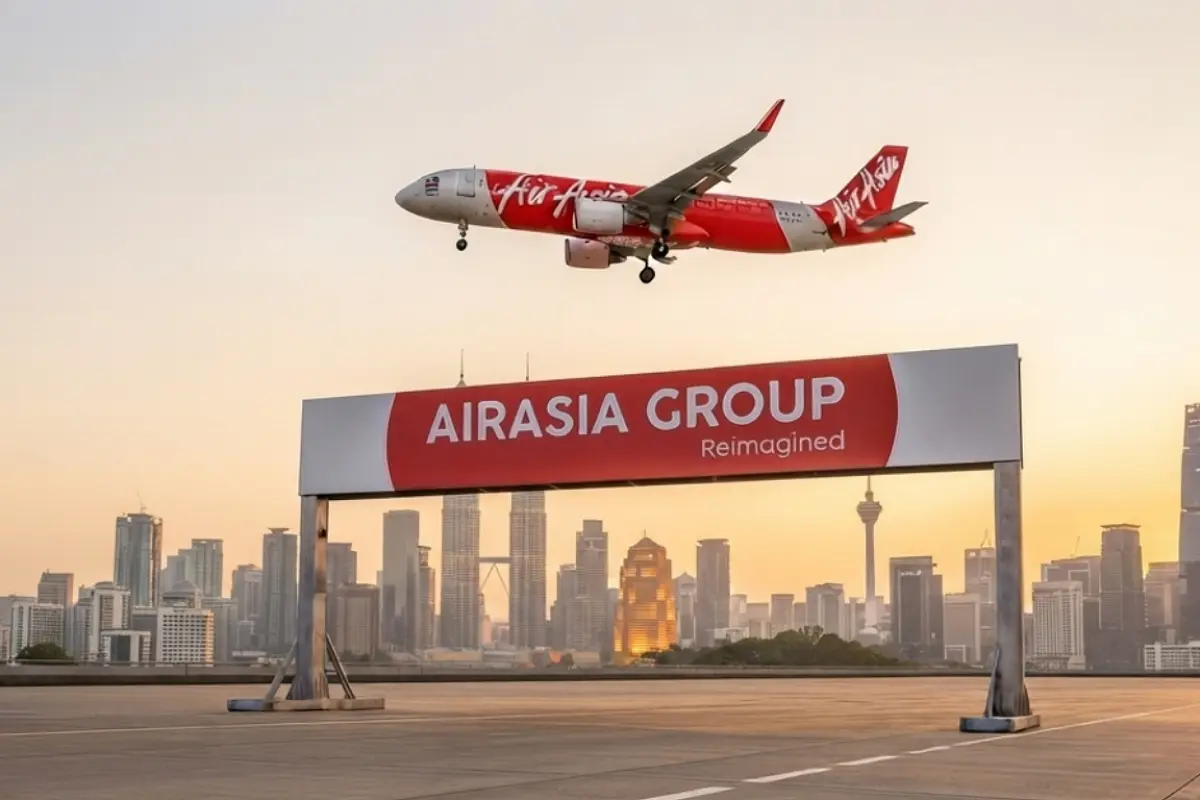
AirAsia Is No Longer Just an Airline, And the Rebrand to AirAsia Group Is the Most Important Strategic Move Tony Fernandes Has Made in Years
One holding company. All the airlines under one roof. A corporate structure finally matching the ambitions that AirAsia has been declaring for two decades. The rebrand from AirAsia X to AirAsia Group is not a name change. It is a fundamental restructuring of how Southeast Asia's most recognisable aviation brand intends to compete for the next chapter of its growth.
AirAsia has always been larger than its structure suggested. The brand spans Malaysia, Indonesia, Philippines, Thailand, Cambodia, and beyond, a network of affiliated carriers flying under the same red livery, the same Allstars identity, and the same low-cost philosophy that Tony Fernandes turned into one of the defining aviation stories of the twenty-first century. But behind that unified brand, the corporate architecture was fragmented in ways that created genuine friction, separate entities, separate financing arrangements, separate fleet planning processes, and the kind of structural complexity that makes executing a coherent group-wide strategy significantly harder than it needs to be.
The rebrand of AirAsia X to AirAsia Group, effective July 2 following overwhelming shareholder approval, changes that. Capital A's aviation businesses have been transferred into AirAsia X, creating a single holding company that owns AirAsia Malaysia and its overseas airline affiliates under one unified structure. The brand has always been one thing in the minds of passengers. The corporate reality is now catching up.
What Was Wrong With the Old Structure and Why It Mattered
To understand why this restructuring is significant, you need to understand what the previous structure actually prevented.
AirAsia's various airline entities across Southeast Asia operated with meaningful independence from each other — separate boards, separate financing relationships, separate fleet strategies, and separate negotiations with aircraft manufacturers, lessors, and financial institutions. That independence had historical reasons. The affiliated airlines in different countries involved local partners, regulatory requirements for local ownership, and the political realities of operating national carriers in markets where aviation is treated as a strategically sensitive industry.
But independence at the corporate level creates duplication at the operational level. When AirAsia Malaysia and AirAsia Indonesia are negotiating separately with Airbus for aircraft, they are two buyers rather than one, and two buyers of the same aircraft type, from the same manufacturer, with overlapping delivery schedules, have significantly less negotiating leverage than a single group placing a consolidated order.
The same dynamic applies to financing. Lessors pricing lease rates for aircraft, banks structuring revolving credit facilities, and bond markets pricing debt instruments all respond to the scale and creditworthiness of the entity they are dealing with. A unified AirAsia Group holding company with consolidated financials, a single credit profile, and the combined fleet commitments of all affiliated carriers is a fundamentally stronger counterparty than a collection of affiliated but separately structured airlines.
Aircraft financing, fleet planning, and the economics of scale that separate the genuinely competitive low-cost groups from the also-rans all become more achievable under a unified holding structure. That is what the rebrand delivers at the operational level beneath the brand story.
The Capital A Aviation Transfer Is the Transaction That Made This Possible
The specific mechanism that enabled the AirAsia Group structure, the transfer of Capital A's aviation businesses into AirAsia X, resolved a corporate architecture problem that had been complicating AirAsia's structure for years.
Capital A had evolved into a mixed entity with aviation and non-aviation businesses sitting uncomfortably alongside each other, the airline operations that were AirAsia's core identity alongside digital ventures, logistics, and other businesses that the group had diversified into during the pandemic period when pure airline revenue was insufficient to sustain the organisation.
Separating the aviation businesses into a dedicated holding company cleans that structure in ways that benefit both the aviation operations and the non-aviation ventures. The aviation group gets a focused ownership structure optimised for airline holding company governance and financing. The non-aviation businesses get the operational clarity that comes from not being structurally mixed with airline assets and liabilities.
The shareholder approval, described as overwhelming, reflects investor recognition that the restructuring makes the sum of the parts more legible and more valuable than the previous combined structure. Markets respond well to corporate structures where the business logic is clear and the governance framework is fit for purpose. AirAsia Group provides both.
How the Unified Structure Changes the Competition With Singapore Airlines and VietJet
The competitive framing of AirAsia Group against Singapore Airlines and VietJet is deliberately chosen and worth examining carefully because the competitive dynamics in each case are different.
Singapore Airlines competes with AirAsia on the full-service versus low-cost dimension, a competition that has always been as much about positioning and passenger segmentation as about route overlap. The establishment of AirAsia Group as a unified integrated aviation holding company changes that competition in a specific way. Singapore Airlines Group has benefited from the clarity and scale of its own holding structure, the ability to coordinate SIA, Scoot, and SilkAir under a unified strategic framework has been a genuine competitive advantage in planning, financing, and market development. AirAsia Group is now building an equivalent structural clarity into its own operations, reducing one of the organisational advantages that Singapore Airlines has historically held.
VietJet is a different competitive comparison, a peer in the Southeast Asian low-cost space that has been building aggressively and positioning itself as an alternative to AirAsia on intraregional routes. A unified AirAsia Group with consolidated fleet planning, unified brand management, and the financing advantages of a single holding company structure is a more formidable competitive entity than the previous fragmented structure in exactly the markets where VietJet is most directly competing.
The reorganisation does not guarantee competitive success against either rival. But it removes structural disadvantages that were making the competition harder than it needed to be.
What the Fleet and Market Expansion Ambitions Look Like From Here
The analysts who describe the reorganisation as laying the foundation for AirAsia's next growth phase are identifying something real about what a unified structure enables that the previous architecture did not.
Fleet expansion is the most immediately tangible benefit. AirAsia's relationship with Airbus — built on one of the largest narrowbody order commitments in aviation history, is the backbone of its fleet strategy. Negotiating future tranches of that relationship from a position of unified group-wide demand, rather than as separate affiliated carriers with separate delivery schedules, creates exactly the kind of consolidated buying power that produces better pricing, better delivery positioning, and better support terms.
New market entry is similarly more straightforward under a unified holding structure. When AirAsia identifies a new market opportunity, a new country, a new long-haul route, a new affiliate structure in a market it does not currently serve, the decision-making process, the capital allocation, and the operational planning all happen within a single group framework rather than requiring coordination across multiple separately structured entities. Speed of execution in aviation is a genuine competitive advantage, and unified group structures execute faster than federated ones.
The ambition to become Southeast Asia's dominant low-cost aviation group is not new for AirAsia. What is new is the corporate architecture that makes executing on that ambition cleaner, faster, and more financially efficient than the structure that preceded it.
The Brand Story and What AirAsia Group Means for Passengers
For the millions of passengers who fly AirAsia across Southeast Asia, the rebrand changes almost nothing immediately visible. The red aircraft, the Allstars crew, the low-fare promise, and the now now now energy that has defined the AirAsia passenger experience since Tony Fernandes bought a struggling airline for one ringgit in 2001, none of that changes because AirAsia X became AirAsia Group.
What might change over time, as the unified structure enables more efficient fleet planning, better financed expansion, and faster market entry, is the breadth and frequency of AirAsia's network. More destinations, more frequencies, more competitive fares made possible by the operational efficiency that unified group economics enable are the downstream passenger benefits of a restructuring that looks corporate and structural from the outside.
The passenger in seat 14A does not care about holding company structures. They care about whether AirAsia flies where they want to go, when they want to travel, at a price they can afford. The AirAsia Group structure is built to improve all three of those dimensions over the medium term even if it changes none of them immediately.
What Tony Fernandes Has Actually Built
The completion of the AirAsia Group restructuring is a moment worth stepping back from the transaction details to appreciate in full context.
Tony Fernandes bought AirAsia for one ringgit and turned it into the airline that proved low-cost long-haul was viable in Asia, that Southeast Asian aviation could produce a genuine regional champion, and that an airline built on the now now now philosophy of radical accessibility could reshape how hundreds of millions of people think about air travel.
The rebrand to AirAsia Group is not the end of that story. It is the moment where the structure of the organisation finally matches the scale of what has been built, where the corporate architecture becomes worthy of the brand that two decades of audacious aviation entrepreneurship created.
Southeast Asia's most recognisable aviation brand now has the holding company structure that its ambitions always deserved. The next chapter of what AirAsia becomes will be written from that foundation.