Temasek Faces Pressure Over Air India’s $1.5B Funding Ask
Temasek-backed Air India's $1.5 billion funding request is now facing scrutiny in Singapore, as an opposition MP questions Singapore Airlines' exposure.
 Jishan Khan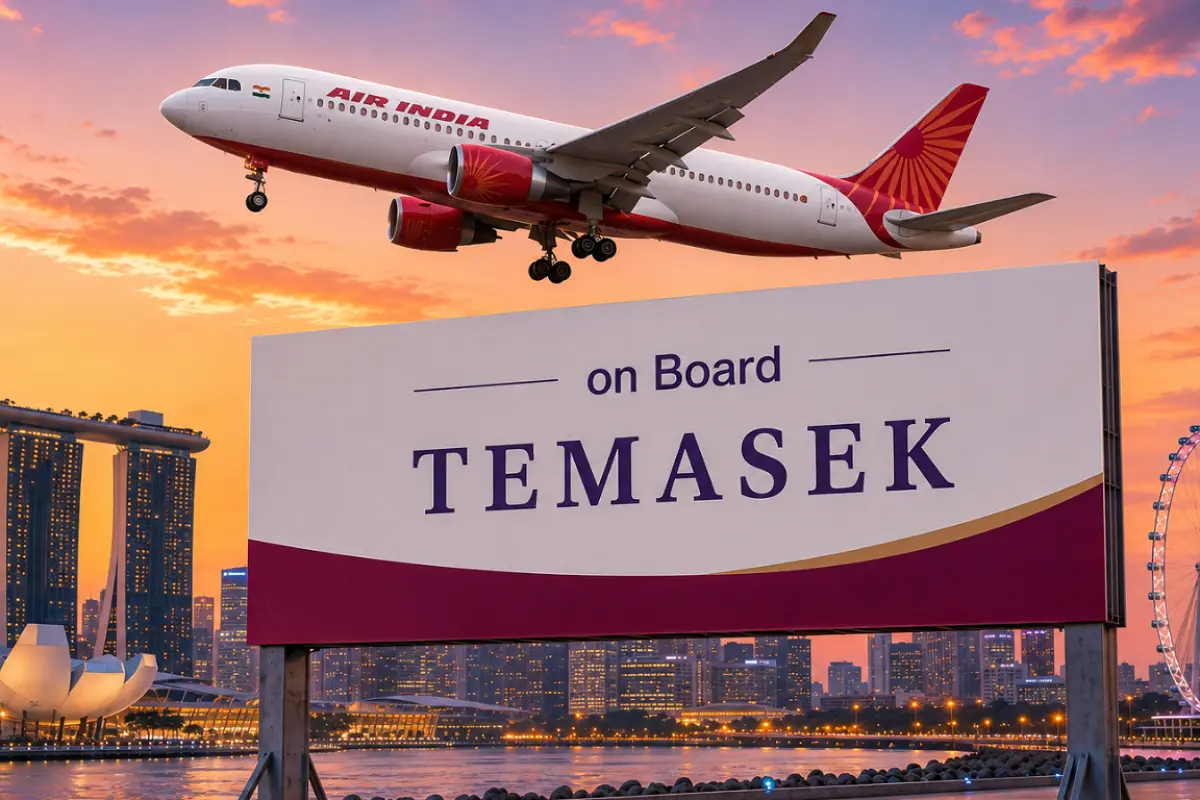
A Singapore Opposition MP Just Made Air India's $1.5 Billion Ask a Domestic Political Problem, Not Just an Airline Boardroom Decision
Temasek, the Singapore state investor that holds a 53% controlling stake in Singapore Airlines, publicly backed SIA's investment in Air India on August 29, 2026, as scrutiny over the loss-making Indian carrier's latest funding request escalated into an actual parliamentary matter. Air India has asked its two owners, Tata Sons and Singapore Airlines, which holds 25.1%, for approximately $1.5 billion in fresh equity, according to Reuters reporting that first broke the story earlier in the week. Workers' Party MP Kenneth Tiong has already filed a formal question for oral answer in Singapore's parliament on September 8, asking the transport minister to assess whether losses from SIA's foreign associates have compromised the airline's "capacity to provide essential transport services", language that elevates this from a commercial capital allocation decision into a question about whether a state-linked strategic asset is being managed responsibly.
That is the real story here. This is no longer simply "should SIA fund Air India again." It is now "should Singaporean taxpayers, however indirectly, be underwriting India's national aviation ambitions."
Why the Temasek Air India Ownership Chain Makes This Political in a Way Most Airline Investments Never Become
Tiong's objection rests on a specific structural argument that is difficult to dismiss as pure political theatre. Temasek owns 53% of Singapore Airlines. Singapore Airlines owns 25.1% of Air India. Every dollar SIA contributes to Air India's fresh equity request therefore flows, at two removes, from an entity wholly owned by the Government of Singapore, Temasek's total assets stood at $521 billion as of 2026, managed on behalf of the state. Tiong's framing, "I will not support, nor expect, any future use of Temasek's funds to prop up Air India via Singapore Airlines. If Singapore Airlines wants to continue its bet on Air India, it should do so on its own two feet, and not on Temasek's", draws a distinction that sounds clean in a soundbite but is genuinely difficult to enforce in practice, since SIA's balance sheet and Temasek's ownership stake are not separable in the way Tiong's statement implies. Any capital SIA raises to fund an Air India contribution, whether through retained earnings, debt, or a rights issue, ultimately affects the value of the asset Temasek holds regardless of which specific pocket the cash comes from.
Temasek's own response has been carefully calibrated, backing the strategic rationale for SIA's original Air India investment while explicitly declining to confirm whether it would support any specific capital contribution toward this new request. That distinction, between endorsing the thesis and committing to fund its next instalment, is the entire diplomatic tightrope Temasek is walking as the September 8 parliamentary question approaches.
Why Air India Losses Have Gotten Large Enough to Change the Conversation
The scale that has triggered this political reaction is genuinely severe. Air India Group posted a record $2 billion loss in the last financial year, contributing directly to SIA reporting a net loss of S$76 million (approximately US$58.9 million) in the first quarter of 2026 alone, a rare quarterly loss for an airline group whose core Singapore Airlines operations, as this feed noted in earlier coverage, posted record annual revenue of S$20.5 billion and a 39% jump in operating profit in the same period, benefiting from displaced Middle East traffic during the Iran conflict. That contrast is precisely what has sharpened scrutiny: SIA's own mainline business is performing exceptionally well, and Air India's losses are the specific drag preventing that strong underlying performance from showing up cleanly in the group's consolidated results.
Combined Air India Group and Air India Express losses for the year to March reached $2.33 billion according to the Reuters figures cited across multiple outlets, a number that dwarfs the roughly $250 million SIA originally paid to acquire its Air India stake as part of the 2022 Vistara merger structure, where SIA contributed its 49% Vistara stake plus approximately Rs 2,058.5 crore in cash in exchange for 25.1% of the enlarged Air India entity, and separately committed further funding of up to Rs 5,020 crore to maintain that stake through the merger's completion.
Why Nobody Seriously Believes Singapore Airlines Air India Can Simply Exit
The most structurally important point buried in the coverage is a commentary from Singapore's own Business Times, cited across multiple reports, arguing that Singapore Airlines could not realistically exit its Air India position because Tata is "the only plausible buyer." That is a genuinely constraining fact. Air India's ownership structure was purpose-built around exactly two shareholders, Tata Sons as majority controller and SIA as strategic minority partner, and no natural third-party buyer exists for a 25.1% stake in an airline that remains deeply loss-making, is subject to Indian foreign ownership rules governing airline control, and is entangled in an active, multi-year transformation programme that only makes sense to an investor already committed to the same turnaround thesis SIA bought into in 2022.
That absence of an exit option is precisely why the "just cut losses and walk away" argument circulating in Singaporean commentary and social media, however emotionally satisfying to shareholders watching quarterly losses mount, does not actually describe an option SIA's board can execute cleanly even if it wanted to. Selling a 25.1% stake in a lossmaking, non-strategic-to-anyone-else Indian airline at anything resembling fair value, absent Tata's willingness to buy it out, is not a realistic near-term path, which leaves SIA's board facing a binary choice closer to "continue funding the turnaround" versus "write the investment down and accept the accounting and reputational consequences" rather than a clean exit.
Why Air India's 2026 Has Been Uniquely Brutal, Even by Its Own Turbulent Standards
This feed has already documented in detail why Air India's losses this year go beyond ordinary post-acquisition transformation costs. Three distinct, largely uncontrollable shocks compounded within the same fiscal year: Pakistan's ongoing airspace ban on Indian carriers, now extended for a 16th consecutive month, as covered extensively in this feed's own reporting on the toll that reroute penalty has taken on Indian long-haul network economics; the US-Israeli conflict with Iran, which disrupted Middle East airspace and drove the fuel cost spike affecting virtually every airline covered across this entire body of reporting this year; and the fallout from the fatal Boeing 787-8 crash that killed 260 people, an event with reputational, operational and regulatory consequences that extend well beyond the direct costs any airline balance sheet can fully quantify.
None of those three factors reflect management failure within Air India's control in the way that, say, chronic route mismanagement or governance failure might. But from a shareholder's perspective, particularly a politically exposed one like Temasek, now facing a formal parliamentary question, the distinction between "losses caused by genuinely exceptional external shocks" and "losses that simply keep arriving, year after year, regardless of stated cause" becomes progressively less persuasive the longer the pattern continues and the larger the cumulative ask grows.
What the SIA Air India Investment Statement Actually Signals
Singapore Airlines own public response has been notably non-committal in exactly the way a board managing genuine internal tension would sound: the airline said it "would carefully consider any requests for additional capital from Air India, taking into consideration the group's other capital requirements and Air India's business strategy." That is not a rejection, but it is also conspicuously not an endorsement, a materially cooler tone than the "long-term strategic investment" and "long game" framing SIA's own CEO Goh Choon Phong used earlier in 2026, as covered in this feed's prior reporting on the airline's initial response to Air India's mounting losses. The shift in tone, from active strategic reaffirmation to careful, conditional language about weighing other capital requirements, suggests SIA's board itself is genuinely more divided or more cautious about this specific $1.5 billion request than it was about the smaller capital commitments made earlier in the turnaround.
What remains conspicuously unaddressed across every report on this story is the most basic financial question underlying the entire dispute: how much of Air India's requested $1.5 billion would come from SIA specifically, proportional to its 25.1% stake, versus the larger share Tata Sons as majority owner would presumably need to contribute. Neither Tata Sons, Air India, Temasek, nor Singapore's Ministry of Transport responded to requests for comment on that or related questions, according to Reuters' original reporting. Until SIA's board actually renders its decision, likely informed by whatever answer Singapore's transport minister gives Tiong's parliamentary question on September 8, the fundamental tension this story has surfaced remains unresolved: a strategically sound thesis about India's aviation growth potential, colliding directly against a shareholder base whose patience for funding that thesis without a visible path to profitability is now being tested in an actual legislature, not just an earnings call.