Hallstatt China Replica: Inside the Village That Got Copied
How a Chinese developer's full scale replica of Hallstatt, Austria, turned a lakeside village of 800 people into a destination for a million visitors a year.
 RUKAIYA KADIWAL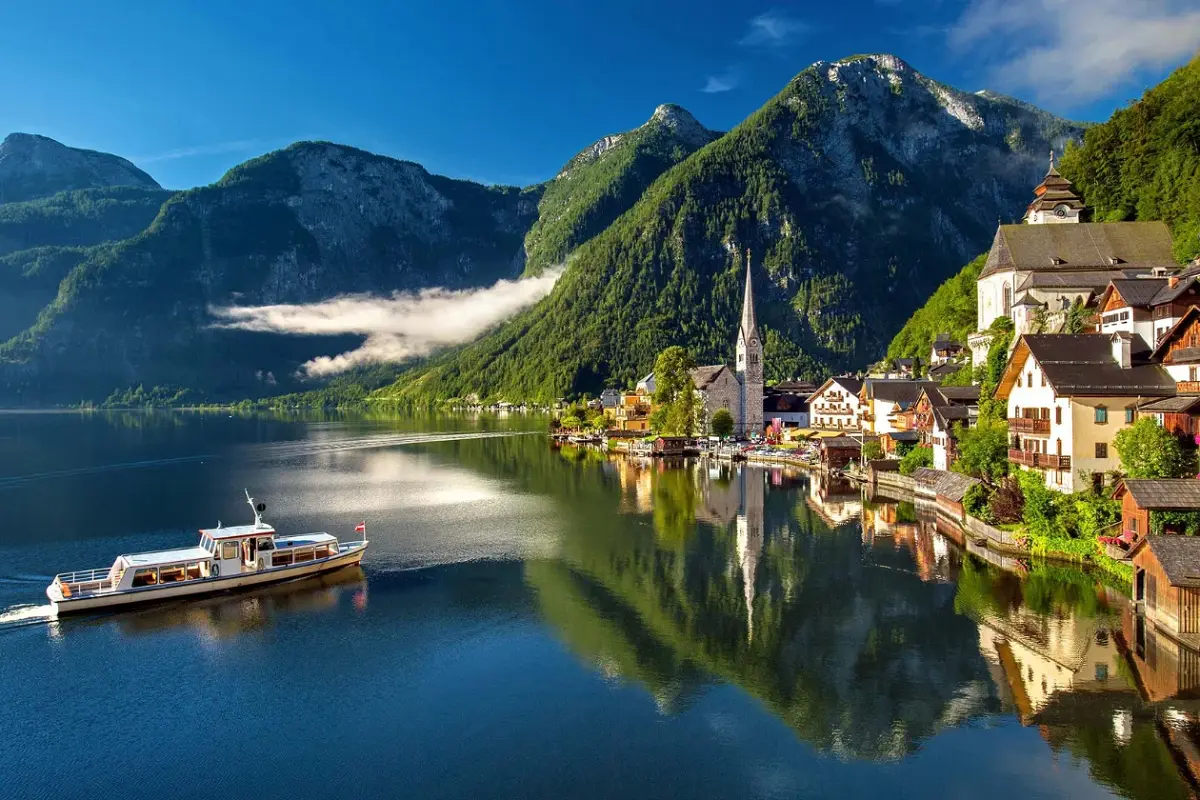
In 2011, a hotel owner in Upper Austria heard a stray comment from a guest and realized her village of 800 people was being measured, photographed, and rebuilt on the other side of the world.
Monika Wenger did not think much of it at first. Guests at her hotel in Hallstatt mention all kinds of things, and a visitor's offhand remark about cameras and notebooks in the lanes did not immediately sound like news. But the detail stayed with her, and when she started asking around, other residents recalled the same thing: quiet groups of Chinese visitors who had spent months in the village not sightseeing so much as documenting, photographing building facades, sketching rooflines, taking measurements of a church tower that has stood over the lake for centuries. Nobody had thought twice about it at the time. In Hallstatt, Wenger would later tell the Associated Press, everybody is being photographed constantly. It took a while for anyone to understand that this particular attention was different.
What those visitors were gathering became clear the following year, nearly 9,000 kilometers away, in the subtropical province of Guangdong. Minmetals Land, the property development arm of China's largest metals trading company, had rebuilt Hallstatt at full scale, street by street, down to the pastel building facades, the angel statues, and a replica of the same church spire that rises over the real village's lakeside square. According to reporting by Radio Free Europe/Radio Liberty, the project cost roughly 940 million dollars. It opened to the public in June 2012, in the city of Huizhou, on the eastern edge of the Pearl River Delta, with, somewhat incongruously, a statue of Mickey Mouse installed nearby.
A Ribbon Cutting, and a Question Nobody Had Asked
Hallstatt's mayor, Alexander Scheutz, flew to Guangdong for the opening and signed a cultural exchange agreement with the developer, a gesture that framed the replica as flattery rather than appropriation. Not everyone in the delegation shared his ease with the arrangement. Wenger, the hotel owner whose guest had first tipped off the village, was blunter in her assessment, telling the Associated Press that the developer should have asked the people who actually owned the buildings, and never did.
The tension in that single sentence, a mayor signing agreements while a local business owner questions the basic courtesy of consent, captures something larger about what happens when a place becomes valuable enough to copy. Nobody in Hallstatt owned the rights to a church spire's silhouette or the color of a shutter, and there was no legal mechanism to prevent the replication of an entire streetscape. What Hallstatt did have, once the story broke internationally, was attention, and attention turned out to be its own kind of asset.
The Copy Became the Advertisement
Before any of this, Hallstatt was already known to a smaller circle of admirers, largely through the Korean television drama Spring Waltz, filmed there and first broadcast in 2006, and through an unconfirmed but persistent rumor that Disney animators drew inspiration from the village for the kingdom of Arendelle. Those threads mattered, but they were nothing compared to what happened once a full scale replica made international news.
The numbers tell the shift plainly. Forty seven Chinese visitors came to Hallstatt in 2005. By 2011, with the Guangdong clone half built and newspapers around the world running the story, that figure had climbed to 8,700, a jump cited by Austria's consul in Guangzhou, Martin Wolle, at a public ceremony covered by China.org.cn. The controversy had done what no marketing campaign could have managed at that speed. Word got around that there was an original, and increasingly, people wanted to see it for themselves. Interest in Hallstatt Austria tourism grew alongside the attention surrounding the replica.
What a Village of 800 Looks Like Under a Million Visitors
Coach traffic tells the story most directly. Scheutz told Euronews that 7,917 tour buses passed through Hallstatt in 2014, and by 2019 the figure had reached 21,254. Overnight stays roughly doubled across the same decade, climbing to 145,260, while day visitors alone crossed a million annually. Lonely Planet has documented what that means on the ground: peak days bring as many as 10,000 people into a town with fewer than 800 residents, all funneled through a single road that reaches the houses via a tunnel carved between the lake and the cliff face.
By August 2023, the arithmetic had become unbearable for some residents. Roughly 100 locals gathered in that tunnel and closed it for fifteen minutes, holding placards asking for what amounted to an emergency brake on visitor numbers. Long time resident Friedrich Idam described the shift to NBC News in terms that left little ambiguity.
"His home was no longer living on tourism," Idam said, "it was being squashed by it."
The quote lands with particular weight because Idam is not describing an abstract policy failure. He is describing a lived sensation, the feeling of a place's own residents becoming incidental to its function. Three months before the tunnel protest, the town council had installed a wooden screen specifically to obscure the most photographed view of the village, an attempt to discourage the crowds gathering for that single postcard shot. The backlash online was immediate and predictable, and the screen came down not long after. Idam also described a smaller, quieter accommodation: with the market square now permanently occupied by visitors, residents moved their weekly farmers market to a less conspicuous corner of town, a modest but telling sign of a community rearranging itself around its own popularity.
The Reason Any of This Exists
Strip away the church spire and the coach buses, and Hallstatt's real claim on history has nothing to do with photographs at all. UNESCO listed the surrounding landscape as a World Heritage Site in 1997 because the mountain above the village has been mined for salt since the Bronze Age, and the town's own name translates roughly to salt settlement. An entire prehistoric European culture, the Iron Age society that traded across the continent, takes its name directly from this place.
In 2002, archaeologists from the Natural History Museum Vienna uncovered a wooden staircase inside the ancient salt workings, and dendrochronology dated it to 1344 BC, making it the oldest known timbered stairway in Europe. The salt itself had preserved the wood so completely that all eight meters of the structure survived intact. Researchers scanned and dried more than seventy individual sections before reconstructing the staircase four hundred meters underground, where visitors can now stand in front of something considerably older than either version of the village above.
Managing a Crowd Without Becoming a Museum
Hallstatt's response to its own popularity has been incremental rather than dramatic. Booked time slots for tour coaches have already produced measurable results. Scheutz told The Local that daily bus numbers have been cut roughly in half and now sit comfortably under a ceiling of 54, even as overnight stays and day visitor totals have returned to pre pandemic levels. He has resisted proposals for a Venice style entry ticket, arguing that formal admission fees would push the town further toward feeling like an exhibit rather than a place people actually live.
Deputy mayor Alfred Gamsjäger has taken a more forceful public stance. Speaking to the Austrian outlet Kurier, in reporting picked up by The Local in 2025, he described the town as literally overrun and pushed for a digital reservation system that would cap visitor numbers at somewhere between 5,000 and 5,500 people a day. The obstacle is geography rather than politics. The single road running through Hallstatt continues on to other communities further up the valley, which means any system metering entry into the village necessarily meters entry for its neighbors too, turning a local traffic problem into a regional negotiation.
This pressure has become a defining part of Hallstatt overtourism, as the village attempts to balance tourism demand with the needs of its permanent residents.
A Different Kind of Problem, Nine Thousand Kilometers Away
Guangdong's version of Hallstatt has faced none of these pressures, largely because it has faced the opposite problem. When Hong Kong Free Press visited the site in 2015, staff at the sales office inside the replica church reported that roughly 65 percent of the houses had sold, yet not a single one was occupied. The town square outside filled daily not with residents but with wedding photographers, using the replica as a backdrop for portraits rather than as anyone's home. Nearby residential developments carry names like Evian and Royal Garden, suggesting the borrowing of European place names was never a one time gesture but closer to a standing business strategy.
The Chinese Hallstatt village therefore developed a very different relationship with tourism from the original Austrian community. It functioned more as a themed destination and photographic setting than as a conventional residential village.
The contrast between the two Hallstatts is where the story finally settles. Copy the gables and the church spire, and what results is a stage set, one capable of absorbing any number of visitors precisely because nobody actually lives inside it. But the things that drew the crowds there in the first place, the salt beneath the mountain, the Bronze Age staircase preserved for three thousand years, the daily friction of residents trying to reach their own front doors, remain wedged in a single valley between a lake and a cliff in Upper Austria. There is, and there will only ever be, one of those.
The Hallstatt China Replica did not create Hallstatt's fame so much as accelerate something that was already beginning, and what it leaves behind is a question with no clean answer: what does a place owe the version of itself that becomes famous, and what is left over, underground and undisturbed, once the cameras move on.
For further context on how hospitality and travel destinations are adapting to rising global demand, related coverage can be found in this roundup of 2026 hotel offers and destination trends.
What Remains
There is a version of this story that ends with outrage, a village wronged by a developer who never asked permission. There is another version that ends with irony, a replica so thoroughly unlived in that it has become its own kind of ghost town, while the original struggles under the weight of too many people wanting to see the real thing. Both versions are true, and neither quite captures what it feels like to be Friedrich Idam, watching the market move to a quieter corner of a town that used to belong, unremarkably, to the people who lived there.
The story also raises questions about Hallstatt replica China, the Guangdong Hallstatt replica, and the wider role of China tourism attractions in recreating internationally recognizable destinations. At the same time, the original continues to attract visitors interested in Hallstatt tourism and the history of the Austrian lakeside community.
For official information and related coverage, visit Space Daily.