Lemon Tree Hotel Bharuch Opens, Marking 12th Gujarat Hotel
Lemon Tree Hotel Bharuch has opened along the Narmada River, becoming the Group's 12th operational hotel in Gujarat with 85 rooms and suites.
 RUKAIYA KADIWAL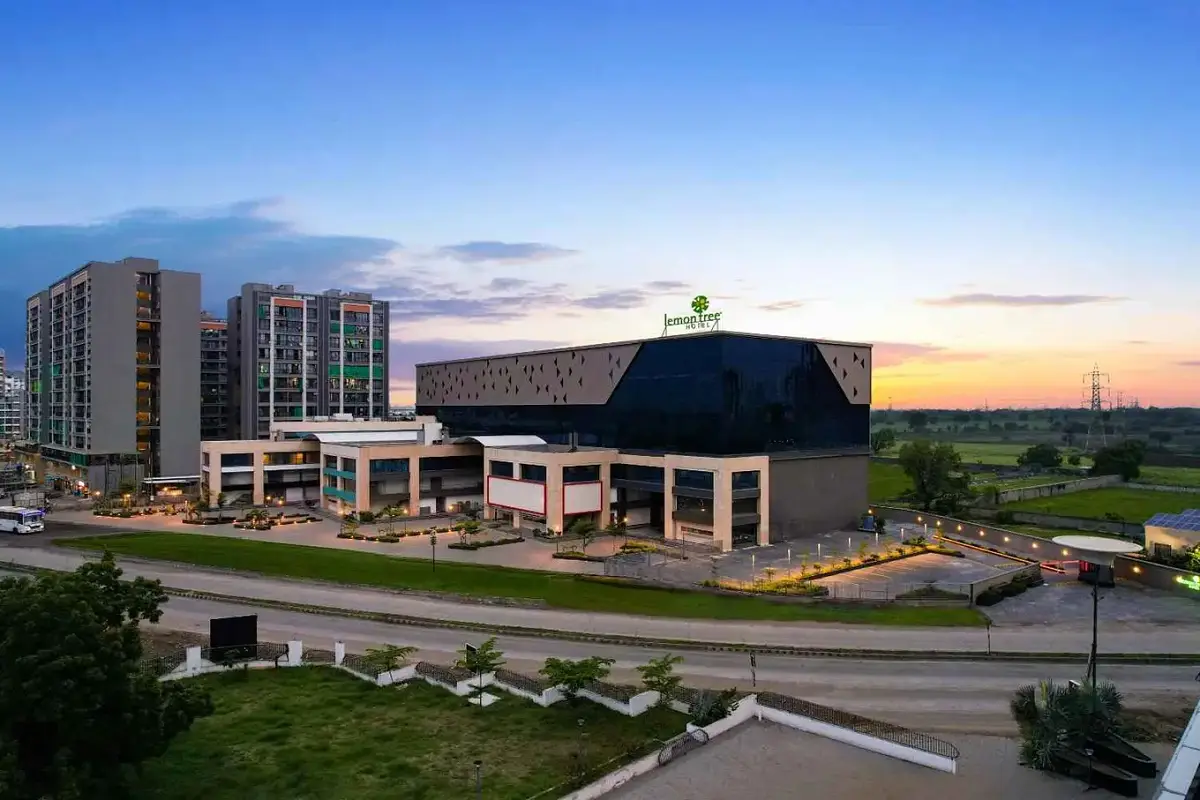
At dusk, the glass facade of the new hotel on the outskirts of Bharuch catches the last orange light of the day, its dark angular exterior standing apart from the residential towers beside it. Below, the road is still quiet, a single bus idling near the entrance, a few construction lights left on from the final weeks of finishing work. It is the kind of scene that precedes almost every hotel opening, a building fully formed but not yet full, waiting for the steady rhythm of check ins that will eventually define it.
That building is Lemon Tree Hotel Bharuch, the newest addition to Lemon Tree Hotels Limited's growing footprint in Gujarat, and now the Group's twelfth operational property in the state. Managed by Carnation Hotels Private Limited, a wholly owned subsidiary of Lemon Tree Hotels, the opening is a modest one by industry standards, 85 rooms in a mid sized industrial city, yet it says something fairly specific about how India's hotel chains are choosing where to grow next.
Why Bharuch, and Why Now
Bharuch is not a city most international travellers could place on a map, but within Gujarat's commercial geography it occupies a useful position. Set along the Narmada River, the city functions as an established industrial and commercial hub, with strong road connectivity to Ankleshwar, Dahej, Vadodara, Surat, Ahmedabad, Vapi and Valsad, a corridor dense with manufacturing, chemical and petrochemical activity that generates a steady stream of business travel. That kind of demand, driven by transit and commerce rather than tourism, tends to be less glamorous than resort development, but it is often more reliable, less exposed to seasonal swings than leisure focused markets.
The city also carries a secondary appeal. It serves as a gateway to regional cultural and spiritual sites, including Kabirvad and the Statue of Unity, giving the new hotel a mix of business, leisure, spiritual and transit travellers to draw from rather than depending on a single guest segment. For a chain expanding methodically rather than opportunistically, that blend of demand types is precisely the kind of market fundamentals that justify a new build.
Twelve Hotels In, Twenty More to Come
What distinguishes this opening from a standalone announcement is the scale of what surrounds it. Lemon Tree Hotels currently has 20 hotels in the pipeline across Gujarat, a figure that reframes the Bharuch opening not as an isolated event but as one node in a much larger, deliberately built network. The strategy reads as an attempt to serve business travellers moving along the state's key industrial and commercial routes, while simultaneously capturing leisure and spiritual travellers exploring the wider region, all within a single, interconnected footprint of properties.
That kind of density strategy, opening enough hotels within a state that guests and corporate travel managers begin to default to the brand almost automatically, has become increasingly common among India's mid market hotel chains, where scale within a region often matters more than a scattering of flagship properties across the country. Gujarat, with its industrial corridors and steady stream of business travel, has proven a particularly suitable testing ground for that approach.
What the Hotel Itself Offers
Inside, the 85 rooms and suites are designed around a straightforward promise, a comfortable, contemporary stay rather than an aspirational one. The hotel's dining is anchored by Citrus Café, Lemon Tree's signature multi cuisine restaurant concept, offering an extensive menu intended to serve both business travellers grabbing a quick meal between meetings and leisure guests settling in for the evening. For groups and corporate events, the property includes banquet and meeting facilities sized for the kind of mid scale gatherings common to an industrial hub like Bharuch.
Beyond the working spaces, the hotel offers a fitness centre, a recreation hub called Refresh, and a spa named Fresco, amenities that, while modest compared to luxury resort standards, reflect what a growing segment of Indian business travellers now expect even from mid market properties, somewhere to unwind briefly rather than simply sleep between meetings.
Getting There, and Why It Matters
Connectivity has clearly shaped the hotel's positioning. Surat Airport sits roughly 75 kilometres away, Vadodara Airport about 70 kilometres, while Bharuch's own railway station and bus station are just seven kilometres from the property, making the hotel considerably more accessible by rail and road than by air. That distinction matters in a market like this one, where much of the travel is intercity and industrial rather than long haul, and where a hotel's proximity to a railway station can matter more to occupancy than its distance from the nearest airport.
A Wider Pattern in Indian Hospitality
The Bharuch opening fits within a broader trend reshaping India's hotel sector, where growth is increasingly concentrated not in metro flagship cities but in tier two and tier three industrial hubs, places whose economic activity has outpaced their hospitality infrastructure. Chains willing to build methodically in these markets, often with smaller room counts and more modest amenity packages than their metro properties, are positioning themselves ahead of demand rather than chasing it after the fact.
That approach carries its own risks. Mid sized industrial cities can be more exposed to fluctuations in a single dominant industry than diversified metro markets, and a hotel built around business travel tied to manufacturing or chemical activity can see occupancy dip sharply if that sector slows. Whether Lemon Tree's broader Gujarat strategy, and the twenty hotels still in its pipeline, proves resilient against that kind of concentration risk will likely become clearer only as the pipeline properties open over the coming years.
What a Twelfth Hotel Really Represents
By the time the hotel settles into its first full season of operations, the glass facade that now catches the sunset over a mostly empty road will likely be surrounded by the ordinary business of a working hotel, guests arriving from the railway station, conference rooms booked for corporate meetings, a steady rotation of travellers moving along Gujarat's industrial corridor. None of it will look particularly remarkable from the outside.
Yet that ordinariness is, in its own way, the point. A twelfth hotel in a single state is not a headline making event on its own, but it is a clear signal of where a hotel chain believes its future lies, not in isolated landmark properties, but in the steady, unglamorous work of being present wherever business travellers need a reliable place to stay. In Bharuch, along a river that has shaped this region's commerce for generations, that bet is now open for business.
More information is available on the official website at lemontreehotels.com. Further reading on the hospitality industry is available at hospitalitycareerprofile.com.