Professional Front Office Hierarchy: Hotel Training Guide
professional front office hierarchy with SOP, roles, reporting structure, workflow coordination, and service standards in hotel operations.
 Shah Vaibhavi
Professional Front Office Hierarchy behind the desk, confusion doesn’t come from guests, it comes from unclear authority. When no one knows who owns the situation, the lobby slows down fast.
Professional Front Office Hierarchy Overview of Front Office Hierarchy in Hotel Operations
The professional front office hierarchy is not about titles, it’s about control.
It tells you who decides, who handles, and who steps in when things go wrong. Without it, tasks overlap and guests feel the delay.
-
Defines roles and reporting lines
-
Keeps communication clean
-
Sets authority for decisions
-
Supports faster guest handling
The front office connects housekeeping, F&B, maintenance, and accounts. If professional front office hierarchy is clear, the hand-off stays smooth.
Pro-tip: When you know who to report to, you waste zero time during pressure.
SOP Procedure for Front Office Hierarchy Management
There’s a structure of professional front office hierarchy. Follow it or the system breaks.
Step 1: Role Definition
Every position must have clear duties. No overlap. No guessing.
Step 2: Reporting Structure
Agents → Supervisors → Duty Manager → Front Office Manager.
Step 3: Task Allocation
Assign work based on shift and role. Balance the load.
Step 4: Communication Flow
All updates, requests, and issues move through proper levels.
Step 5: Escalation Process
Don’t jump levels. Escalate step-by-step unless urgent.
Step 6: Shift Handover
Document everything. Next shift should not “figure it out.”
Step 7: Performance Monitoring
Supervisors track output and SOP discipline.
Pro-tip: Broken handovers create 80% of front desk mistakes.
Front Desk Hierarchy Structure and Roles
Everyone has a lane. Stay in it, but know who supports you.
-
Front Office Manager: Runs the department, controls standards, reports to management
-
Assistant Front Office Manager: Supports daily ops, handles issues
-
Duty Manager: Controls the shift, handles escalations
-
Front Desk Supervisor: Manages desk flow, checks SOP
-
Front Desk Agents: Guest interaction, check-in/out, requests
-
Reservation Agents: Bookings and availability
-
Bell Desk Staff: Luggage and movement
-
Concierge: Guest assistance and local info
-
Night Auditor: Night ops and financial checks
Pro-tip: Respect the chain. It protects you during tough situations.
Front Office Workflow and Operational Coordination
Hierarchy keeps the flow clean across all stages.
-
Pre-Arrival: Reservations + supervisor checks (VIPs, requests)
-
Arrival: Agents handle desk, supervisors control flow
-
Stay: Requests handled at desk, escalated when needed
-
Departure: Billing + check-out, supervisors ensure accuracy
Daily coordination:
-
Housekeeping → room status
-
Maintenance → technical fixes
-
F&B → dining issues
-
Accounts → billing
If one link slows down, the whole chain feels it.
Guest Interaction and Escalation Process
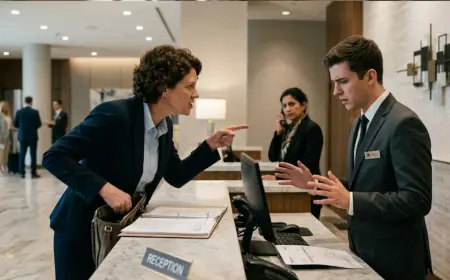
Not every problem needs a manager. But every problem needs control.
Level 1 – Front Desk Agent
Handles basic requests and complaints.
Level 2 – Supervisor
Steps in for complex or delayed issues.
Level 3 – Duty Manager
Handles escalations, VIPs, sensitive cases.
Level 4 – Front Office Manager
Takes over high-risk or major guest dissatisfaction.
Key rules:
-
Give clear information
-
Take ownership
-
Escalate on time
-
Stay calm and professional
Pro-tip: Late escalation is worse than escalation itself.
Tools and Systems Used
Hierarchy runs on systems. Use them properly.
-
Property Management System (PMS): Reservations, billing, guest data
-
Customer Relationship Management (CRM): Guest history
-
Central Reservation System (CRS): Multi-channel bookings
-
Communication Systems: Team coordination
-
Reporting Tools: Daily reports and tracking
Wrong updates = wrong decisions. Keep entries clean.
Service Standards and Performance Metrics
Hierarchy is measured through performance. Not position.
-
Greeting: within 5 seconds
-
Check-in: 3–5 minutes
-
Check-out: 2–3 minutes
-
Request response: 5–10 minutes
-
Complaint escalation: immediate when needed
-
Operational accuracy: 100%
These are daily expectations. Not targets.
Evaluation and Training Assessment
You don’t fix hierarchy with meetings, you fix it with discipline.
-
Role-based training
-
Supervisor observation on shift
-
Performance reviews
-
PMS and report audits
-
Guest feedback checks
Focus on coordination and decision-making at every level.
In conclusion
Hierarchy keeps the desk under control.
Clear roles. Clean communication. Timely escalation.
That’s what keeps the lobby moving, and the guest experience steady.