Beijing Robotic Noodle Restaurant Unveils a Futuristic Bowl
The Beijing robotic noodle restaurant lets customers scan, order and watch automated arms prepare and deliver noodles, blending automation with human oversight.
 RUKAIYA KADIWAL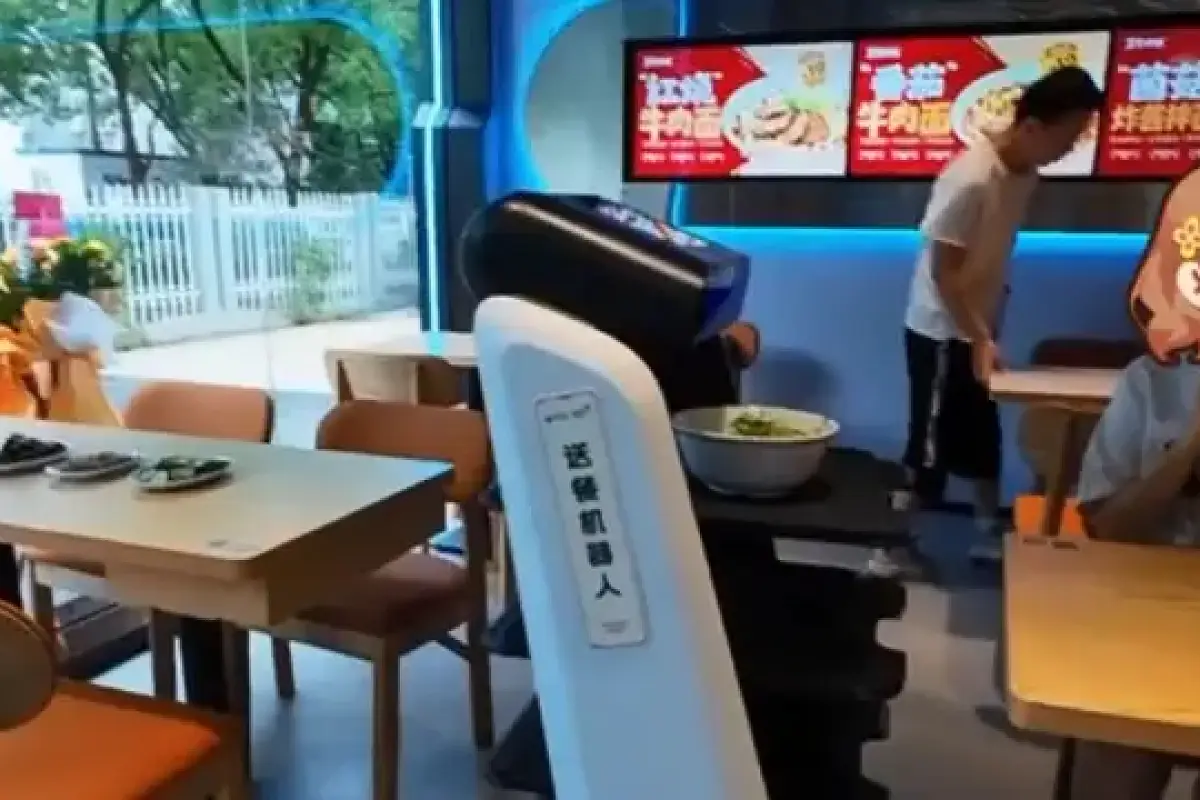
A delivery robot glides past a wall mounted screen advertising beef brisket noodles, its single articulated arm balancing a steaming bowl with the kind of steady precision no rushed waiter could quite match. Nearby, a young employee glances up from his phone, unbothered, as though watching a machine deliver lunch has already become routine rather than remarkable. This is the Beijing robotic noodle restaurant that began trial operations on August 14, and for the small group of diners currently eating here, the strangeness of the scene is already starting to wear off.
According to China Daily, the establishment describes itself as the first fully commercialized restaurant of its kind in the Chinese capital, where key stages of food preparation and serving are handled by automated systems rather than human hands. It is a modest claim on paper, but inside the restaurant, it plays out as a quiet, almost domestic choreography between machines and the people who still keep everything running.
A Trial Aimed First at Employees, Then the Public
At this early stage, the restaurant operates primarily for company employees rather than the general public, a deliberate limitation that allows the operators to work through operational kinks before wider exposure. The establishment is expected to open to all visitors at the end of August, giving the team roughly two weeks to observe how the systems perform under real, if controlled, demand.
That staged rollout reflects a caution not always associated with flashy automation stories. Rather than unveiling the concept to a curious public immediately, the restaurant has chosen to test its rhythms internally first, treating its own staff as the initial audience for a concept still finding its footing.
How the Robotic Noodle Restaurant in Beijing Actually Works
The ordering process begins simply enough. Customers scan a QR code, choose an item from the digital menu, and pay for their meal directly through their phone, a sequence familiar to anyone who has already ordered food through an app in recent years. What changes is everything that happens next.
The automated system prepares the noodles independently, adding broth, sauce and toppings according to the selected recipe without a human cook intervening in the process. Once the dish is ready, a robotic arm transfers the finished bowl to a waiting delivery robot, which then carries the meal directly to the customer's table, completing a journey from order to plate with almost no direct human contact along the way.
Yet the restaurant does not run entirely without people, a detail that complicates any simple narrative of full automation. Staff continue monitoring food supplies, replenishing ingredients, preparing drinks, and clearing used dishes, work that remains stubbornly human even as the more visible parts of service shift toward machines.
What Is Actually on the Menu
During this trial launch, visitors can choose from a modest but focused selection, including noodles with mushrooms, noodles with beef brisket and tomatoes, and noodles with braised beef. Prices range from 16 yuan, roughly 2.37 US dollars, up to 19 yuan, positioning the restaurant firmly within everyday, accessible dining rather than novelty pricing built around the spectacle of automation.
The operators have indicated plans to expand the menu with new items as the trial progresses, suggesting the current lineup is intentionally narrow, a deliberate choice that likely simplifies the automated system's workload while operators gather data on performance and customer response.
The Company Behind the Machines
The automated equipment powering this robot restaurant Beijing diners are now sampling was developed and manufactured by Beijing Yuli Technology, a company whose broader ambitions extend well beyond a single noodle counter. The technology is currently undergoing pilot testing, with mass production potentially following once the trial phase demonstrates reliable performance.
Beyond the noodle preparation and serving system itself, Beijing Yuli Technology is also testing humanoid robots intended for carrying items and collecting used dishes, an expansion that suggests the company views this restaurant less as an endpoint and more as a proving ground for a broader suite of service robotics. Full technical details on the company's robotics program are available on the official Beijing Yuli Technology website.
What Automation Like This Reveals About the Industry
Restaurants experimenting with robotic restaurant China operators have introduced in recent years often frame automation as a labor solution, addressing staffing shortages or rising wage costs in dense urban markets. This particular launch, however, complicates that framing slightly, since human staff remain essential to supply management and cleanliness even as the customer facing elements of service shift toward machines.
That balance, machines handling the visible, repeatable tasks while people manage the variable, judgment driven ones, may prove more instructive to the wider hospitality industry than a fully unmanned restaurant ever could. It suggests a model where automation augments rather than replaces the workforce entirely, at least in this early stage of deployment. Similar shifts toward reimagining what dining experiences can look like are unfolding elsewhere too, including within India's growing appetite for tiny, chef led dining concepts, where scarcity and intimacy, rather than automation, are reshaping what diners now value most.
A Restaurant Watching Itself Learn
The trial's stated purpose, demonstrating how effectively robotic solutions can operate in everyday restaurant service, treats this location less as a finished product and more as an ongoing experiment, one being observed as closely by its own operators as by any customer walking through the door. Every bowl delivered successfully, and presumably every small malfunction along the way, becomes data feeding back into a system still being refined.
By the time this restaurant opens fully to the public at the end of August, the novelty of a robotic arm and a wandering delivery robot may have already faded into something closer to routine for the employees eating there now. What remains genuinely open to question is whether the wider public will experience that same quiet acceptance, or whether watching a machine, rather than a person, place a bowl of noodles in front of them will feel like something worth pausing for, at least the first time.