California Pizza Kitchen Automated Kiosks Launch Nationwide
California Pizza Kitchen plans 1,000 automated kiosks by 2029 through a T-ROC Global partnership, targeting hospitals, hotels, and sports venues.
 RUKAIYA KADIWAL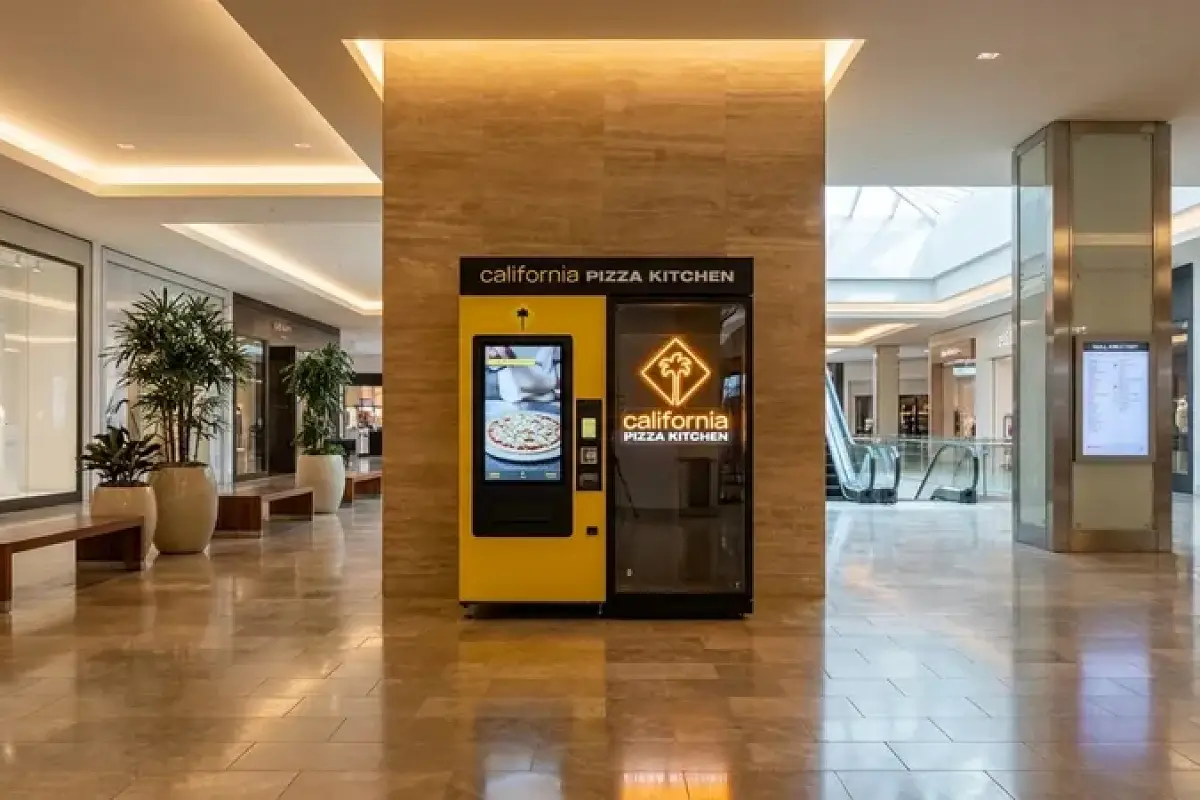
California Pizza Kitchen automated kiosks are starting to appear in places a full restaurant could never reach. In the corridor of a shopping mall, past sunlight falling through a skylight, a yellow kiosk glows against a stone pillar. A small screen shows a pizza rotating slowly under a heat lamp. There are no servers here. There is no host stand. There is only a machine, a menu, and about ninety seconds between order and first bite.
This is where California Pizza Kitchen is placing its next bet. It is not a new storefront. It is the space between storefronts, the hospitals, hotels, and sports venues where a full restaurant was never practical.
A Chain Reversing Its Own Decline
California Pizza Kitchen has spent five years shrinking. In 2021, the chain operated 167 total locations. By early 2026, after ten net closures the year before, that number had fallen to 121. This is according to the company's franchise disclosure documents. The decline has been concentrated almost entirely in company-operated restaurants.
Its franchised system has stayed steady. It never dropped below thirteen or climbed above fifteen stores across five years. It even added two net franchised locations last year. That steadiness has not translated into meaningful growth. CPK opened a domestic franchise program in 2021. It allowed refranchising in 2023. It signed a multi-unit franchise agreement in Nevada last year. None of these moves has produced the expansion CPK needs.
Why California Pizza Kitchen Chose Automated Kiosks
CPK is now turning to a partnership with T-ROC Global, a retail technology company. Together they plan to deploy as many as one thousand automated pizza kiosks by 2029. The rollout begins in clusters of at least twenty units. It will span roughly thirty major U.S. markets. T-ROC will operate the machines on CPK's behalf.
Michael Beacham, CPK's president, framed the move as a continuation, not a sudden pivot. The brand's vending machine efforts, he said, have "accelerated through a partnership with T-ROC" and "introduces CPK to entirely new occasions and venues where consumers desire quality food on the go." His comment matters. It positions the kiosk rollout as a strategy CPK has tested for years, not a rushed reaction to falling store counts.
How the CPK Kiosk Technology Works
Each kiosk relies on Turbo Chef equipment paired with data-driven intelligence. Together they produce a restaurant-quality CPK pizza in about ninety seconds. That speed sits at the center of the strategy. A traveler between flights, a visitor waiting on hospital news, a fan arriving early to a stadium gate, none of them want a full-service meal. But a pizza ready before their next announcement is a different offer entirely.
CPK already runs vending machines in several airports. That is a smaller version of the same idea. Brett Beveridge, T-ROC's chief executive, described the new deal as a chance to build something larger. "Consumers increasingly expect their favorite brands to meet them where they are, and technology is making that possible in entirely new ways," he said. "By combining CPK's brand, food and loyal following with T-ROC's nationwide infrastructure and technology capabilities, we have an opportunity to build a new national distribution channel at a meaningful scale." The quote reveals the partnership's real ambition. It is not just adding machines to a few new spots. It is building a distribution channel that runs parallel to CPK's restaurant business.
The Business Case Behind CPK's Kiosk Strategy
The venues CPK is targeting share one trait. They combine high foot traffic with too little space for a full restaurant. Hospitals rarely have room for a sit-down chain outlet. Hotels often lack the guest volume to justify a dedicated lease. Sports venues see demand only in short bursts around events. A kiosk sidesteps each constraint. It needs a fraction of the space. It needs none of the staffing a full location would require.
For a brand losing company-operated stores year after year, that math carries real appeal. Brand awareness, not just unit count, appears to be the currency CPK is chasing now. Every kiosk placed in a hospital lobby or hotel corridor puts the CPK name in front of new consumers. Some of them may never have visited a standalone location. That exposure could build the kind of familiarity that supports future franchise growth, even if it does not reverse the closures already on record.
What This Signals for the Restaurant Industry
CPK's move sits inside a wider shift already visible across restaurants. Automation and off-premise formats increasingly substitute for traditional real estate. Chains facing shrinking store counts are finding that a kiosk, a vending machine, or a delivery-only footprint can reach customers without the capital a full restaurant requires. Whether that substitution can offset years of closures remains an open question. It will likely take several years of kiosk data to answer with confidence.
What is clear is that CPK chose to test this question at scale. A rollout spanning thirty major markets, in clusters large enough to generate real data, suggests a company committing meaningfully to the format. It is not treating automated kiosks as a minor side experiment.
The Distance Between a Kiosk and a Kitchen
There is something telling in the image of a pizza rotating behind glass in a mall corridor. A machine prepares it. Someone consumes it who may never set foot in an actual California Pizza Kitchen dining room. It is not the version of the brand its founders built decades ago. It may be the version best suited to how people move through airports, hospitals, and hotel lobbies today, brief, transactional, and hungry for something familiar in an unfamiliar place. Whether that reverses a five-year decline will not be answered by a press release. It will be answered, ninety seconds at a time, by whoever stops in front of the yellow kiosk and decides to order.
Related reading: Jack in the Box names president in CEO succession step