Oberoi Hotels India: Exclusive Reasons Foreign Guests Are Missing
Oberoi Hotels India says high paying foreign guests are still missing as Middle East tensions curb travel, pushing the luxury group toward domestic guests.
 RUKAIYA KADIWAL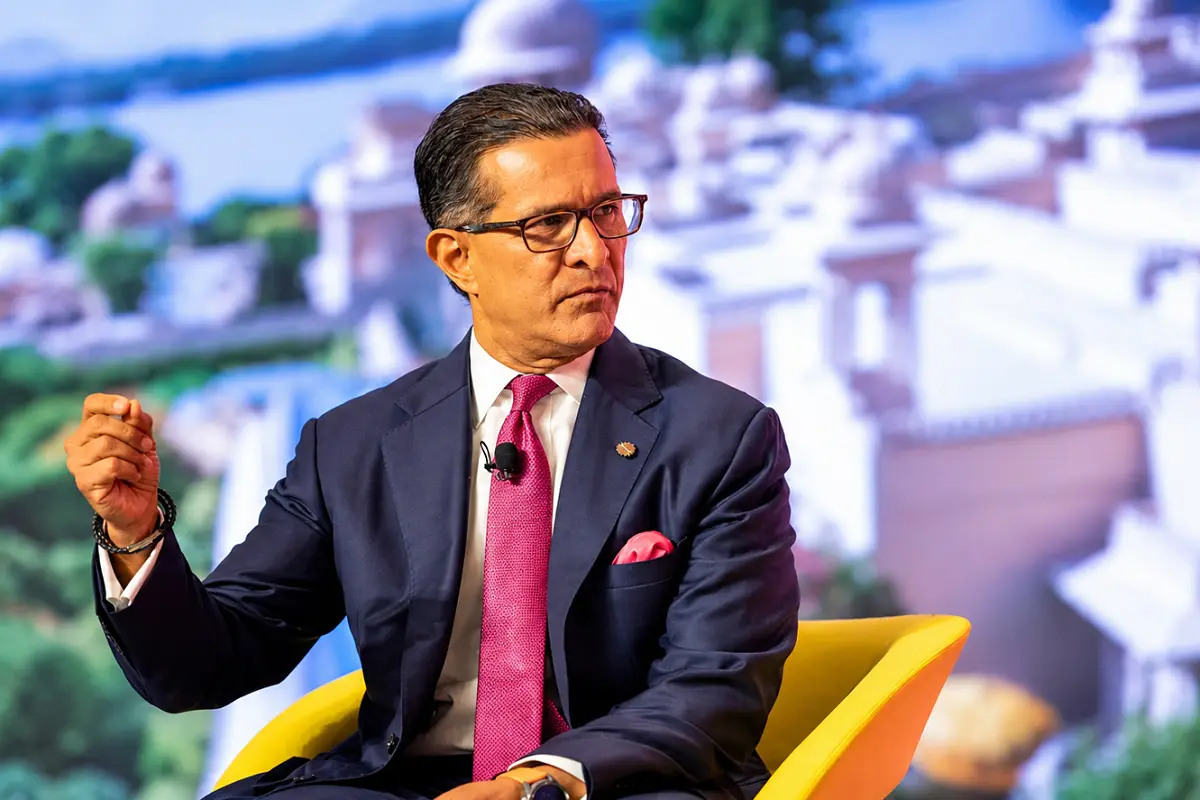
>
On stage at the Skift India Summit this year, seated in a yellow chair with the domes of an Indian palace glowing behind him on a video screen, Vikram Oberoi made a fist and held it in the air, the way people do when they are trying to land a point that matters more than the words alone. He was not talking about design or cuisine or the marble lobbies his family's hotels are known for. He was talking about who was, and was not, walking through their doors.
The absence he was describing has a particular shape in the luxury hotel business. Rooms are being filled. Restaurants are being booked. But a certain kind of guest, the international traveler who once arrived from London or Dubai or New York and spent freely without checking the exchange rate twice, has not returned in the numbers the industry grew used to before the world's geography of conflict shifted again.
A Company Built on a Certain Kind of Arrival
Oberoi is not a company that talks about itself in half measures, and it does not need to. As managing director and CEO of EIH Limited, the parent company behind the Oberoi and Trident hotel brands, Vikram Oberoi runs one of India's most recognized names in luxury hospitality, a business built over decades on the promise that certain travelers, regardless of where they came from, would find in an Oberoi property a version of India polished to a very particular standard.
That promise depended, in part, on a steady flow of visitors from outside the country. International guests have historically been the more valuable segment for hotels like these, not simply because of volume but because of what they spend once they arrive, on rooms, on spa treatments, on the kind of extended stays that domestic weekend travelers rarely book.
What Changed, and Why It Matters
EIH Limited disclosed this week that international guest arrivals fell at its hotels during the most recent quarter, a decline the company traced directly to the conflict in the Middle East, which has held back overseas travel to India from a region that has long fed its luxury tourism pipeline.
"We would expect that trend to continue just given what is happening in West Asia," Oberoi said on the company's earnings call, a sentence delivered without alarm but without much optimism either. It is the kind of line executives use when a problem is not new but is not going away on its own schedule, and it explains why the company is not simply waiting the situation out.
Oberoi told investors the company hopes international business will strengthen in the third and fourth quarters, but only if conditions in the region stabilize, a condition entirely outside the hotel group's control. That caveat is doing a great deal of work in an earnings call otherwise built around numbers the company can actually influence.
Why the Domestic Guest Cannot Fully Replace the Foreign One
What makes this shortfall difficult to simply absorb is not occupancy, which India's domestic travel boom has helped sustain, but spend. Oberoi was direct about the gap between the two guest segments, noting that international guest propensity to pay is higher than that of domestic travelers, a distinction that goes to the heart of why luxury hotel economics do not treat every filled room as equal.
A domestic traveler filling a room in Udaipur or Agra keeps the lights on and the staff employed, and there is real value in that steadiness, particularly in a year when overseas demand has been unreliable. But the incremental revenue that comes from a guest booking a suite upgrade, ordering the tasting menu rather than the set breakfast, or extending a two night stay into five, has traditionally come disproportionately from abroad. Losing that segment, even partially, changes the shape of a hotel's revenue far more than its headline occupancy figures reveal.
Spending Into the Gap
Rather than wait for geopolitics to resolve itself, EIH responded to the shortfall by spending more, directing resources toward winning over the domestic traveler more aggressively than the company might have needed to in a year when international arrivals were flowing normally. It is a defensive strategy dressed as an offensive one, an acknowledgment that the guests who are available deserve more investment precisely because the ones who are not available cannot be substituted for free.
For a brand built on exclusivity, that shift carries its own quiet tension. Courting a broader domestic base while preserving the sense of rarity that luxury pricing depends on is not a simple marketing adjustment, it is a balancing act that touches everything from how rooms are packaged to how loyalty programs are structured.
A Wider Pattern Across Indian Luxury Travel
Oberoi's disclosure lands alongside a broader reordering of demand across India's hospitality sector this year. Airlines and hotel groups exposed to the Gulf and wider West Asia corridor have described similar patterns, of bookings softening even as broader travel volumes hold up, and of businesses needing to lean harder on markets closer to home to offset routes and guest segments disrupted by conflict.
The split is not uniform across the industry. Mid market hospitality brands, less reliant on the highest spending international traveler, have in some cases held their occupancy steadier through the same period, while luxury operators have felt the absence of high paying guests more acutely in rate rather than in room count. It is a distinction worth holding onto, because it complicates any simple narrative of an industry in trouble. The rooms, broadly, are being sold. It is the composition of who is buying them, and what they are willing to spend once they arrive, that has shifted.
What the Numbers Do Not Quite Capture
There is something almost old fashioned about a hotel company willing to say, plainly, that certain guests matter more to its business than others, even as it works to make every guest feel equally welcome once they arrive. It is not a comfortable thing to admit in an industry built on the language of hospitality and inclusion, yet it is an honest one, and honesty about revenue segments is different from indifference toward the people occupying the rooms.
What Oberoi's earnings call ultimately describes is not a company in distress but a company recalibrating, quietly and in real time, around a version of demand it did not choose and cannot fully predict. Oberoi Hotels has weathered shifts in global travel before, and the current quarter's numbers suggest a business absorbing a shock rather than one destabilized by it.
Waiting for a Region to Settle
There is a particular kind of patience required in hospitality, the patience of a business that cannot control the geopolitics shaping who boards a plane, and can only control how well it treats whoever eventually walks through the door. Vikram Oberoi's closed fist on that stage in front of a screen showing his own hotels' setting was not a gesture of frustration so much as one of emphasis, the kind a person makes when describing something they have thought about carefully and cannot yet resolve.
For now, the luxury rooms across Oberoi's properties are filling with travelers who did not always used to be the primary audience, and the company is spending to make sure they feel like more than a substitute. Whether the high paying foreign guest returns in the numbers the group once relied on will depend on a region far from any hotel lobby in India, a reminder that even the most carefully run hospitality business ultimately answers to a world it does not get to design.
Readers following how family owned hospitality businesses are navigating their own local versions of uncertainty may also be interested in this account of Four Seasons Mountmellick's reopening, a smaller story with a similar undercurrent, of a business choosing to invest rather than retreat while conditions outside its control remain unsettled.