Spring Airlines Pays $46.7M to Shareholders While Raising $1.5B
Spring Airlines is raising $1.5 billion through bonds while paying a $46.7 million dividend, supporting its low-cost fleet expansion strategy.
 Jishan Khan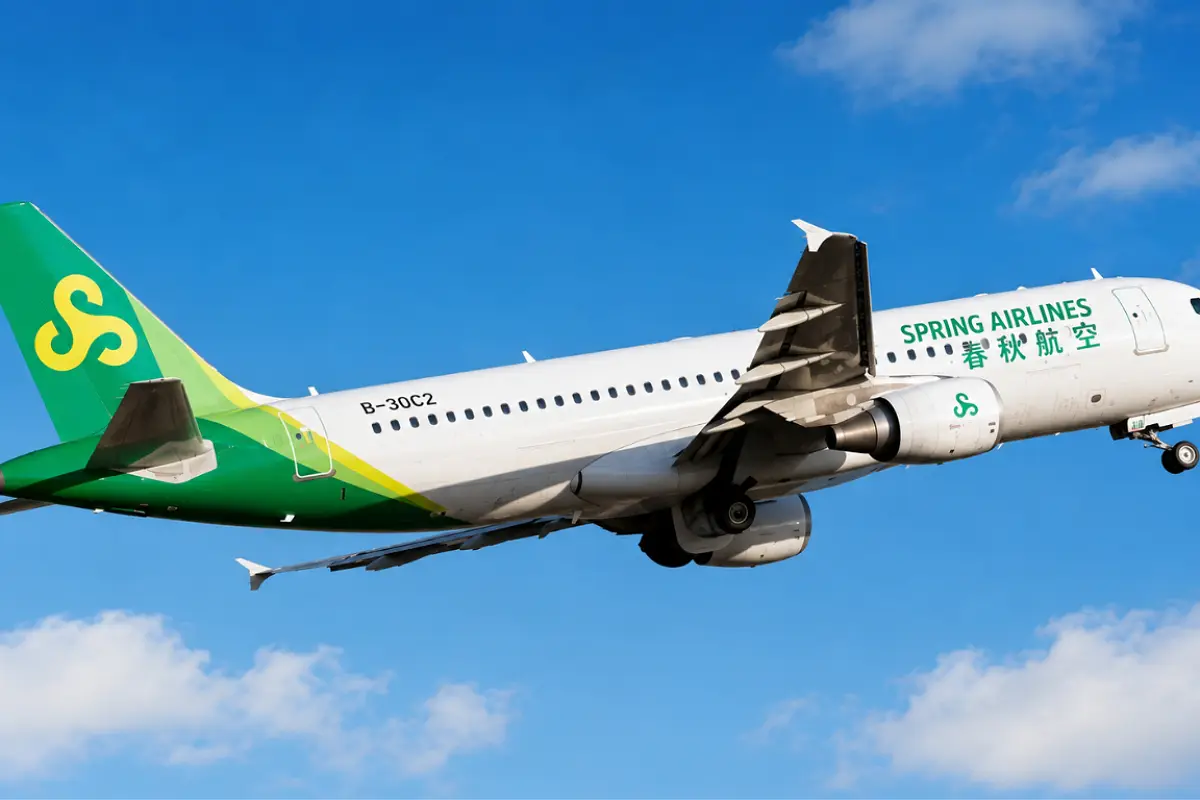
Spring Airlines Just Paid Shareholders $46.7 Million and Asked Bond Markets for $1.5 Billion in the Same Board Meeting, the "Four Avoids" Strategy Explains Why That's Not a Contradiction
Spring Airlines board approved a plan to issue up to CNY 10 billion (USD 1.5 billion) in corporate bonds with maturities up to five years, subject to shareholder approval, while separately approving a CNY 314 million (USD 46.7 million) interim dividend equal to 30.1% of its first-quarter attributable net profit, both decisions landing in the same August 27 board session. On paper, raising $1.5 billion in debt while simultaneously distributing cash to shareholders looks like a company hedging in two directions at once. Read against Spring's own publicly stated growth philosophy, it is neither contradictory nor unusual, it is the company executing precisely the disciplined-but-aggressive playbook its leadership has been describing at industry conferences all year.
The "Four Avoids" Strategy That Explains Every Number in This Story
At Routes Asia 2026 in Xi'an, Spring Airlines vice president Zhang Wuan laid out what the company calls its "four avoids" approach to remaining competitive in China's brutally crowded aviation market: avoid direct competition with high-speed rail, avoid diversified investments outside the core airline business, avoid widebody aircraft, and avoid operational waste. Every one of those principles shows up directly in this bond-and-dividend announcement. Zhang's own words on the diversification point are unusually blunt for airline-executive commentary: "As many companies grow, they tend to invest in other industries. We remain focused on our airline business. It's better to have cash in your hands than being tied up with banks."
That last line is worth sitting with, because it reframes what looks like a straightforward debt raise into something more calculated. Spring is not borrowing $1.5 billion because it lacks cash, it is borrowing because holding committed credit facilities and bond proceeds in reserve, rather than locking capital into bank relationships or scattering it across side investments, is explicitly the treasury philosophy this leadership has told the market it follows. The interim dividend, paid out at just 30.1% of quarterly profit rather than a more aggressive payout ratio, fits the same logic, return some capital to keep shareholders satisfied, but preserve the overwhelming majority of both earnings and new borrowing capacity for the fleet expansion Zhang has been describing publicly since at least April.
Why an Airline That Explicitly Avoids Widebodies Still Needs $1.5 Billion
Spring operates a deliberately simple fleet, 134 aircraft at the end of 2025, comprising 75 Airbus A320-200ceos, 47 A320neos and 12 A321neos, with a single-class cabin across the entire operation. Zhang was explicit about why: "We operate a single aircraft type, all Airbus A320 and A321, and a single-class product in the cabin to maintain low cost." That single-family, single-class discipline is precisely what makes Spring's stated fleet targets, more than 200 aircraft within five years, rising to around 300 by 2035, achievable without the kind of runaway capital intensity that plagues carriers juggling multiple aircraft types, multiple cabin configurations and the associated multiplication of crew training, spare parts inventories and maintenance procedures.
Spring already has a 30-aircraft A320neo order placed at the end of 2025, with deliveries running 2028 through 2032, on top of the roughly 30 aircraft the airline expects to add in 2026 alone. Funding that pace of delivery, even with the lower unit cost of a single-manufacturer, single-family fleet, requires exactly the kind of large, flexible capital pool a CNY 10 billion bond programme provides, particularly one explicitly earmarked across working capital, debt repayment and fixed-asset purchases rather than restricted to one narrow use.
The Rail Competition Problem That Makes Spring's Business Model Genuinely Different From China's State Carriers
Zhang's comment that Spring's average route length of roughly 1,200 km "allows it to remain competitive against rail on medium-haul sectors" is not incidental colour, it is the central strategic insight differentiating Spring from the capital-raising patterns this feed has covered extensively across Air China, China Eastern and China Southern throughout 2026. China's high-speed rail network has become one of the most formidable competitive threats to short-haul domestic aviation anywhere in the world, and it disproportionately pressures state-owned full-service carriers whose route networks and cost structures are less able to reposition around rail-resistant medium-haul markets. Spring's explicit strategy of avoiding head-to-head competition with rail on shorter routes, while concentrating capacity on the 1,000-1,500 km band where flying retains a clear time advantage, is a structural choice that keeps the airline's core unit economics healthier than carriers forced to defend shorter routes rail can serve more cheaply.
That distinction matters directly for how this bond issuance should be read relative to Air China's USD 3 billion state-backed placement or China Eastern's shareholder-backed buyback, both covered in this feed's earlier reporting. Those raises were explicitly framed around addressing mounting losses and strengthening balance sheets weakened by fuel costs, competition and, in China Eastern's case, a genuine need for capital injection. Spring's bond programme, by contrast, is being raised by a carrier that just posted a full-year profit for 2025 and is voluntarily paying a dividend in the same announcement. This is expansion capital for a company executing from strength, not stabilisation capital for one working through weakness.
Why Rising Fuel Costs Have Not Derailed the Growth Plan, According to Spring's Own Framing
Zhang addressed the elephant in the room directly at Routes Asia, the same Iran-conflict-driven fuel cost spike that this feed has documented forcing capacity cuts, fleet groundings and emergency financing across dozens of carriers globally throughout 2026, from AirAsia's USD 1 billion liquidity search to Cebu Pacific's executive pay cuts to India's ATF price freeze. His characterisation was notably calm relative to how most airline executives have discussed the same pressure: "Zhang said the airline views rising fuel prices as a short-term challenge, and he remains confident in underlying travel demand," reportedly adding some version of "if the sky falls, the industry" faces it together, a framing that treats the fuel shock as a shared, temporary sector-wide headwind rather than an existential threat specific to Spring.
That confidence is easier to sustain from Spring's specific cost position than it would be for a full-service carrier. A single-aircraft-family, single-class, no-widebody operator with among the lowest cost-per-available-seat-kilometre metrics in Chinese aviation has considerably more room to absorb a fuel price spike before it threatens profitability than a carrier running a more complex, higher-cost-base widebody and premium-cabin network. Domestic routes account for roughly 60% of Spring's capacity, a share that Zhang noted has actually increased in recent months following a diplomatic dispute between China and Japan that dampened outbound tourism demand, illustrating the kind of real-time network flexibility a simple, single-fleet-type operation can execute more nimbly than a carrier managing multiple aircraft types across more rigid long-haul scheduling commitments.
What "All Chinese People Can Afford to Fly" Actually Means as a Financing Strategy
Zhang's own stated mission for the airline, "Our LCC model seeks to achieve the objective that all Chinese people can afford to fly", is not just a marketing line; it describes a specific growth thesis about China's aviation market that this feed has tracked repeatedly through 2026, from IATA's own World Air Transport Statistics data showing China's aviation market as the world's second-largest and still growing at a healthy 4.8% annually, to the broader pattern of Chinese carriers pursuing aggressive expansion even amid fuel cost pressure that has forced retrenchment among international peers. Spring's bet is that China's demand growth curve for low-cost, mass-market air travel remains steep enough, and its own cost discipline sharp enough, to justify tripling its fleet by 2035 while every other major Chinese carrier this feed has covered, from Air China's state-backed recapitalisation to China Southern's Chongqing Airlines injection, is focused primarily on stabilising balance sheets rather than expanding market share.
The CNY 10 billion bond programme is the financing mechanism for that bet. The CNY 314 million dividend is Spring demonstrating, in the same breath, that funding aggressive growth and returning capital to shareholders are not mutually exclusive when the underlying business is generating the kind of profit margin, 10.80% trailing twelve-month net margin, per the company's most recent reported financials, that gives a board genuine room to do both simultaneously rather than being forced to choose