United Airlines Unveils “Relax Row” Economy Seats That Convert Into Couch-Style Seating
United Airlines has introduced its new “Relax Row” economy seating concept, allowing passengers to convert seats into couch-style arrangements for enhanced comfort.
 Jishan Khan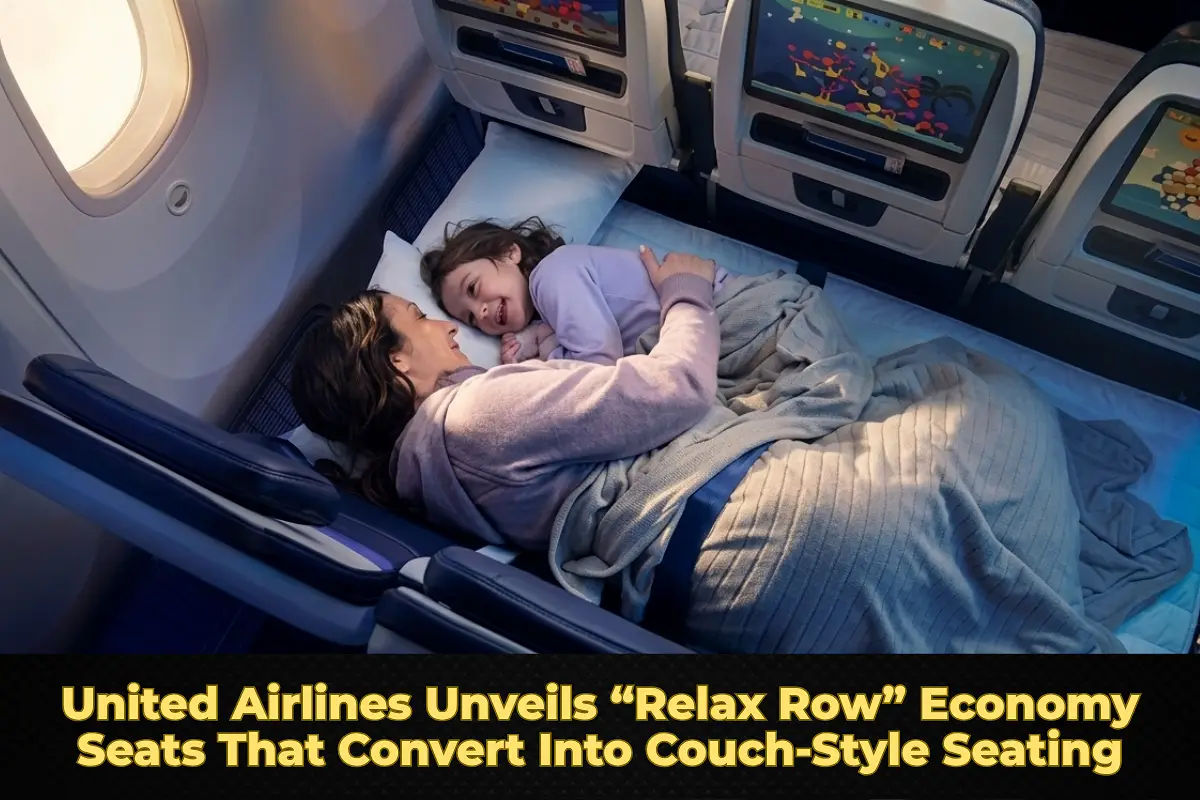
United Airlines has introduced a new economy seating concept called “Relax Row” in 2026, allowing passengers to transform a row of seats into a couch-style configuration, as the airline seeks to enhance passenger comfort and differentiate its onboard experience. The initiative, announced as part of the carrier’s broader cabin innovation strategy, aims to provide greater flexibility and comfort for travelers, particularly on long-haul routes.
The concept is designed to address evolving passenger expectations, with travelers increasingly seeking more comfortable and adaptable seating options without upgrading to premium cabins. By reimagining traditional economy seating, United Airlines is positioning itself to compete more effectively in a market where onboard experience plays a growing role in customer choice.
Innovative Seating Concept
The “Relax Row” concept allows a full row of economy seats to be converted into a flat or semi-flat couch-like surface, enabling passengers to stretch out during flights. This is achieved through a redesigned seat structure that allows seat cushions to be adjusted and aligned to create a continuous surface.
The configuration is expected to be particularly appealing for families, couples, and passengers traveling on long-haul flights who prioritize comfort but may not wish to pay for business-class seating. By offering a more relaxed seating arrangement within the economy cabin, United Airlines aims to bridge the gap between standard and premium travel experiences.
The concept reflects a broader trend in aviation design, where airlines are exploring ways to maximize space utilization while improving passenger comfort.
Focus on Passenger Experience
Passenger experience has become a key competitive factor in the airline industry, with carriers investing heavily in cabin upgrades and new seating concepts. The introduction of “Relax Row” highlights United Airlines’ focus on enhancing comfort and meeting diverse traveler needs.
Traditional economy seating has long been criticized for limited space and comfort, particularly on longer flights. By offering a more flexible seating arrangement, the airline aims to address these concerns and improve overall satisfaction.
The new seating concept also aligns with changing travel preferences, where passengers are increasingly willing to pay for incremental comfort upgrades rather than full premium-class fares.
Commercial Strategy and Revenue Potential
The “Relax Row” is expected to be offered as a paid upgrade within the economy cabin, providing an additional revenue stream for the airline. Passengers may be able to reserve an entire row for personal use, effectively creating a more spacious and comfortable travel environment.
This approach allows United Airlines to monetize unused seat capacity while offering a differentiated product. By targeting travelers seeking comfort at a lower price point than business class, the airline can tap into a broader customer segment.
The concept also provides flexibility in pricing, enabling the airline to adjust rates based on demand, route, and season.
Design and Operational Considerations
Implementing convertible seating within an aircraft cabin presents several design and operational challenges. These include ensuring compliance with safety regulations, maintaining structural integrity, and managing weight constraints.
United Airlines has indicated that the “Relax Row” concept has been developed with these considerations in mind, incorporating features that allow for quick reconfiguration while adhering to aviation safety standards.
The airline will also need to address operational factors such as seat allocation, cleaning procedures, and turnaround times, as the new configuration may require additional coordination between ground and cabin crew.
Industry Trends in Cabin Innovation
The introduction of “Relax Row” reflects a broader trend in the aviation industry toward innovative cabin designs. Airlines are increasingly exploring new seating configurations, modular cabins, and flexible layouts to enhance the passenger experience.
Such innovations are driven by a combination of competitive pressures, technological advancements, and changing consumer expectations. As passengers demand greater comfort and personalization, airlines are responding with creative solutions that go beyond traditional seating models.
Other carriers have experimented with similar concepts, including lie-flat economy options and hybrid seating arrangements, indicating a shift toward more versatile cabin designs.
Target Market and Customer Appeal
The “Relax Row” is likely to appeal to a wide range of passengers, including leisure travelers, families, and business travelers seeking additional comfort without the cost of premium cabins. The ability to lie down or stretch out during a flight can significantly enhance the travel experience, particularly on long-haul routes.
For families traveling with children, the concept offers a practical solution for managing comfort and rest during flights. Couples and solo travelers may also find value in the added space and flexibility.
The offering could also attract passengers who might otherwise choose competing airlines with more comfortable economy options.
Competitive Positioning
By introducing “Relax Row,” United Airlines is positioning itself as an innovator in cabin design and passenger experience. The concept provides a unique selling point that can differentiate the airline in a highly competitive market.
As airlines continue to compete on factors beyond price, such as comfort and service quality, innovative seating solutions are becoming increasingly important. The ability to offer enhanced comfort within the economy cabin can provide a significant advantage.
The move also signals United Airlines’ willingness to experiment with new ideas and adapt to changing market dynamics.
Future Outlook
Looking ahead, the success of the “Relax Row” concept will depend on passenger acceptance, operational feasibility, and financial performance. If successful, the airline may expand the offering across more aircraft and routes.
The concept could also influence broader industry trends, encouraging other airlines to explore similar innovations in economy seating. As competition intensifies, the focus on passenger experience is expected to drive further experimentation and investment in cabin design.
United Airlines may also continue to refine the concept based on customer feedback, potentially introducing additional features or variations to enhance its appeal.
United Airlines has introduced its “Relax Row” seating concept, allowing economy passengers to convert seats into a couch-style configuration, with rollout plans expected as the airline evaluates its impact on passenger experience and revenue.