Noida International Airport Art Showcases Paresh Maity Work
Noida International Airport art installation features works by Paresh Maity, creating a cultural gateway to North India. Read more.
 nishathapa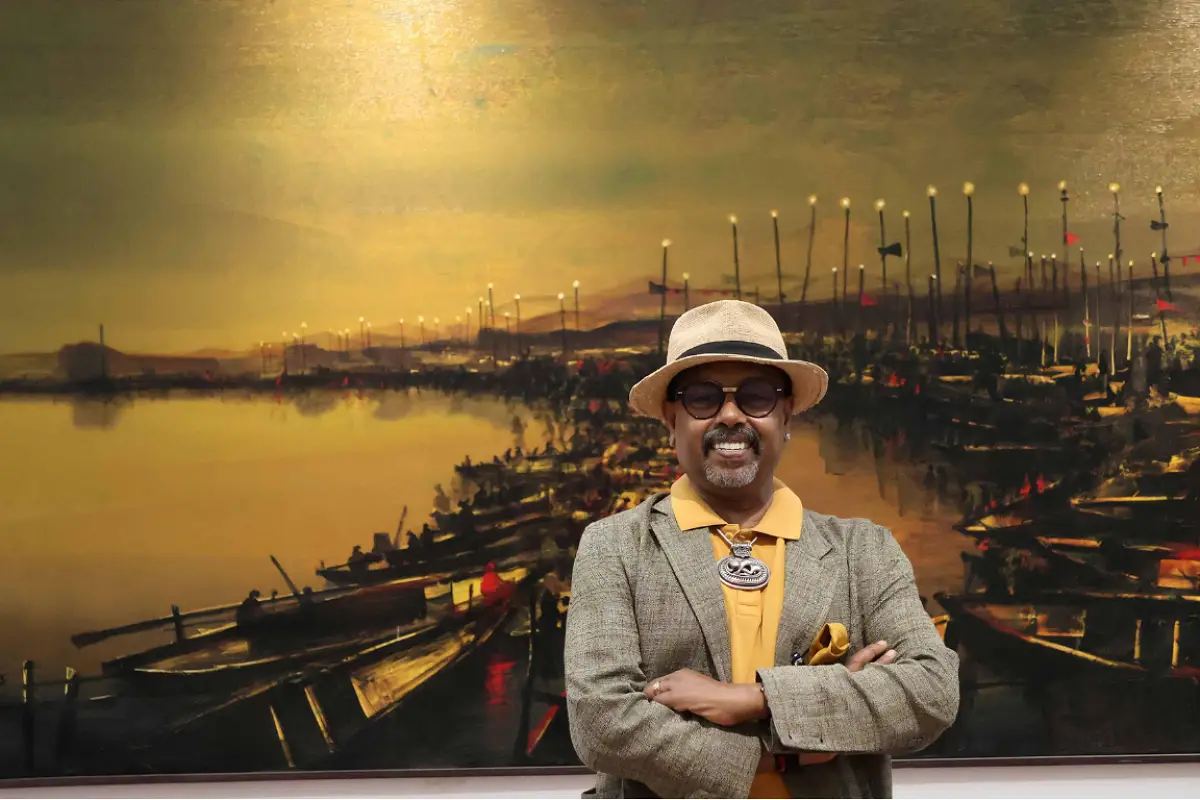
NOIDA, May 27, 2026: Noida International Airport has integrated two major works by Padma Shri awardee Paresh Maity into its terminal, a large-scale brass bell installation titled Mystic Abode and a six-panel oil-on-canvas painting titled Awakening (Jagriti). Together, the works form the artistic and cultural backbone of a terminal designed to function as more than a transit facility, an introduction to the spiritual and historical landscape of Uttar Pradesh for every passenger who passes through it.
The ambition is significant. Airports are among the few public spaces where an institution can place art in front of millions of people who did not seek it out. Most use that opportunity modestly, branded installations, corporate abstract works, generic regional motifs. Noida International Airport has used it to commission one of India's most internationally recognised living painters, and to ask him to represent the entire spiritual and cultural geography of northern India in two works. That is a serious curatorial decision, and the two pieces Maity has produced for the terminal are worth understanding individually.
Mystic Abode: 8,000 brass bells and the sound of stillness
Mystic Abode is constructed from more than 8,000 brass bells, a material with deep resonance in Indian domestic and sacred culture. Bells mark thresholds in Indian life: the entrance of temples, the doorways of homes, the beginning of prayer, the transition from outside to inside. In a functioning airport terminal, one of the noisiest, most restless environments that architecture produces, an installation built from bells creates a counter-experience. It does not add to the noise. It recontextualises it.
The piece is designed as a reflective space, encouraging travellers to pause between the momentum of departure and the anxiety of arrival. The sound and symbolism of the bells draw on the atmosphere of traditional Indian homes and places of worship, not to make the airport feel like a temple, but to offer the quality of attention that such spaces invite. In a terminal where most design decisions push passengers forward, Mystic Abode creates a moment to stand still.
Awakening (Jagriti): a visual journey across six sacred geographies
Awakening (Jagriti) is an oil-on-canvas work spread across six panels, each dedicated to a distinct landmark in Uttar Pradesh's spiritual and cultural landscape. The sacred ghats of Varanasi open the composition. The teachings of Buddha at Sarnath, where the first discourse of the Dharma was delivered, follow. The Taj Mahal in Agra represents the architectural and devotional legacy of the Mughal era. The landscapes of Mathura and Vrindavan carry the traditions of the Vaishnavite path. The sacred city of Ayodhya, associated with the birthplace of Lord Ram, anchors the devotional heartland of northern India. The energy of the Mahakumbh, the largest religious gathering on earth, closes the sequence.
The six panels are unified by the theme of sunrise, which Maity uses as both a visual and philosophical device. A sunrise is simultaneously a daily fact and a symbol of the beginning of inner awakening, of new journeys, of the possibility that each day offers something not yet known. For a painting installed in an international airport, the metaphor is exact. Every passenger in that terminal is, in some sense, at the start of something.
The four sacred rivers, Ganga, Yamuna, Saryu, and Saraswati, run as a connective thread through the panels, linking the geographies not just spatially but mythologically. The rivers are not background elements. They are the argument: that these places belong to the same continuous cultural and spiritual story, one that flows rather than divides.
The terminal's design language: red granite, ghats and havelis
The art does not sit in isolation. The terminal itself has been designed around the heritage vocabulary of western Uttar Pradesh. Red granite references the material and colour palette of the region's historic monuments. The steps leading into certain zones echo the form of the ghats of Varanasi, the broad descending stone terraces that define how the city meets its river. Open courtyard-style spaces within the terminal draw from the architectural logic of the traditional haveli, where enclosed outdoor areas created a sense of arrival and gathering.
Passenger experience has been integrated into the design rather than treated as a separate layer. Calm courtyard zones after security give travellers space to decompress between the intensity of check-in and the wait of the gate. High ceilings maintain an open quality that prevents the terminal from feeling compressed. Natural lighting is managed carefully, and navigation systems are designed to be clear enough that the architecture itself can carry the atmosphere without competing with wayfinding anxiety.
Who Paresh Maity is, and why this commission matters
Paresh Maity is one of India's most internationally exhibited living artists, with a career spanning nearly five decades. His works are held in the permanent collections of the Rashtrapati Bhavan, the British Museum in London, and the National Gallery of Modern Art in New Delhi, three of the most significant institutional collections in which an Indian artist can be represented. He is a recipient of the Padma Shri, India's fourth-highest civilian honour.
He is also the artist behind one of the world's longest airport murals, installed at Delhi's Indira Gandhi International Airport, a precedent that makes his presence at Noida International Airport a deliberate continuation of a tradition of large-scale public art in Indian aviation infrastructure, and one that places NIA in distinguished company from its opening.
What this means for how Indian airports are being designed
The integration of serious, commissioned art into a new airport terminal is a statement about what kind of experience the airport intends to offer, and what kind of impression India intends to make on the international travellers who will pass through it. Noida International Airport's decision to anchor its cultural programme in the specific heritage of Uttar Pradesh, rather than defaulting to generic national motifs, reflects a more precise and respectful form of place-making.
A passenger arriving at Noida International Airport from abroad will encounter, before they leave the terminal, the ghats of Varanasi, the bells of a traditional home, and the sacred rivers that connect Uttar Pradesh's most significant sites. They will not have visited those places yet. But they will already have been introduced to them, not through a brochure or a screen, but through the considered work of one of India's finest painters. That is a meaningful first impression.