Three Valley Gap Chateau Hides a Remarkable Legacy
Three Valley Gap Chateau near Revelstoke is a self-sufficient castle hotel and ghost town built by one family, powered entirely by its own hydro system.
 RUKAIYA KADIWAL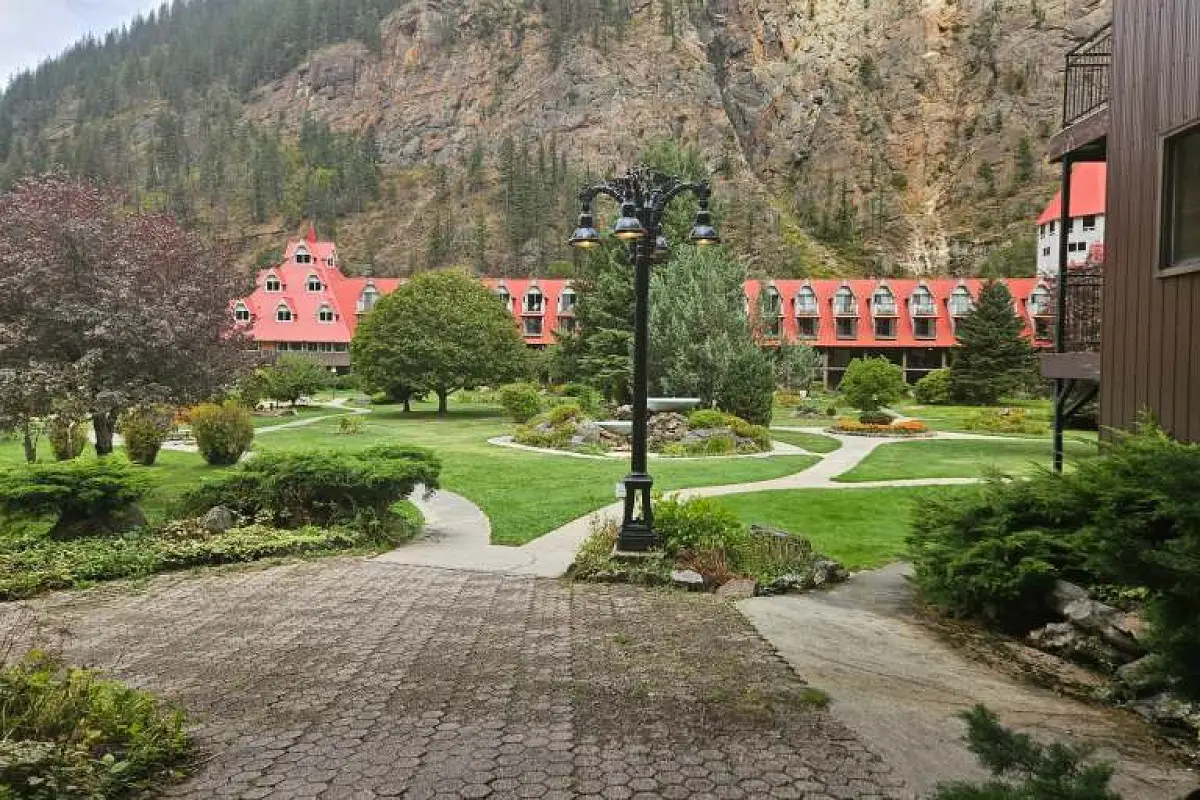
Along a narrow stretch of the Trans-Canada Highway west of Revelstoke, thousands of travelers pass a cluster of red rooftops rising between sheer cliffs each year, most never slowing down long enough to wonder what sits behind them. "Some people don't know what it is or they keep driving by instead of stopping in, that continues to this day," co-owner Mike Bell said. "It's a pretty narrow point on the highway, everyone goes by, everyone sees it. People eventually do stop and are impressed." That quiet persistence, drawing curious travelers decade after decade despite its unassuming roadside presence, defines Three Valley Gap Chateau, a story documented by iNFOnews.ca.
Three Valley Lake Chateau & Historic Ghost Town is a 200-room hotel styled to resemble a castle, drawing repeat visitors from around the world each year even as countless others continue driving past unaware of what waits just off the highway.
Far More Than a Hotel
What distinguishes this property from a typical roadside stay is its sheer scope. The establishment functions as an off-grid, self-sufficient tourist attraction, decorated throughout with antiques, historic buildings, vintage cars, and train cars, each object carrying its own distinct origin, age, and story. Walking through its interior and exterior spaces feels less like touring a hotel and more like moving through layered decades of history compressed into a single site.
That sense of accumulated history is entirely intentional, the product of one family's decades-long commitment to preservation and self-reliance in a remote corner of British Columbia's interior.
A Grandfather's Vision Takes Root
The chateau began as a family legacy started by Mike's grandfather, Gordon Bell, a visionary entrepreneur who purchased land on the shores of Three Valley Lake at the foot of the Monashee Mountains alongside his wife, Ethel Bell, in the 1950s. The first sections of the hotel opened in the early 1960s, built in a location that offered little in the way of existing infrastructure or oversight.
"He wanted to be self-sufficient, he wanted to do everything himself, how he wanted it," Mike said. "Out here, there were no building codes at the time, there was nothing. He had to provide water, power and sewer himself." That radical self-sufficiency became the defining characteristic of the entire property, a philosophy that continues shaping how the chateau operates today.
An Improvised Power Plant Built From Necessity
Initially powered by diesel generator, the property's energy needs eventually outgrew that solution as fuel costs climbed. Gordon responded by building his own power plant in 1980, running four kilometers of overhead power line alongside 5,000 feet of submarine cable laid beneath the lake itself. "Our power plant is on a different piece of property seven kilometres away," Mike explained. "We have a pool of water and intake high up to maintain constant pressure and it's pushed through a turbine attached to a generator to make electricity."
"A company provided the expertise for the small hydro system at the time, but I don't think it was a common thing to do," Mike added, a comment that underscores just how unusual this level of engineering ambition was for a private hotel operation in the early 1980s. The chateau remains fed by a mountain spring to this day, operating with no municipal services and no connection to BC Hydro's provincial power lines.
Rescuing History From the Scrap Heap
As Gordon continued expanding the hotel over the following decades, he simultaneously began collecting train cars and automobiles, many donated directly by members of the public. That collecting habit traced back to a specific moment of local history. "In the 60s, a dam was built south of Revelstoke and flooded out a lot of communities," Mike said. "They just burned the buildings and churches, all sorts of things, and he tried to do his part to preserve things."
"He hated to see things going in the garbage or being crushed for scrap metal," Mike said, a sentiment that explains why the property today functions as much as an informal museum as it does a functioning hotel, filled with objects that might otherwise have vanished entirely from the region's collective memory.
A Family Business Passed Forward
When Gordon passed away in 2007, ownership of the site transferred into a family trust shared among multiple family members, several of whom, including Mike, have become deeply knowledgeable custodians of the property's history and operations. Mike's own two sons have worked at the chateau as well, continuing a tradition of hands-on family involvement across generations. "He wanted to have a business for his family," Mike said, a simple statement that captures the property's enduring purpose beyond its function as a tourist destination.
Rooms Built From Rock and Views Built From Wilderness
Every room within the chateau offers a distinct outlook, whether toward the lake, the train collection, a meticulously kept courtyard, or the surrounding mountain cliffs where mountain goats are occasionally spotted by guests. One particularly distinctive room, called The Cave, is constructed entirely from wall-to-wall rock, including a spring-fed bath and shower built directly into the stone.
Onsite, visitors can purchase tickets to explore the Heritage Ghost Town, filled with antiques, period-accurate building facades, a historic church, and a museum collection of vintage automobiles displayed alongside an antique gas pump. "All of the cars run except the Dodge," Mike said. "My grandfather didn't like Dodges so that was his joke, that they all run except for the Dodge, which is typical, he'd say," a small, enduring joke that has apparently outlived the man who first told it.
A Turntable, a Trudeau Story, and Layers of Canadian History
An enormous circular building on the property houses train cars arranged around a large turntable once used to physically rotate locomotives. "Every divisional point had a turntable, they say locomotives weren't very good at backing up," Mike explained. "This one is 85 feet in diameter and still functions," a remarkable claim for a piece of railway infrastructure this old, still operational decades after its original purpose became largely obsolete elsewhere.
Among the vast train collection sits a particularly notable car, the same one Pierre Trudeau traveled aboard during a visit through the region in the 1980s. "He gave the famous Trudeau salute, that is, he gave some protestors the middle finger and this is the actual car he did it from," Mike said, a small but memorable piece of Canadian political history preserved almost by accident within this remote mountain property.
A Stop That Doesn't Require an Overnight Stay
Travelers don't need to book a room or purchase a ghost town ticket to experience part of what Three Valley Gap offers. Some visitors simply pause to admire the scenery, take photographs, or sit along the lake's beach. A restaurant and gift shop remain open onsite for those who want a more substantial stop, offering practical hospitality alongside the site's historical attractions, positioning the property within a broader pattern of destination-anchored hospitality concepts gaining renewed attention globally this year, not unlike the way heritage and cultural storytelling have shaped recent hotel concepts such as the Noted Collection Amman Hotel's coffee-heritage concept, where a property's identity is built directly around local history and craft rather than standardized hospitality formulas.
A Legacy the Founder Knew Was Safe
Inside the entryway of the main building, a plaque telling Gordon Bell's story sits near comfortable chairs, occasionally joined by a cat sleeping nearby, a quiet, unassuming tribute to a man whose ambition shaped an entire remote corner of the Monashee Mountains. "My grandfather was an entrepreneur, and he died knowing his legacy was safe," Mike said. That legacy continues today in the red rooftops still catching the eyes of highway travelers, in the hydro turbine still humming seven kilometers away, and in a family still choosing, generation after generation, to keep the lights on at Three Valley Gap Chateau exactly the way Gordon first imagined they should be.