Carnation Canteen Unveils Art, Music and Melbourne Soul
Carnation Canteen in Fitzroy blends art, literature and lunar folklore, as chef Audrey Shaw reveals the inspirations behind her Melbourne restaurant.
 RUKAIYA KADIWAL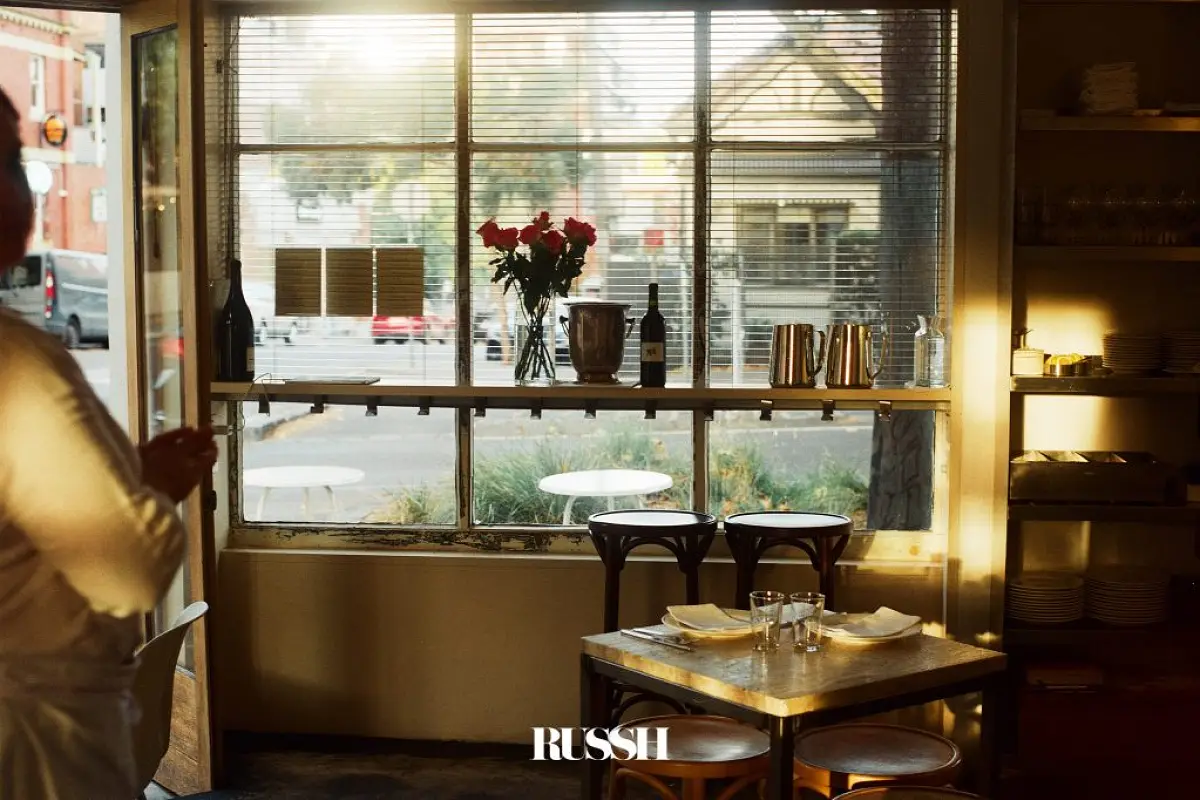
Late afternoon sun slants through a row of paned windows, catching a jar of red roses and a silver ice bucket resting on a worn timber sill, the street outside blurred just enough by old glass to feel like memory rather than traffic. Inside, a figure in white moves toward the door, unhurried, while a small table sits set for two, cutlery already arranged beside two empty water glasses waiting to be filled. This quiet, golden moment captures something essential about Carnation Canteen, the Fitzroy restaurant where chef and restaurateur Audrey Shaw has built a space where atmosphere carries as much weight as anything arriving from the kitchen.
Shaw, a former architect turned Melbourne based chef, approaches hospitality with an instinct that treats the dining room and the plate as inseparable concerns. At both Carnation Canteen and its sister venue Bar Carnation, impeccable produce and rigorous cooking exist alongside an unwavering visual sensibility, one shaped as much by literature, art and inherited taste as by culinary technique alone.
An Omen Written in the Sky
Some restaurateurs speak in numbers and margins. Shaw, when discussing the energy inside her restaurant, reaches instead for lunar folklore. She confirmed that the Canteen team actually notes in their nightly briefing whether it happens to be a full moon, a small ritual meant to prepare staff for the mildly strange, occasionally erratic behaviour that seems to arrive alongside it.
That instinct carries particular resonance given how the restaurant itself began. Shaw recalled that Carnation Canteen opened on a full moon, and at the end of a genuinely chaotic first service, she and her team stepped into the courtyard for a drink and noticed a giant bright ring circling the moon above them, a lunar halo caused by moonlight refracting through ice crystals suspended in high altitude clouds. She described the moment as feeling like a good omen, a small piece of cosmic reassurance on an otherwise overwhelming night.
A Childhood Restaurant Called Le Eaglemont
Shaw's relationship with hospitality traces back further than her professional career suggests. From around age ten, she recalled planning elaborate Sunday lunch menus with her mother whenever her grandparents visited, painstakingly creating a menu for each guest under the invented name Le Eaglemont, taken from the Melbourne suburb where her family lived.
She would cut photographs from Gourmet Traveller magazine to collage onto each menu's cover, a detail her mother has apparently preserved, since Shaw noted the menus still live in her family's kitchen cupboard today. That early instinct toward hospitality as performance and generosity clearly foreshadowed the restaurant she would eventually build as an adult.
A Single Painting, Chosen With Purpose
Walk into Carnation Canteen and only one piece of art hangs on the walls, a deliberate restraint from a chef whose personal aesthetic runs considerably more maximalist. Shaw described the piece as a bunch of carnations by Sidney Nolan, painted during his experimental 1980s period, and explained that her grandfather died just before the restaurant opened.
He left her a sum of money, and she spent the entirety of it on that single painting, a choice she believes he would have appreciated given his own roots in Fitzroy, where he was born and raised. That single sentimental extravagance, rather than a wall crowded with art, speaks to how carefully Shaw considers what actually belongs inside her restaurant's identity.
Literature as a Second Language
Shaw's reading habits reveal as much about her sensibility as her cooking does. She named Ben Lerner's writing as something that floored her enough to finish in a single sitting, alongside a deep affection for Cormac McCarthy's Border Trilogy and what she called a weakness for cowboy stories more broadly, tracing similar territory through Denis Johnson and Thomas McGuane.
Autofiction occupies significant space in her reading life too, with Rachel Cusk's cerebral style and Joan Didion's cool, detached intelligence both resonating deeply, though Shaw admitted with characteristic honesty that she probably resembles confessional writer Eve Babitz more closely than the composed Didion she admires. She also cited Natalia Ginzburg's clarity, Javier Marías's philosophical romance and Siri Hustvedt's writing on art and psychology as ongoing influences, alongside poets Anne Carson and Eileen Myles.
Cooking as a Continuation, Not a Career
Shaw never attended culinary school, learning instead entirely on the job, and for a long time preferred describing herself as a cook rather than a chef, a distinction she held with genuine pride. She sees her work as a continuation of generations of women who cooked for their families first rather than as a formal profession, naming Marcella Hazan, Patience Grey and Rachel Roddy among her influences.
While hesitant to reduce anyone by leading with gender, Shaw acknowledged admiring numerous female restaurateurs, including Alice Waters, Ruth Rogers, Judy Rodgers, Margot Henderson, Clare De Boer and Brigette Hafner, describing them collectively as uncompromising and exacting in their vision. She credited that lineage with giving her the courage to open her own restaurant, noting there is a distinctly different energy in kitchens run by women. Full details on Carnation Canteen and the RUSSH interview series are available on the official RUSSH website.
Trusting the Grower Over the Perfect Vegetable
Asked to define the perfect vegetable, Shaw rejected the premise entirely, explaining she cares little about visual perfection and considerably more about flavour. She described celery grown this season by Paul at Days Walk Farm as gnarled and riddled with worm bites, the kind of produce most shoppers would instinctively avoid, yet its flavour remained unmatched precisely because she trusted the grower behind it.
That philosophy extends into how she runs her kitchen more broadly, prioritising relationships with producers over cosmetic uniformity, a value increasingly rare within an industry often pressured toward standardised, camera ready plating over genuine flavour and provenance.
Music, Memory and a Song Called Chosen
Music threads through Carnation Canteen's daily rhythm in ways Shaw admitted surprised even her once the restaurant opened. Her mother arranges flowers every Wednesday while the team listens to Wham, a ritual apparently started by a former chef named Joseph and now running nearly two years strong. Thursdays bring The Strokes during the kitchen's big prep day, while chef Isaac introduced the whole team to the band Geese along the way.
When asked which single song most captures the chapter of her life when Carnation Canteen first opened, Shaw named Chosen by Blood Orange without hesitation, crediting it with carrying her team through difficult services and overwhelming Friday nights during those early, uncertain months.
A Kitchen Upstairs, Built From Almost Nothing
Before Carnation Canteen opened, Shaw lived upstairs from the restaurant with her husband, camping essentially, with an outhouse serving as their toilet and shower and only a small gas cooktop for meals. That arrangement continued for roughly nine months even after opening, since the upstairs space contained only a sink, meaning the couple would descend into the Canteen kitchen once the restaurant closed each night to cook whatever they could scavenge from the pantry and fridge.
Shaw described that period generously as cooking, though admitted the reality involved considerably more improvisation than technique. It was there, in those late night, half formed meals, that she tested every recipe eventually served at Carnation Canteen, a kitchen she described as remaining exceptionally close to her heart. That kind of quiet, unglamorous devotion to craft, tested long before any customer ever sat down, echoes across hospitality more broadly, including in how restaurant operators worldwide continue rethinking what genuine value looks like at the table, a theme also visible in recent coverage of Xiaocaiyuan's deliberate pivot back toward dine in dining across China.
What Remains When the Lights Go Down
Long after the last table clears and the flowers her mother arranged each Wednesday begin to wilt slightly by week's end, what lingers about Carnation Canteen is not any single dish or design choice, but the accumulated weight of everything Shaw has folded into the space, a grandfather's painting, a childhood menu still tucked in a kitchen cupboard, a song that carried a team through its hardest nights. Hospitality, at its most honest, has always been this kind of quiet accumulation, memory layered carefully onto memory, until a restaurant becomes something closer to a life fully lived than simply a place to eat.