Chinese Airlines Gain Competitive Edge as China-Europe Routes Expand Rapidly
Chinese carriers are strengthening their position on China-Europe routes as capacity expands and operational advantages give them a competitive edge over European rivals.
 Jishan Khan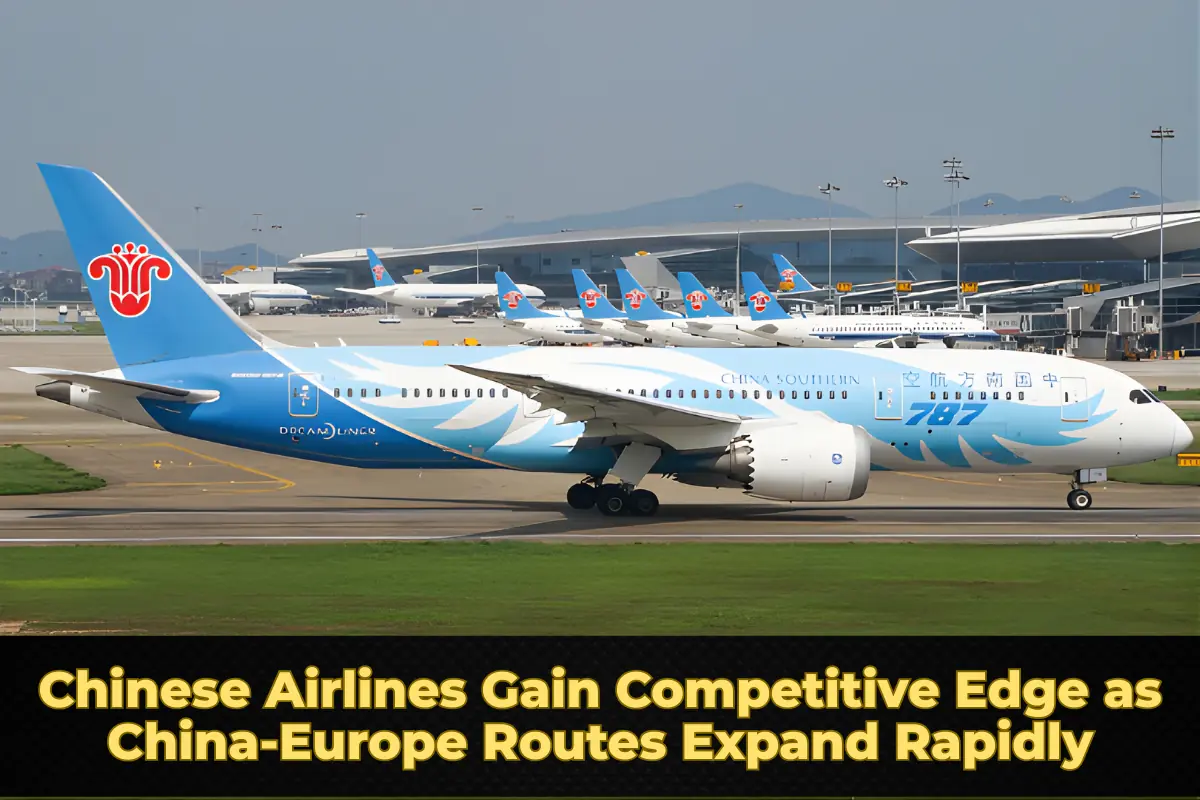
Chinese airlines are strengthening their foothold in the China-Europe aviation market as route capacity expands and operational dynamics shift in their favor, giving them a growing advantage over European competitors. The development comes as international travel demand continues to recover, prompting airlines to reconfigure networks and deploy capacity strategically across key long-haul corridors.
Carriers based in China have been increasing frequencies and adding new routes linking major Chinese cities with European destinations, capitalizing on favorable operating conditions and strong outbound demand. The expansion is taking place in 2026, a period marked by intensifying competition and evolving geopolitical and economic factors shaping global aviation.
Rapid Expansion of China-Europe Capacity
Chinese airlines have been steadily increasing seat capacity on routes connecting China and Europe, restoring and surpassing pre-pandemic levels on several key corridors. Major hubs such as Beijing, Shanghai, and Guangzhou are seeing a rise in direct connections to cities across Western and Central Europe.
This growth is driven by a combination of pent-up travel demand, government support for international connectivity, and airlines’ strategic focus on rebuilding long-haul networks. The addition of new services and higher frequencies is enabling Chinese carriers to capture a larger share of passenger traffic between the two regions.
European airlines, while also restoring capacity, are facing constraints that have limited their ability to match the pace of expansion by their Chinese counterparts. This imbalance is contributing to a shift in market dynamics on one of the world’s most important long-haul travel corridors.
Operational Advantages for Chinese Carriers
A key factor behind the growing competitiveness of Chinese airlines is their ability to operate more efficient flight paths over Russian airspace. While many European carriers continue to avoid these routes due to geopolitical restrictions, Chinese airlines have maintained access, allowing them to operate shorter and more cost-effective flights.
The use of these routes reduces flight times, lowers fuel consumption, and improves aircraft utilization, giving Chinese carriers a significant cost advantage. This operational efficiency translates into more competitive pricing and improved margins, further strengthening their position in the market.
In contrast, European airlines are often required to take longer alternative routes, increasing operational costs and limiting scheduling flexibility. These challenges have made it more difficult for them to compete effectively on certain China-Europe routes.
Impact on Airline Competition
The divergence in operating conditions is reshaping competition between Chinese and European airlines. Chinese carriers are increasingly able to offer more direct flights, shorter travel times, and competitive fares, making them more attractive to both leisure and business travelers.
This shift is particularly evident on high-demand routes connecting major economic centers, where frequency and convenience play a critical role in passenger choice. As a result, Chinese airlines are capturing a larger share of traffic on these routes.
European carriers, meanwhile, are focusing on optimizing their networks, adjusting capacity, and leveraging partnerships to remain competitive. Some airlines are also emphasizing premium services and connectivity through their hubs to differentiate their offerings.
Strategic Network Adjustments
Airlines on both sides are adapting their strategies in response to the changing competitive landscape. Chinese carriers are prioritizing expansion on profitable long-haul routes, deploying widebody aircraft to maximize capacity and efficiency.
At the same time, European airlines are reevaluating their route networks, focusing on markets where they can maintain strong demand and sustainable yields. This includes adjusting frequencies, redeploying aircraft, and exploring alternative routes to mitigate operational challenges.
Partnerships and alliances are also playing a role in maintaining connectivity, with airlines leveraging codeshare agreements and joint ventures to extend their reach and provide seamless travel options.
Passenger Demand and Market Trends
Demand for travel between China and Europe has been rebounding steadily, supported by business travel, tourism, and educational exchanges. The restoration of visa services and easing of travel restrictions have further contributed to the recovery.
Chinese outbound travel, in particular, is a key driver of growth, with increasing numbers of passengers traveling to European destinations for leisure and business purposes. Airlines are responding to this demand by expanding capacity and enhancing service offerings.
At the same time, European travelers are gradually returning to China, although demand levels vary by market and are influenced by economic conditions and travel policies.
Economic and Geopolitical Factors
The competitive dynamics on China-Europe routes are being shaped by broader economic and geopolitical factors. Airspace restrictions, fuel prices, and regulatory environments all play a role in determining airlines’ operational capabilities and cost structures.
Access to Russian airspace has emerged as a particularly significant factor, creating a divergence in operating conditions between Chinese and European carriers. This has had a direct impact on route economics and competitive positioning.
In addition, currency fluctuations and economic trends in both regions are influencing travel demand and airline revenues, adding another layer of complexity to the market.
Industry Implications
The growing advantage of Chinese airlines on China-Europe routes has broader implications for the global aviation industry. It highlights the importance of operational flexibility, cost efficiency, and strategic network planning in a competitive environment.
Airlines that can adapt quickly to changing conditions and leverage their strengths are better positioned to capture market share and sustain growth. The current dynamics also underscore the impact of external factors, such as geopolitics, on airline operations and competition.
For passengers, increased competition may lead to more options and potentially more competitive fares, although the benefits may vary depending on route and airline availability.
Outlook for the China-Europe Corridor
Looking ahead, the China-Europe aviation market is expected to remain a key battleground for airlines, with continued growth in demand and capacity. Chinese carriers are likely to maintain their expansion momentum, further strengthening their presence on these routes.
European airlines, meanwhile, will continue to adapt their strategies to address operational challenges and remain competitive. This may include exploring new partnerships, optimizing route networks, and investing in more efficient aircraft.
The balance of competition will depend on a range of factors, including regulatory developments, geopolitical conditions, and market demand. Airlines on both sides will need to remain agile to navigate these uncertainties.
Current Status
Chinese airlines are expanding rapidly on China-Europe routes and gaining a competitive edge, supported by operational advantages and strong demand as global aviation continues to recover.