StarFlyer International Flights Resume With Overnight Strategy
StarFlyer international flights resume after 6.5 years as the airline restarts Kitakyushu-Taipei service with an overnight strategy to improve profitability.
 Jishan Khan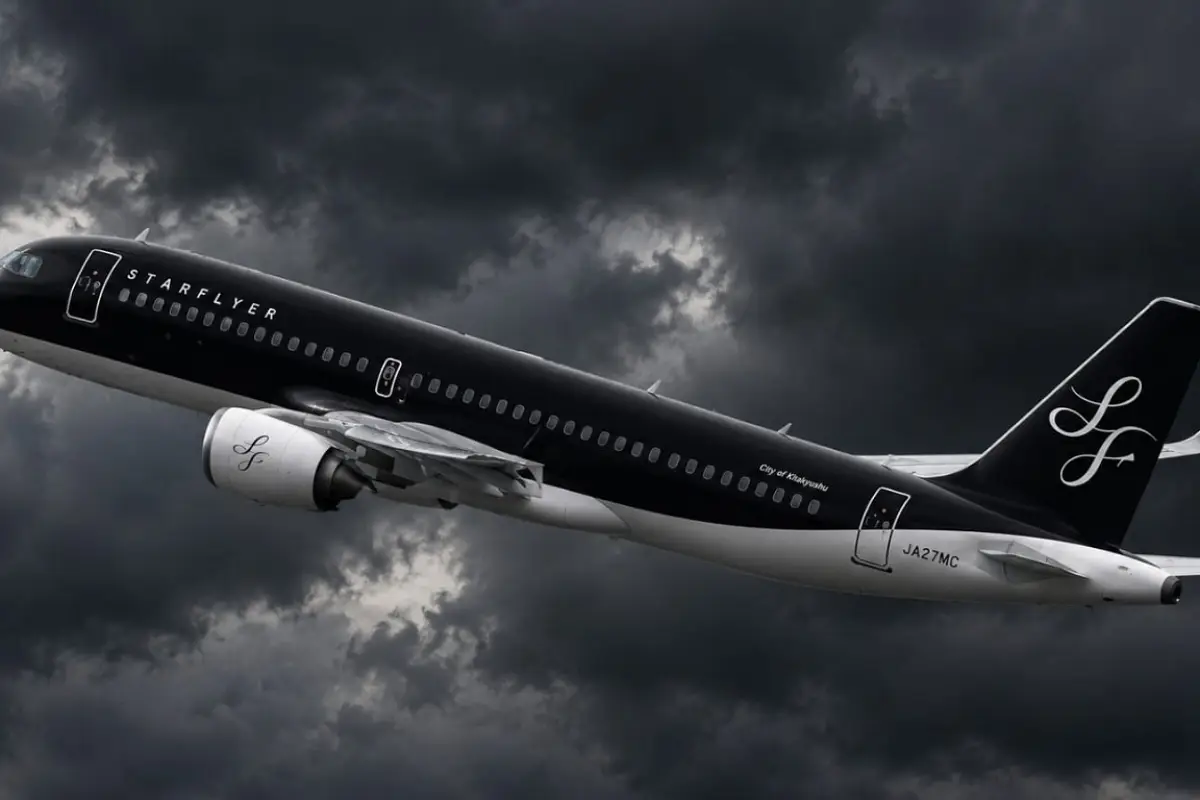
StarFlyer’s First International Flight in 6.5 Years Left an Hour Late From an Airport That Never Sleeps, Because That’s the Entire Business Model
StarFlyer resumed scheduled StarFlyer international flights on September 2, 2026, restarting three-weekly Kitakyushu-Taipei/Taoyuan flights after suspending the route in March 2020. President Osamu Machida made his intent unmistakable at the commemorative ceremony, "We do not intend to stop at three weekly flights." The airline plans to expand to as many as four East Asian routes by fiscal 2028, and to push into Southeast Asia from fiscal 2029. This is not a nostalgic one-route revival. It is the opening move of a boutique domestic carrier attempting to become something meaningfully bigger.
Why the Schedule Itself Is the Strategy, Not an Inconvenience
Flight 7G801 departs Kitakyushu at 11:40pm and lands in Taipei at 1:10am. The return, 7G800, runs the same overnight pattern in reverse. Most airlines would treat that timing as a compromise forced by slot scarcity. Machida framed it instead as the entire commercial logic of the route: both Kitakyushu and Taipei Taoyuan operate around the clock, and an overnight service lets passengers "make effective use of their time at their destination" arriving in Taipei just after 1am means a full working or leisure day ahead, rather than losing half a day to a conventional daytime flight. These StarFlyer overnight flights are therefore part of the airline's commercial strategy, not simply a scheduling compromise.
That is not spin. TRAICY's own reporting confirms StarFlyer has explicitly built its resumption strategy around late-night and early-morning slots specifically "to improve efficiency and profitability," with the airline stating its break-even point is low enough to generate contribution profit even at modest fares on this kind of schedule. Overnight slots are typically the cheapest and least contested at any airport, and Kitakyushu, a secondary regional gateway with none of the congestion pressures facing Narita, Haneda or Kansai, has genuine capacity to offer them reliably. StarFlyer is trading passenger convenience for cost structure, betting that Taiwan-bound leisure and business travelers will accept a redeye in exchange for a fare a daytime slot could not support.
Notably, the actual inaugural flight did not even leave on time, the aircraft pushed back at 12:06am on September 3 rather than its scheduled 11:40pm, technically launching StarFlyer's international comeback a day later than planned. A small footnote, but a fitting one for an airline whose whole return has been shaped by exactly this kind of late-night operational precision.
A Comeback That Took Three Full Years to Actually Happen
The timeline behind this single restart is worth laying out because it shows how deliberately, and how slowly, StarFlyer approached re-entering international markets. The airline first signalled intent to resume in December 2022 with charter flights between Kitakyushu and Taipei running January-February 2023. It then floated a spring 2026 target as far back as May 2025, with President Machida forming an internal review team and naming Taipei, Seoul and Hong Kong as candidate destinations, while cautioning that "securing favorable time slots remains a challenge." Further charter flights ran again in Q1 2026 as an explicit "precursor" to scheduled service, before ch-aviation reported in March that the target had firmed to "late 3Q26." The September 2 launch is the product of that multi-year, charter-tested, deliberately staged re-entry, not a sudden pivot, but the final step of a process StarFlyer had been quietly building toward for roughly four years.
That caution matters. StarFlyer is not simply flipping a switch on a route it once flew. It spent years testing demand through charters, assessing slot availability, and building the case internally before committing to permanent scheduled service, a materially more conservative approach than an airline chasing headlines with an immediate full relaunch.
Why Nagoya Is Being Left Behind, Deliberately
Before the pandemic, StarFlyer operated two Taiwan routes at equal frequency, Kitakyushu-Taipei and Nagoya/Chubu-Taipei, both once daily. Only one is coming back. The company has said explicitly that it will "concentrate its management resources on the Kitakyushu route for the time being," with Nagoya "expected to remain suspended." That is a telling capital-allocation decision from an airline this feed's coverage elsewhere has shown operates with real financial discipline: FY2024 revenue of ¥42.9 billion and net profit of ¥1.9 billion, with FY2025 guidance projecting continued revenue and operating profit growth even as net profit was expected to dip slightly on foreign exchange losses.
Choosing to concentrate on a single route rather than restoring both simultaneously reflects a company unwilling to spread a still-recovering balance sheet across two comeback bets at once. Kitakyushu is StarFlyer's home base, the airline is headquartered there, giving it inherently stronger local demand generation, ground infrastructure and brand recognition than Nagoya, where StarFlyer would be competing for Taiwan-bound traffic against a much larger airport with far more existing carrier competition. Betting everything on the home turf route first is the lower-risk sequencing choice and a key part of the StarFlyer strategy.
The Cabin Detail That Reveals How Seriously StarFlyer Takes Its Premium Positioning
One of the more specific details buried in the relaunch coverage is genuinely revealing about how StarFlyer differentiates itself from Japan's low-cost carriers. Before the 2020 suspension, the airline maintained a distinct international cabin configuration, including aircraft fitted with galley ovens specifically to serve hot meals, presented in bento-box-style containers. With this relaunch, StarFlyer has eliminated the separate domestic/international cabin distinction entirely, deploying its standard 162-seat A320neo configuration (with older A320ceos available as backup) across both networks, while still preserving the airline's signature seat pitch, black leather seating with footrests, and complimentary Inmarsat GX satellite Wi-Fi, now extended to international routes for the first time.
That is StarFlyer betting its core product differentiator, genuinely spacious, premium-feeling economy seating achieved by simply carrying fewer passengers per aircraft, travels well internationally without requiring a specialized international fleet configuration to prove it. It is a meaningfully different competitive answer than Japan's ultra-low-cost carriers (Peach, Zipair, Jetstar Japan) would give to the same question, and it positions StarFlyer closer to a boutique, comfort-first regional carrier than a budget operator chasing the lowest possible seat-mile cost.
Why "Four Routes by FY2028" Is a More Modest Ambition Than It First Appears
StarFlyer's own medium-term management strategy for fiscal years 2026-2028, formulated in April, names international expansion as one of its explicit growth pillars, with a stated target of up to four East Asian routes by fiscal 2028, before turning attention to Southeast Asia from fiscal 2029 onward. Read against the airline's actual pace of execution, three years from initial 2023 charter tests to this single scheduled restart, a four-route target within roughly two more years is a genuinely ambitious acceleration, not a conservative continuation of the same cautious tempo.
That acceleration will hinge entirely on whether Kitakyushu-Taipei actually generates the demand growth Machida is hoping for. His own framing was explicit that daily service "assessing demand growth" is the next milestone before StarFlyer commits further capital or slots to additional East Asian destinations, meaning this single three-weekly route is functioning as the test case for the entire broader international strategy. If Kitakyushu residents and Taiwan-bound leisure travelers embrace the overnight schedule and premium cabin at the fares StarFlyer needs to charge, the airline has a validated template to replicate toward Seoul or Hong Kong, the two other cities Machida named as candidates back in 2025. If demand disappoints even on home turf, the more ambitious four-route, then Southeast Asia, expansion plan becomes considerably harder to justify internally.
What This Says About Secondary Japanese Airports More Broadly
StarFlyer's return also sits inside a broader pattern this feed has tracked across regional aviation throughout 2026, secondary cities increasingly building direct international connectivity rather than routing everything through Tokyo or Osaka's major hubs, similar in spirit to Sun PhuQuoc Airways establishing Phu Quoc as an international gateway in its own right, or Edinburgh Airport building direct European connectivity independent of London. Kitakyushu Airport, a comparatively small regional facility in northern Kyushu, is betting that direct Taiwan access, even at unsociable overnight hours, is worth more to its local business and leisure travelers than the alternative of connecting through a larger domestic hub first.
Whether that bet pays off for StarFlyer specifically depends on load factors over the coming months. But the airline has already demonstrated, through nearly four years of methodical charter-testing and staged planning before this launch, that it is not treating international re-entry as a symbolic gesture. It is treating it as a genuine, if cautiously sequenced, second growth engine, one Machida has now put a specific number and a specific deadline against, in public, with his own name attached to it.