FoodNeverComes: The South Korean App Where You Order Food and Nothing Arrives
FoodNeverComes lets you order food that never arrives — and it's going viral. Here's the South Korean dopamine site trend explained. Read on.
 Prajakta Sanjay Warwadkar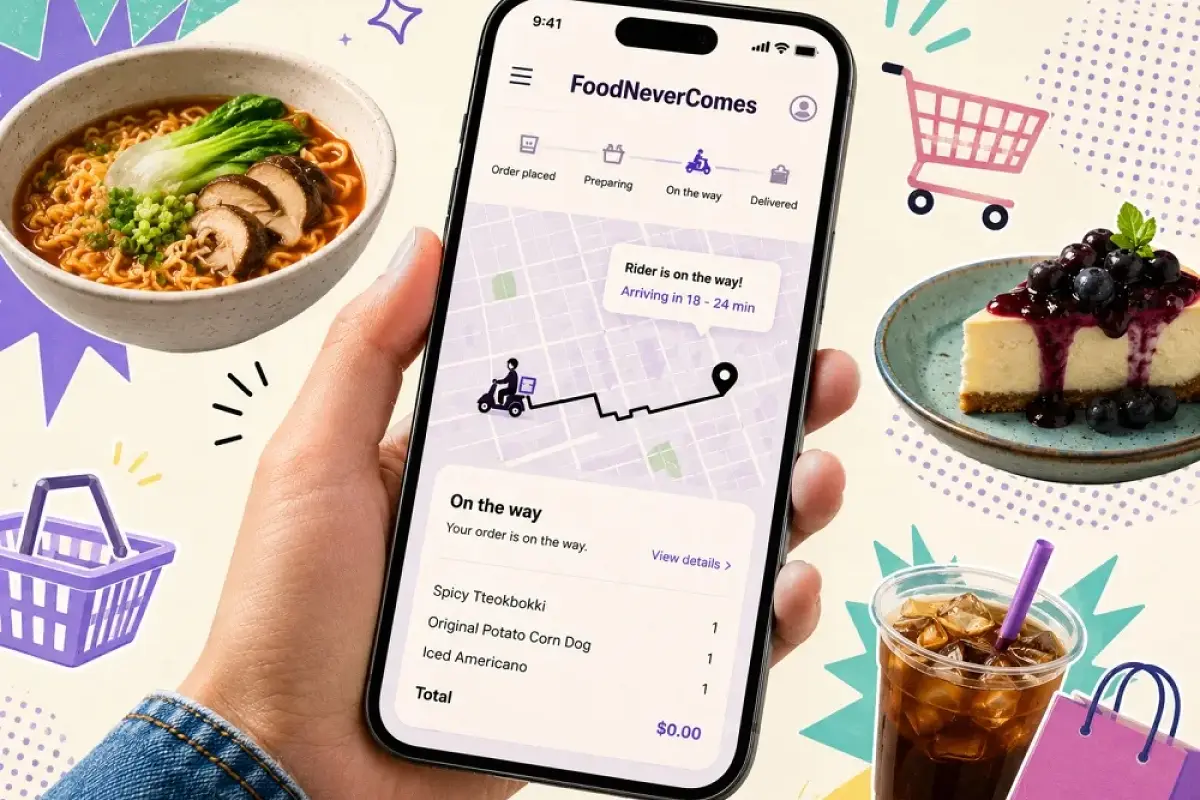
Imagine opening a food delivery app, scrolling through your favourite restaurants, adding items to your cart, entering your address, hitting order and then watching a little animated rabbit rider on a map slowly make its way to your door. Except no one is actually coming. No food, no bill, no regret. Just the feeling of having ordered something, without any of the consequences.
That's FoodNeverComes a South Korean app that has gone viral across the internet in June 2026, sparking a global conversation about dopamine, digital habits, and whether simulating retail therapy counts as self-care or just a very strange new form of denial. Here's the full story of where it came from, how it works, and what it says about the way we eat, shop, and scroll in 2026.
What is FoodNeverComes and how does it actually work?
FoodNeverComes has all the hallmarks of a real food delivery app. You scroll through a list of restaurants, choose your dishes, make customisations, enter your delivery address and payment method, and place your order. A courier accepts it. A tracking window opens. An animated rabbit rider appears on a live map and begins moving toward your location.
The only thing that never happens is the delivery itself. No money leaves your account. No knock at the door. No takeaway containers. Once the "order" is placed, the app shows you a message celebrating what you saved calories, money, or both and the whole experience ends there.
This is what developers and users in South Korea are calling a "dopamine site": a platform that replicates the full ritual of online shopping or food delivery without any real transaction taking place. You get the scroll, the browse, the decision, the checkout, the confirmation ping and then the simulation ends. The reward was always in the ritual, not the result.
Who built it and why
FoodNeverComes was created by a South Korean software engineer who goes by Malhee online. The origin story is as relatable as the app itself. Malhee described the idea forming on what they called "one of those nights when I kept opening and closing delivery apps" not out of hunger, but out of habit.
"I started it as a joke at first, but surprisingly, just satisfying that urge to 'order something' made it weirdly fulfilling without actually ordering," Malhee wrote on social media in Korean. The app was reportedly built with the help of ChatGPT and vibe-coding techniques, starting as a basic demo before developing into a fully functional web experience.
Malhee was direct about who the app is designed for. "Anyone who wants to quit delivery apps but can't, who's on a diet but keeps reaching for the app, or just wants to check out a quirky app you're all welcome," they wrote. What started as a personal tool to break a delivery habit quickly went viral across Korean social media, drawing users who recognised the compulsion immediately.
The science behind why it works
It sounds strange that pretending to order food could feel satisfying but the neuroscience actually supports it. Research published in Psychology Today has long established that dopamine is released in the brain in anticipation of a reward, not when the reward is received. The pleasure centre fires when you're browsing, deciding, and clicking — not when the parcel arrives or the food lands on the table.
That's why the checkout moment on any shopping app feels so good, and why so many people find themselves opening delivery apps out of habit even when they're not particularly hungry. The browsing and the ordering are themselves the reward. FoodNeverComes strips away everything after that moment and delivers only what your brain was really after in the first place.
Researchers who study digital behaviour have noted that dopamine sites tap into the same psychological mechanisms as real apps — the small anticipatory rewards that turn scrolling into a compulsion but redirect them toward a financially and calorically neutral outcome. In that framing, it's less a strange internet joke and more a piece of low-tech harm reduction.
The broader dopamine site trend in South Korea
FoodNeverComes didn't emerge in isolation. It's part of a wider wave of "dopamine sites" that have been quietly growing in popularity among South Korean Gen Z users since early 2026. The Korea Times reported in May 2026 that young South Koreans were increasingly turning to these platforms for what one might call consequence-free digital gratification.
Some dopamine sites simulate general online retail in the style of Amazon full storefronts with product listings, reviews, filters, and recommendations, all populated with real-looking (but entirely fake) inventory. Users can browse, build wishlists, fill carts, and receive simulated order confirmations. Others, like FoodNeverComes, are tightly focused on a single compulsion. One site even simulates virtual cigarette breaks for people trying to quit smoking.
The timing is not coincidental. South Korea's economy has been under real pressure rising prices, stagnant wages, and a tightening job market have hit young adults particularly hard. Online shopping and food delivery became comfort behaviours during leaner times, and now, as budgets shrink further, these apps offer the ritual without the receipt.
What the rest of the internet thinks
When FoodNeverComes went viral beyond South Korea in mid-June 2026, the global reaction was divided and revealing.
On social platform X, responses ranged from empathy to existential despair. "The world is such a depressing place, man," read one widely shared reply. Another user described dopamine sites as "window shopping for people who can't touch grass." A third called it "playing pretend for adults," noting the parallel to children playing at shopping with toy registers and imaginary groceries.
On Reddit's community for online shopping addiction, the conversation was more nuanced. One user drew a direct comparison to non-alcoholic beer for recovering alcoholics: "Scratches the itch, especially in the beginning. You end up moving on from it, but it can be a really helpful stepping stone." Others were sceptical. "This would not work for me," wrote one commenter. "It would just piss me off knowing nothing is actually coming." A third found a middle ground: "There are a lot more important things we can be doing with our time and attention. But if playing pretend keeps you from spending your money and cluttering your house up, maybe the time invested is worth it."
That last comment might be the most honest framing of the whole thing. Nobody is claiming dopamine sites are a profound solution to consumer culture. But for someone whose hand reflexively reaches for a delivery app at 11 p.m. not out of hunger but out of habit, a free simulation that satisfies the urge and saves them thirty dollars might just be useful enough to matter.
What this trend says about food, money, and digital habits in 2026
Food delivery apps are brilliant pieces of persuasive design. They are built to reduce every point of friction between a craving and a purchase — fast loading, saved addresses, one-tap reorder, estimated delivery times that create urgency. The result is that for millions of users, the line between "I'm hungry" and "I've ordered something" has become almost invisible. The app opens before the decision is even made.
FoodNeverComes exposes the mechanics of that loop by removing the one variable that usually makes it expensive: the actual food. What it reveals is that the compulsion was never really about the meal. It was about the ritual of choosing, the small thrill of committing to an order, and the brief comfort of having something on its way.
For the hospitality and foodservice industry, this is worth paying attention to. It points to something real about how food delivery has evolved from a convenience into a behavioural pattern, and in some cases, a compulsion. The most thoughtful food brands understand that they're not just selling meals. They're selling the feeling of being taken care of. FoodNeverComes is, in its strange way, a mirror held up to that dynamic.
FoodNeverComes is a peculiar little app, but the questions it raises are not peculiar at all. Why do we keep opening delivery apps when we're not hungry? What are we actually looking for when we add things to online carts at midnight? And is a simulation that satisfies that urge without costing anything really so different from a dozen other digital coping tools we've all already normalised?
Whether you find it funny, sad, clever, or all three probably says something about your own relationship with the scroll. One thing is certain: the app's creator Malhee built it on a restless night, shared it as a joke, and accidentally started a global conversation about dopamine, habit, and the hidden cost of convenience culture.
Have you tried FoodNeverComes or would you? And what do you think the dopamine site trend says about where food delivery culture is heading? Drop your thoughts in the comments below.
Sources: Hospitalitycareerprofile.com
Read more: Restaurant Technology Trends Reshape Hospitality in 2026