Gaggan Anand RAGA Delhi Marks a Chef's Return Home
Gaggan Anand RAGA Delhi signals a defining moment, as Asia's most celebrated progressive Indian chef prepares to open his first restaurant in his home country.
 RUKAIYA KADIWAL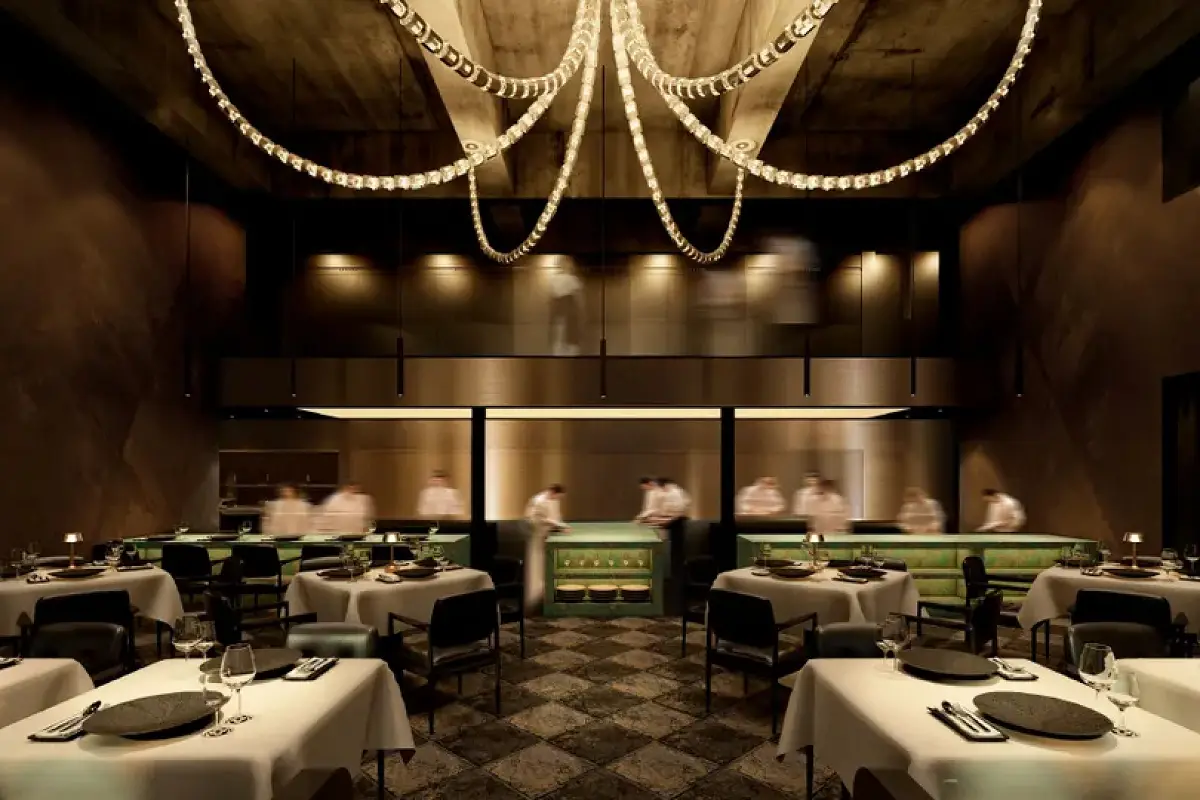
The rendering shows a room that does not apologize for itself. Dark walls absorb the light rather than reflecting it. White tablecloths sit beneath a chandelier made of what appears to be cascading chain, its loops catching the low ceiling light in a way that is theatrical without announcing itself as such. Behind a green-tiled pass, blurred white-jacketed figures move with the practiced economy of a kitchen already in rhythm. This is RAGA, the new Delhi restaurant from Gaggan Anand, and even as a rendering it carries the particular weight of a room built by someone who has spent years imagining exactly this.
Gaggan Anand RAGA Delhi and the Question India Has Been Waiting to Answer
For a chef whose reputation was largely built in Bangkok, the decision to open in Delhi carries a meaning that goes beyond real estate. Gaggan Anand RAGA Delhi arrives as the culmination of a career built on the argument that Indian cuisine could be the foundation for cooking as technically ambitious, as conceptually rigorous, and as globally relevant as anything being produced in Tokyo, Copenhagen, or New York. The question his return to India poses is whether his home country is now ready to receive that argument on its own terms, not as an import but as something that belongs here.
Bloomberg's India Edition framed the opening in precisely those terms, with reporter Menaka Doshi writing that Gaggan Anand has changed, and so has India, and that the chef believes his home country is finally ready for him. That framing matters because it places the restaurant within a larger cultural conversation, one about what Indian fine dining has become, who it is for, and what it takes to build a serious culinary institution in a country whose food culture has always been extraordinary and whose fine dining infrastructure is still catching up to that fact.
The Career That Precedes the Delhi Opening
Gaggan Anand built his international reputation in Bangkok, where his restaurant Gaggan held the top position on Asia's 50 Best Restaurants list for four consecutive years, a run that made it one of the most discussed restaurants in the world during that period and established its chef as the most prominent voice in progressive Indian cooking working anywhere on the planet. The restaurant's tasting menus, built around emoji-only course descriptions and a cooking philosophy that treated Indian flavor as the starting point for a genuinely experimental kitchen, drew diners from across the world to Thailand to experience a version of Indian cuisine they had not encountered before.
That success in Bangkok was never simply a Bangkok story. It was always partly about India, about the flavors and traditions Anand carried with him from his home country and the question of what would happen when he eventually brought that conversation back. RAGA is where that question gets its answer.
What the Room Says Before the Food Arrives
Design in a restaurant of this ambition functions as a statement of intent, and the RAGA rendering communicates its intentions clearly. The room is dark in a way that is considered rather than merely dim, the kind of darkness that focuses a diner's attention on what is directly in front of them rather than on the broader social theater of the room. The chandelier overhead, with its cascading chain loops, introduces a vertical drama that draws the eye upward without demanding it stay there. The green-tiled pass at the back of the room gives the kitchen a visual presence in the dining space, making the act of cooking visible without reducing it to performance.
These are choices that signal a restaurant designed for a specific kind of attention. RAGA is not built for a quick meal between meetings. It is built for an evening spent in it, for the kind of dining that asks something of the guest as well as the kitchen, and that rewards patience in the same way a piece of music rewards being listened to from beginning to end.
Why Delhi, and Why Now
India's fine dining landscape has changed considerably over the past decade. Cities including Mumbai, Delhi, and Bengaluru have developed dining cultures capable of sustaining ambitious restaurants with serious tasting menus, extensive wine programs, and the kind of guest expectations that make such operations viable. The infrastructure of knowledge, both among chefs and among diners, has reached a point that would have been harder to locate ten or fifteen years ago.
Anand's stated belief that India is finally ready for him is not a dismissal of what came before but an acknowledgment that readiness is a two-way condition. A chef returns to his home country not only when he is ready to do so but when the audience, the supply chains, the kitchen talent, and the broader dining culture have reached a point where what he wants to do is possible. That alignment, between a chef at a particular point in his career and a city at a particular point in its culinary development, is what RAGA represents.
What RAGA Means for Indian Fine Dining
The name itself carries intention. Raga, in classical Indian music, is a melodic framework, a set of notes and movements within which improvisation happens, a structure that makes freedom possible rather than limiting it. Naming a restaurant after that concept suggests Anand intends the same relationship between Indian culinary tradition and the cooking he will produce within it, tradition as foundation rather than constraint, structure as the condition for something genuinely new rather than its opposite.
For Delhi's dining scene, a restaurant of this profile arriving from a chef of this reputation introduces a competitive and aspirational benchmark that raises the conversation around what Indian fine dining can be. Whether RAGA's opening accelerates the development of comparable ambition elsewhere in the city or simply stands alone as a singular institution will become clear over time. What is already clear is that a room this carefully designed, in a city this ready, from a chef who has spent his entire career building toward this moment, is unlikely to arrive without consequence.
A Room Waiting to Be Filled With Something Real
For now, RAGA exists only in a rendering, its tables set, its chandelier lit, its kitchen staff blurred into suggestion rather than presence. The food that will eventually arrive on those white tablecloths has not yet been described in public. The conversations that will take place at those tables have not yet happened. A restaurant, before it opens, is still entirely a promise, and promises made by chefs who have already kept one this large carry a particular kind of weight. Delhi is waiting. So, in its own way, is the rest of the world that has been following this particular chef's journey from the beginning, wondering when he would finally bring it home.
Related reading: Beef Egg Foo Young in Las Vegas gets a Certified Angus upgrade