Qatar Airways Equips 150 Widebodies With Starlink
Qatar Airways has equipped 150 widebodies with Starlink, offering over 23 million passengers free high-speed Wi-Fi as Gulf carriers compete.
 Jishan Khan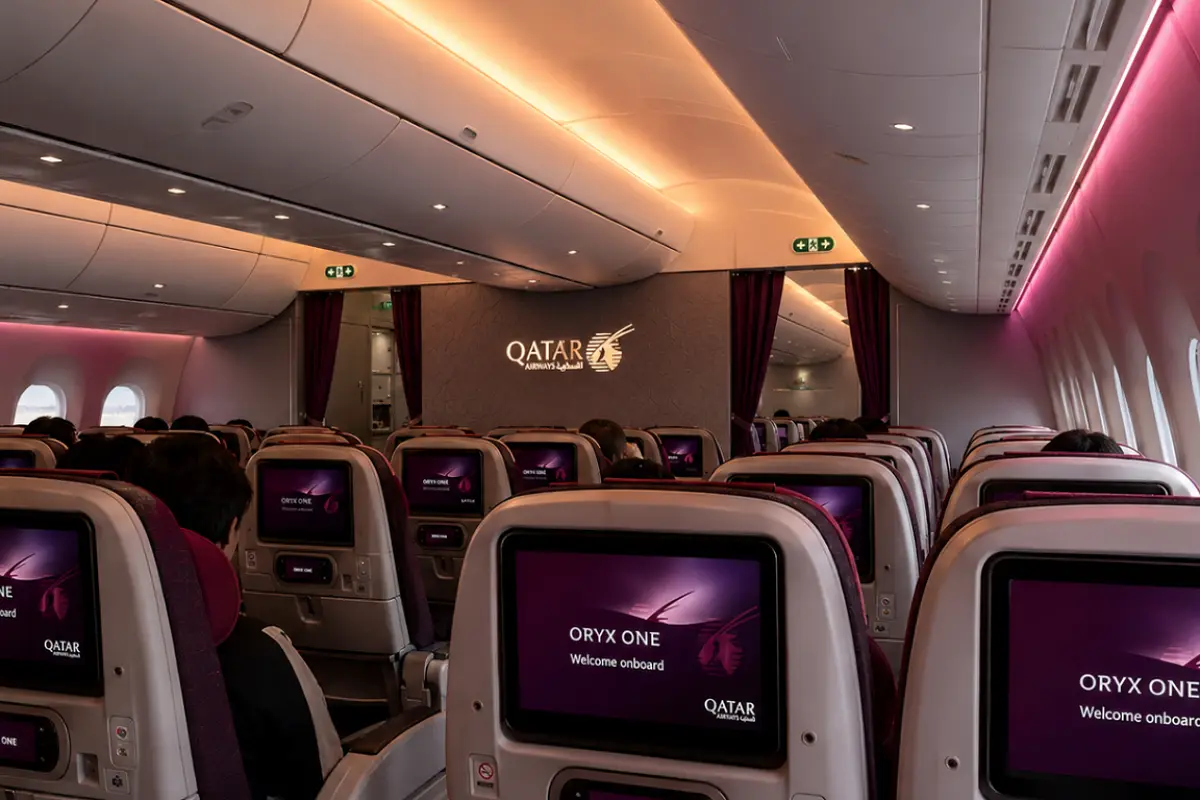
Qatar Airways Has Retrofitted 150 Widebodies With Starlink in Under Two Years, Free Wi-Fi Is Becoming the New Battleground for Gulf Carrier Loyalty
Qatar Airways has become the first airline in the world to operate a Starlink-equipped Boeing 787-9, completing installation across its entire 787-8 sub-fleet in seven months and bringing its total Starlink-equipped widebody count to 150 aircraft, more than 83% of its widebody fleet. The rollout follows nine-month and eight-month retrofit programmes across the 777 and A350 fleets respectively, giving Qatar Airways the world's first and largest Starlink-equipped fleet of all three aircraft types. Since launch in October 2024, more than 23 million passengers have connected across over 86,000 flights, with up to 323 Starlink-equipped departures now operating daily.
Twenty-three million passengers in under two years is not a rollout anymore. It is a completed transformation of what flying Qatar Airways actually means.
Why Speed Was the Whole Strategy
The sequence of installation timelines, nine months for 777, eight for A350, seven for 787-8, is not incidental. Each retrofit programme was faster than the one before it, which tells you Qatar Airways treated the rollout itself as a competitive asset worth optimising, not just a technical upgrade to check off. In an industry where satellite Wi-Fi retrofits typically drag across years rather than months, compressing three separate fleet-wide programmes into a combined timeline of under two years required dedicating hangar slots, engineering teams and parts supply specifically to Starlink work during every scheduled maintenance check available across the widebody fleet.
That speed matters commercially because connectivity announcements lose their power the longer they take to become universal. An airline that promises Starlink and delivers it to 10% of its fleet within a year is making a marketing claim. An airline that reaches 83% completion with a firm year-end deadline for the remainder is making Starlink synonymous with its entire long-haul product.
Why Free Changes the Adoption Curve Entirely
Every Starlink-equipped Qatar Airways flight offers Wi-Fi at no additional charge, authenticated through Privilege Club membership rather than a paid session model. That decision explains why 23 million passengers have connected rather than a smaller number of business travellers willing to pay per session. Legacy inflight Wi-Fi economics, typically USD 10 to 30 per flight, created a structural ceiling on adoption regardless of how good the underlying technology was, because most leisure passengers simply would not pay for something they were unsure would even work reliably.
Making the service free removes that psychological barrier entirely. A passenger who would never pay USD 20 for uncertain inflight internet will connect automatically the moment it costs nothing, and Starlink's low Earth orbit satellite architecture means the experience at 500 Mbps genuinely rivals home broadband rather than merely being "good enough." The 23-million-passenger figure is Qatar Airways demonstrating, with real usage data, that free plus genuinely fast is the combination that converts inflight Wi-Fi from a nice-to-have into a defining feature of the flight itself.
The Gulf Rivalry This Actually Sits Inside
Qatar Airways is not doing this in isolation. Emirates has been running its own connectivity upgrades, and the broader Gulf carrier competition for premium and business travellers has increasingly shifted from cabin hardware, lie-flat seats, private suites, onboard lounges, toward softer differentiators that shape the entire journey experience rather than just the seat itself. A passenger choosing between Doha, Dubai and Abu Dhabi as a connecting hub for a long-haul journey is increasingly weighing which airline lets them work uninterrupted, stream content reliably or stay in constant contact with family during a 14-hour crossing, and Qatar Airways completing a clean sweep across all three of its widebody families before any Gulf rival matches that scope gives it a genuine, measurable edge in that comparison.
The Boeing 787-9 milestone specifically extends that advantage onto one of the most common aircraft types flying medium-to-long-haul routes into Doha from Asia, Africa and Europe, meaning the free, high-speed experience Qatar has built its reputation on is now reaching passengers on exactly the routes where connecting traffic decisions are made.
What "By the End of 2026" Actually Signals
With 83% of the widebody fleet already equipped and a firm year-end target for full 787 completion, Qatar Airways is close to having no widebody aircraft in its fleet without Starlink, an outcome that transforms connectivity from "usually available" into "guaranteed," which is a different promise entirely to make to passengers. Airlines that can say with certainty that every long-haul aircraft in their fleet offers a specific, verifiable experience gain a marketing and loyalty advantage that partial rollouts can never fully replicate, because "usually" always carries an asterisk that "always" does not.
The remaining Boeing 787-9s still need installation before the promise is complete. But at the pace Qatar Airways has already demonstrated across three separate fleet types, closing that final gap by December looks less like an ambition and more like a formality.