Why Food Businesses Can't Ignore Digital Transformation Anymore
Digital transformation is helping food businesses improve efficiency, customer experiences and decision-making through technology adoption. Read more.
 Prajakta Sanjay Warwadkar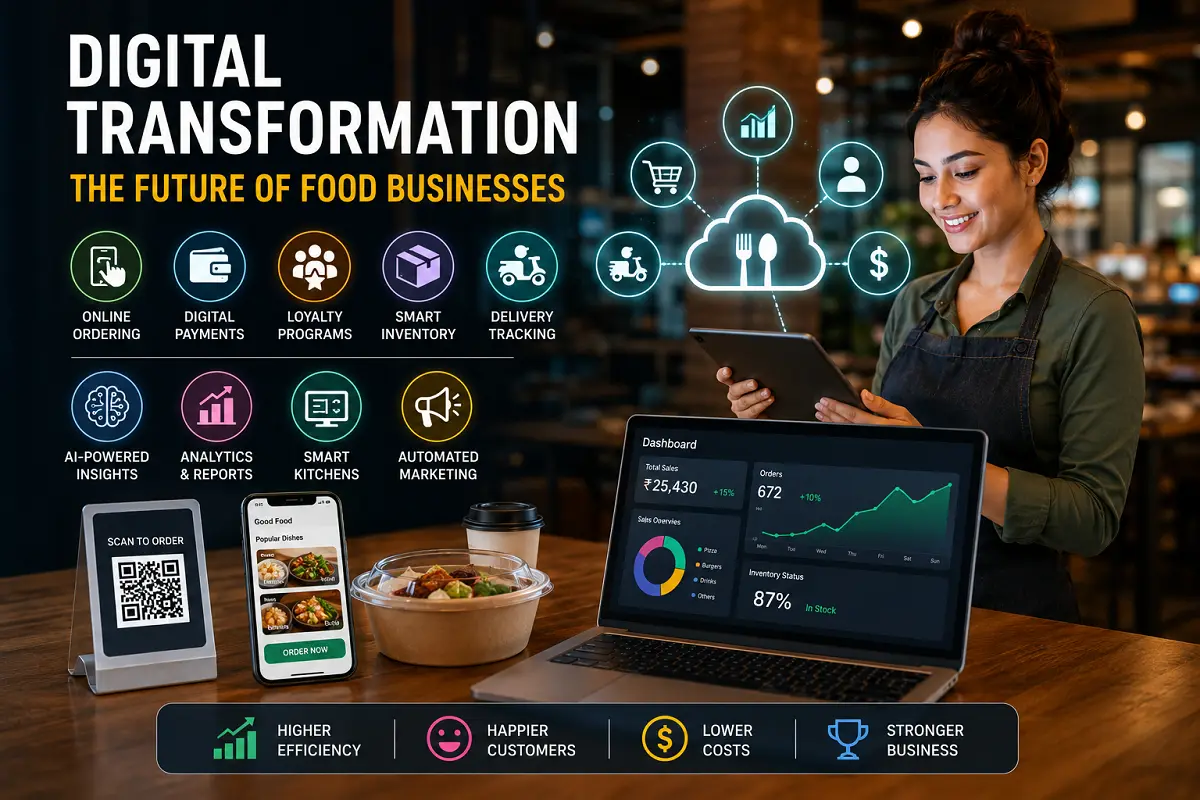
Mumbai, June 9, 2026 — Why Can't Ignore Digital Transformation Food Businesses Anymore
The food industry isn't becoming digital.
It already is.
A customer places an order through an app. Payment happens instantly. Inventory updates automatically. A loyalty offer arrives on their phone before they've even finished eating. Behind the scenes, managers are checking dashboards, tracking sales, monitoring stock levels, and reviewing customer behaviour in real time.
A lot has changed.
What's interesting is how normal all of this feels now.
A few years ago, many of these tools were considered optional. Today they're becoming part of everyday operations for restaurants, cafes, cloud kitchens, bakeries, food delivery brands, and even small independent businesses.
Customers have changed. Competition has changed.
Food businesses are changing too.
Why Is Digital Transformation Food Businesses Happening So Fast?
Honestly, because customer expectations moved faster than most businesses expected.
People want convenience.
They want quick ordering. Fast payments. Accurate deliveries. Personalised offers. Instant updates. And they want everything to work smoothly.
Nobody gets excited about waiting anymore.
Restaurants and food businesses had to adapt. There wasn't much choice.
At the same time, operators were dealing with rising costs, staffing challenges, growing delivery demand, and increasing competition. Technology didn't solve every problem overnight, but it gave businesses better tools to manage them.
And once competitors start operating more efficiently, everyone notices.
What Does Digital Transformation Actually Mean?
Despite how complicated the phrase sounds, digital transformation is fairly simple.
It's the process of using technology to improve how a food business operates, serves customers, and makes decisions.
That can include:
-
Online ordering systems
-
Digital payment solutions
-
Customer loyalty programmes
-
Inventory management software
-
Delivery tracking platforms
-
AI-powered customer support
-
Smart kitchen systems
-
Restaurant analytics tools
-
Automated marketing campaigns
Some of these changes are highly visible.
Others happen quietly in the background.
The customer may never see them, but they still affect the experience.
The Biggest Changes Happening Across The Food Industry
Food businesses are becoming more connected than ever before.
Orders, payments, inventory, customer data, and marketing efforts are increasingly linked together through digital systems.
Cloud kitchens are probably the most obvious example.
Some operate almost entirely through technology. No dining room. No physical menu. Just apps, delivery platforms, dashboards, and digital workflows keeping everything running.
Traditional restaurants are moving in the same direction too, although usually at a slower pace.
Not every business needs to become fully digital.
But most need to become more digital than they were yesterday.
Traditional Operations vs Digital Food Businesses
One of the biggest differences is visibility.
Traditional businesses often rely on manual tracking and experience. Digital businesses can see what's happening almost immediately.
|
Traditional Food Operations |
Digitally Transformed Operations |
|
Manual record keeping |
Real-time digital tracking |
|
Limited customer insights |
Detailed customer analytics |
|
Slower operational decisions |
Faster data-driven adjustments |
|
Paper-heavy workflows |
Digital-first systems |
|
Reactive planning |
Predictive forecasting |
Experience still matters, of course.
Some restaurant owners can identify a problem simply by walking through the kitchen.
Technology doesn't replace that.
It supports it.
What Benefits Are Food Businesses Actually Seeing?
The obvious benefit is efficiency.
Tasks that once took hours can often be completed in minutes.
But the long-term advantages are where things become really interesting.
Businesses start identifying patterns they never noticed before.
For example:
-
Certain menu items may consistently outperform expectations.
-
Customer spending habits may change during specific seasons.
-
Delivery demand may increase on particular days of the week.
-
Loyalty programmes may reveal which customers return most frequently.
-
Inventory reports may uncover hidden sources of waste.
Small discoveries.
Big impact.
Over time these insights influence everything from menu planning to staffing decisions.
Is Digital Transformation Worth The Investment?
For most food businesses, yes.
The upfront costs can feel uncomfortable. Software subscriptions, equipment upgrades, staff training. It all adds up.
But so do operational inefficiencies.
Many businesses discover they're losing far more money through waste, poor visibility, and outdated processes than they realise.
The important thing is investing in the right technology.
Not every restaurant needs artificial intelligence.
Not every cafe needs advanced automation.
Sometimes improving online ordering and inventory management creates the biggest improvement.
Practical solutions usually outperform trendy ones.
Digital Trends Shaping The Food Industry In 2026
Several technologies are driving the next stage of transformation:
-
AI-powered demand forecasting
-
Smart kitchen management systems
-
Contactless payments
-
Voice ordering technology
-
Personalised customer experiences
-
Automated inventory management
-
Restaurant analytics platforms
-
Digital loyalty programmes
-
Cloud kitchen technology
-
Integrated delivery systems
Some of these trends will become industry standards.
Others may disappear.
That tends to happen whenever technology evolves quickly.
What Happens Next?
Technology will continue moving deeper into food business operations throughout 2026 and beyond.
What's interesting is that customers may notice it less.
The best systems usually stay in the background. Guests don't think about inventory software, data analytics, or automated workflows. They simply expect things to work.
Fast ordering.
Accurate deliveries.
Smooth payments.
Good experiences.
The technology becomes visible only when something goes wrong.
And that's probably the strongest sign of successful digital transformation.
Pro Tip
Many food businesses make the mistake of chasing technology trends instead of solving operational problems.
Start with the bottlenecks.
If stock management is causing waste, fix that first. If customers struggle to place orders, improve the ordering experience. If repeat business is low, focus on loyalty and customer communication.
The most successful digital transformation projects are rarely the most expensive ones. They're usually the ones that make everyday operations easier for both staff and customers. Small improvements implemented consistently often create far greater results than large technology investments that nobody fully uses six months later.
Frequently Asked Questions
What is digital transformation in the food industry?
Digital transformation refers to using technology to improve restaurant operations, customer experiences, inventory management, marketing, payments, and business decision-making.
Why is digital transformation important for food businesses?
It helps businesses improve efficiency, reduce costs, enhance customer satisfaction, and make faster, more informed decisions.
What technologies are driving digital transformation in food businesses?
Popular technologies include online ordering systems, AI tools, smart kitchens, restaurant analytics, digital payments, inventory software, and customer loyalty platforms.
Can small restaurants benefit from digital transformation?
Yes. Many affordable tools now allow independent restaurants and food businesses to improve operations without requiring large technology budgets.
Will digital transformation continue after 2026?
Industry trends suggest continued growth in AI, automation, analytics, customer personalisation, and digital business operations across the food and hospitality sectors.
Read more: Restaurant Technology Trends Reshape Hospitality in 2026