Airplane Mode Rules Shift as Global Wi-Fi Flight Demand Surges 88%
Satellite internet and evolving aviation regulations are making airplane mode increasingly obsolete as airlines move toward fully connected flights.
 Jishan Khan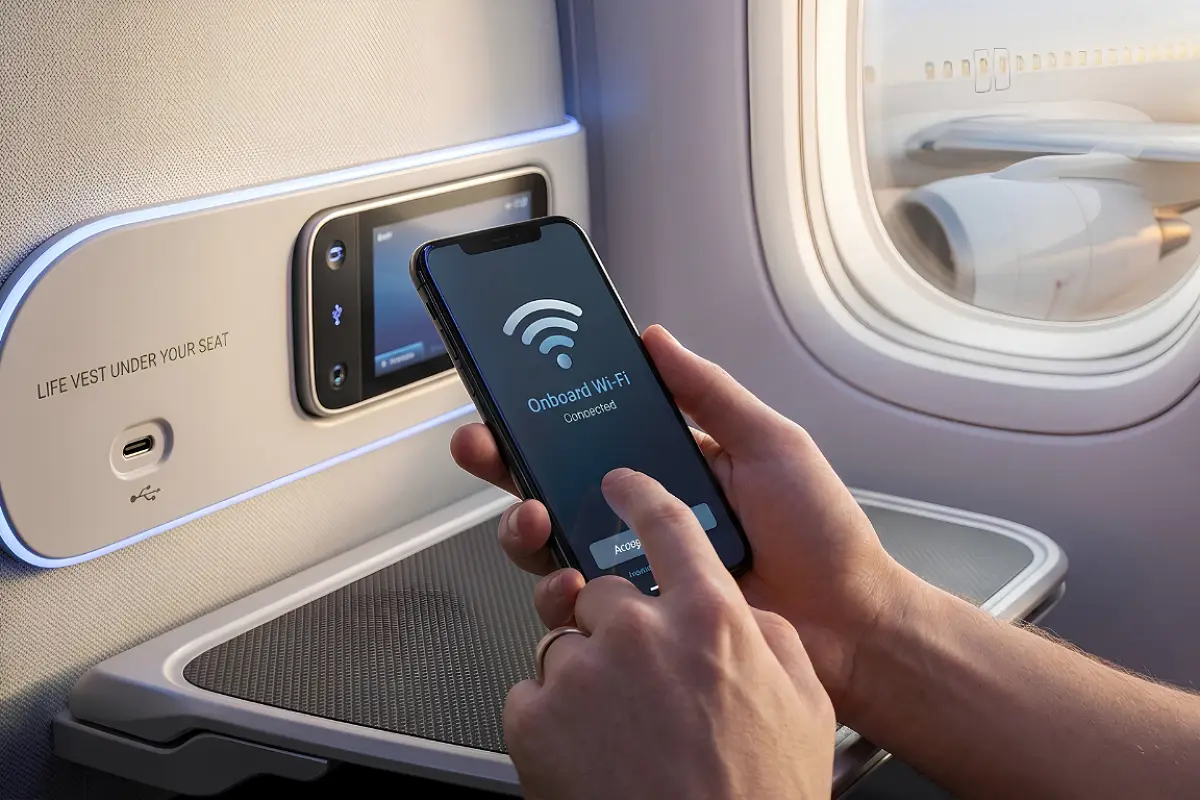
The Days of Airplane Mode May Be Numbered, And the Technology Replacing It Is Already Flying Above Your Head
Satellite internet on widebody fleets. European regulators already loosening mobile restrictions. Airlines turning connectivity into a competitive weapon. The rule that has governed every flight you have ever taken is quietly becoming a relic of a problem that no longer exists the way it once did.
Every passenger knows the routine. The cabin door closes, the announcement comes, and somewhere between forty thousand feet of altitude and six hours of flight time, you are expected to have switched your phone to a mode named after the very situation you are in.
Airplane Mode has been a fixture of commercial flying for so long that most passengers have stopped questioning why it exists. It exists because mobile phone signals were once a genuine concern for aircraft navigation and communication systems, a concern serious enough that regulators decided the safest approach was to eliminate the signals entirely rather than manage them selectively.
That concern was legitimate when it was introduced. The technology landscape that generated it has changed so fundamentally that the rule is beginning to look like a solution to a problem that is disappearing faster than the regulation governing it.
Why Airplane Mode Was Actually Introduced
The original logic behind disabling mobile signals on aircraft had two distinct components that are worth separating because they are evolving at different speeds.
The first was interference with aircraft avionics and navigation systems. Early concerns centred on whether mobile phone signals could affect sensitive instruments, altimeters, navigation receivers, communication systems, in ways that created safety risks.
Testing and operational experience over decades has largely addressed this concern, with modern aircraft designed and certified to tolerate the electromagnetic environment that passenger devices generate. The evidence that mobile signals cause meaningful interference with current generation aircraft systems is thin enough that it is no longer the primary argument for maintaining the restriction.
The second concern was interference with ground-based mobile networks. When a phone at cruising altitude searches for a signal, it can connect to multiple ground towers simultaneously in ways that create network congestion and technical problems for telecom infrastructure that is designed for ground-level use.
This concern is more practical than safety-related, it is about protecting network architecture rather than protecting the aircraft, and it is precisely the concern that onboard connectivity systems are designed to eliminate by managing all passenger connectivity through a single controlled channel rather than allowing individual devices to communicate directly with ground infrastructure.
What Satellite Internet Is Actually Changing
The expansion of satellite-based internet connectivity across commercial aviation fleets is not just giving passengers faster WiFi. It is fundamentally changing the technical architecture of in-flight connectivity in ways that make the original Airplane Mode logic increasingly redundant.
Systems like Starlink, which Qatar Airways has already deployed across its widebody fleet as the first airline to do so at scale, work by routing all passenger connectivity through the aircraft's own satellite terminal rather than through individual device connections to ground infrastructure. The aircraft becomes the connectivity node. Passenger devices connect to the aircraft's system. The aircraft connects to the satellite. The satellite connects to the ground network.
In this architecture, individual passenger devices never communicate directly with ground towers. The interference concern that originally motivated the ground network protection argument disappears entirely, not because it has been regulated away but because the technical pathway that created it no longer exists.
When every major airline has this kind of connectivity infrastructure, the technical justification for Airplane Mode on those aircraft becomes very difficult to articulate with a straight face.
Europe Is Already Moving
The regulatory movement on in-flight mobile usage is most advanced in Europe, where the approach has shifted from blanket prohibition toward managed permission through approved onboard systems.
European regulators have been exploring frameworks that would allow passengers to use mobile services, voice calls, data, messaging, during flight, provided those services are routed through certified onboard connectivity systems that manage the signal environment in controlled ways. Several European carriers already operate under expanded connectivity permissions that would have been unthinkable under the original Airplane Mode rationale.
The United States Federal Aviation Administration has historically been more conservative on this question, but the direction of regulatory travel globally is clear. As onboard connectivity systems become standard rather than premium features, and as the technical case for individual device signal restriction weakens, the regulatory frameworks that mandated Airplane Mode will come under pressure to reflect the actual risk environment rather than the one that existed when the rules were written.
Why Airlines Are Now Commercially Motivated to Make Connectivity Work
One dimension of this story that does not get discussed enough is the commercial incentive airlines now have to push connectivity as far and as fast as regulators will allow.
Free in-flight Wi-Fi has already become a competitive differentiator for carriers that offer it. Qatar Airways' Starlink deployment is explicitly positioned as a product advantage over competitors who cannot offer the same quality of connectivity. JetBlue built a significant portion of its brand identity around free Wi-Fi before its other challenges overwhelmed that positioning. Airlines that offer reliable, fast, free connectivity are winning premium and business travellers who have a genuine need to stay productive on long-haul routes.
The next stage of that competition, if regulators allow it, is full in-flight mobile service. The airline that can credibly offer passengers the ability to use their phones normally from gate to gate, without switching modes or managing connectivity manually, has a product advantage that goes beyond Wi-Fi speeds. It removes one of the most consistent friction points in the flying experience and makes air travel feel less like a disconnected interruption and more like a seamless extension of normal daily life.
That commercial motivation means airlines are not passive observers in this regulatory evolution. They are active participants in pushing regulators toward frameworks that allow them to offer the connectivity products their passengers want and their revenue models increasingly depend on.
The Safety Argument That Will Survive Everything Else
Even as the technical and regulatory case for Airplane Mode weakens, one argument for maintaining some version of the rule will survive longer than the others, not because of interference concerns but because of operational discipline.
The moments in a flight where passenger attention and awareness matter most, taxi, takeoff, and landing, are also the moments when phones are most likely to distract passengers from safety briefings, emergency procedures, and crew instructions.
The Airplane Mode requirement, whatever its original technical justification, has a secondary function as an attention management tool during the phases of flight where full passenger awareness has genuine safety value.
Airlines and regulators may find that even in a fully connected aircraft environment, some version of device management during critical flight phases survives, not because of signal interference but because a cabin where every passenger is actively engaged with their phone during takeoff is a cabin that is harder to manage in an emergency.
That is a more defensible argument than the original interference rationale, and it may be the form in which some version of the Airplane Mode instruction persists even after the technical case for it has fully collapsed.
What the Fully Connected Aircraft Actually Looks Like
The endpoint of this trajectory, the fully connected aircraft that several carriers are already building toward, is a cabin where passengers experience uninterrupted connectivity from the moment they board to the moment they disembark, with satellite systems managing all device traffic through controlled onboard infrastructure, individual device signals never touching ground networks directly, and the concept of a special aviation mode for phones reduced to a historical footnote.
That aircraft exists today in partial form on carriers operating Starlink and equivalent systems. It will exist in complete form across the mainstream commercial fleet within a timeframe that is measured in years rather than decades.
When it does, the Airplane Mode announcement will either have disappeared entirely or will survive as a abbreviated version focused on the takeoff and landing phases, a vestigial reminder of a technical concern that satellite connectivity made obsolete, delivered by cabin crew who may eventually struggle to explain why the rule existed in the form it did for so long.
The skies are getting connected faster than the regulations governing them can keep up. Airplane Mode is not gone yet. But its retirement is no longer a question of whether. It is a question of when.