Heart Aerospace Flies Largest Electric Aircraft Using Just $5
Heart Aerospace flew its X1 demonstrator for 27 minutes using about $5 of electricity, marking a major step toward its hybrid-electric ES-30 regional aircraft.
 Jishan Khan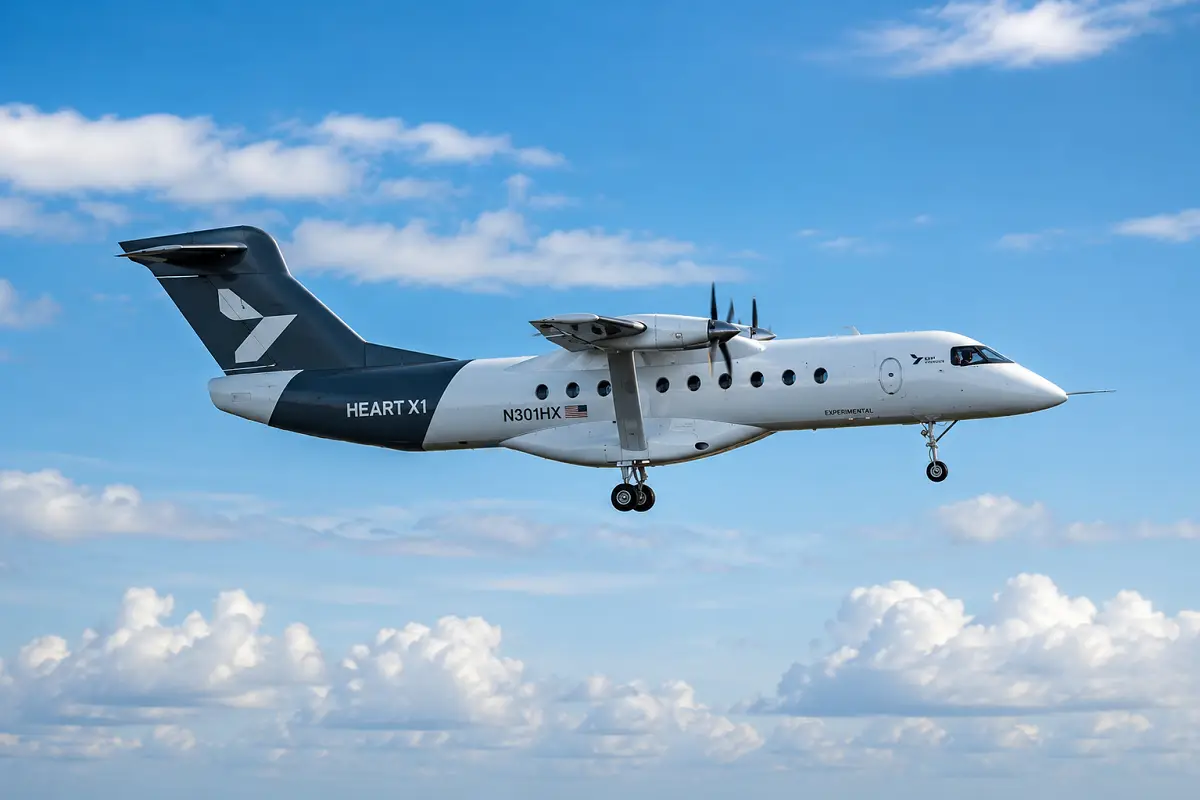
The Largest Electric Aircraft Ever Flown Just Used $5 of Electricity, Here's Why That Number Is Both Remarkable and Misleading
Heart Aerospace flew its X1 demonstrator for 27 minutes at Plattsburgh International Airport, New York on August 12, 2026, reaching 1,100 feet on an all-electric propulsion system that delivered more than one megawatt of power. At 25,000 pounds takeoff weight and a 106-foot wingspan, X1 is the largest battery-electric aircraft ever flown, roughly three times heavier than the previous record holder. The flight used approximately $5 worth of electricity. Jet fuel that week was averaging $3.50 a gallon, up 63% year-on-year.
That $5 figure has been the headline in every outlet covering this story. It is also the number most likely to mislead readers who do not read past it.
What $5 Actually Measures
The $5 electricity cost is real, but it measures 27 minutes of a low-altitude experimental test flight, taxi, takeoff, climb to 1,100 feet, basic manoeuvring, landing. It is not a per-flight operating cost for a commercial route, and it does not include crew costs, maintenance, insurance, airport fees, battery depreciation or any of the other expenses that make up an airline's actual cost per departure. Comparing it directly to jet fuel cost per flight is comparing two numbers that are not measuring the same thing.
What the $5 figure does demonstrate, credibly, is the fundamental physics advantage electric propulsion holds over combustion. Electricity is a dramatically cheaper energy source than jet fuel per unit of usable propulsion, and that gap does not disappear when you scale up to a full commercial operating cost model, it just gets diluted by the other cost categories that both aircraft types share. Heart's own claim, that the production ES-30 could deliver operating costs 40% lower than legacy regional turboprops, is the more meaningful number for evaluating commercial viability. It accounts for lower maintenance requirements and greater aircraft uptime alongside the energy cost advantage, not just the electricity bill in isolation.
Heart Aerospace X1 Is Not the Aircraft That Will Fly Passengers
X1 is a full-scale technology demonstrator, not a prototype of a certifiable commercial aircraft. It exists to validate aerodynamics, structural design, battery systems and Heart's own organisational capability to design, build, test and operate a large electric aircraft, the full-stack competency the company needs before it can credibly pursue FAA Part 25 certification for the ES-30. X1 is also purely electric, while the ES-30 is a hybrid-electric design combining large electric inboard motors with turboprop-powered outboard engines, a configuration X1 alone cannot validate.
That validation falls to X2, Heart's second demonstrator, scheduled for hybrid-propulsion flight testing later in 2026. X2 will be the first time Heart's specific combination of electric and turboprop propulsion operates together in flight, and it is X2's results, not X1's, that feed most directly into the ES-30 certification campaign. X1's 27-minute flight is an important proof point in a much longer sequence, not the final exam.
The Timeline That Matters More Than the Milestone
Heart originally targeted X1's first flight for Q2 2025. It flew in August 2026, a delay of over a year, with the company not publicly detailing the specific cause. Pre-production ES-30 development is underway at Heart's Los Angeles pilot manufacturing plant, with flight testing for that aircraft scheduled to begin in 2028, three separate years after X1's first flight. Type certification is targeted for 2031, and the reported all-electric range of 200 kilometres extends to roughly 800 kilometres in hybrid configuration carrying 25 passengers, figures that will need to be proven, not merely modelled, across the X2 and ES-30 test campaigns still ahead.
Why the Order Book Is the Real Story
Heart's $9.4 billion in customer commitments from United Airlines, Air Canada and JSX is arguably more significant than the flight itself. United holds 100 ES-30 orders and Air Canada holds 30 firm orders with additional options. Those are major North American carriers committing real capital to an aircraft that will not enter service for five more years, based on a technology roadmap that is still working through its second demonstrator phase.
That level of commitment from established airlines reflects genuine confidence that regional turboprop routes, the Embraer ERJ and ATR-served segment that has struggled economically for years on rising fuel and maintenance costs, represent the most realistic near-term market for electric aviation. Short regional routes under 400 kilometres are precisely where current battery energy density can operate credibly, exactly the segment Air New Zealand's Beta Technologies trial identified as commercially promising if the aircraft is sized correctly.
X1 proved the airframe can fly at commercial scale on batteries. Whether the ES-30 proves it can fly profitably on a real airline schedule is a question that 2028's flight testing, not this week's headline, will begin to answer.